
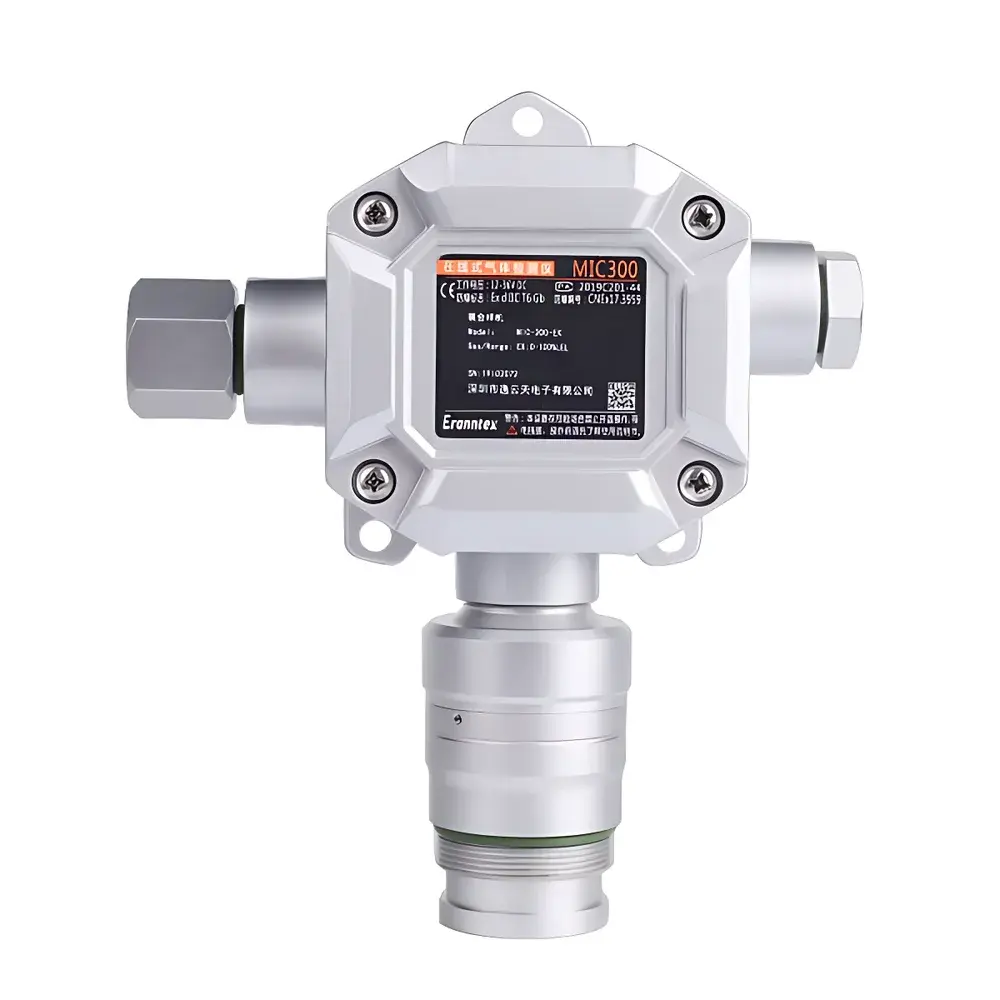
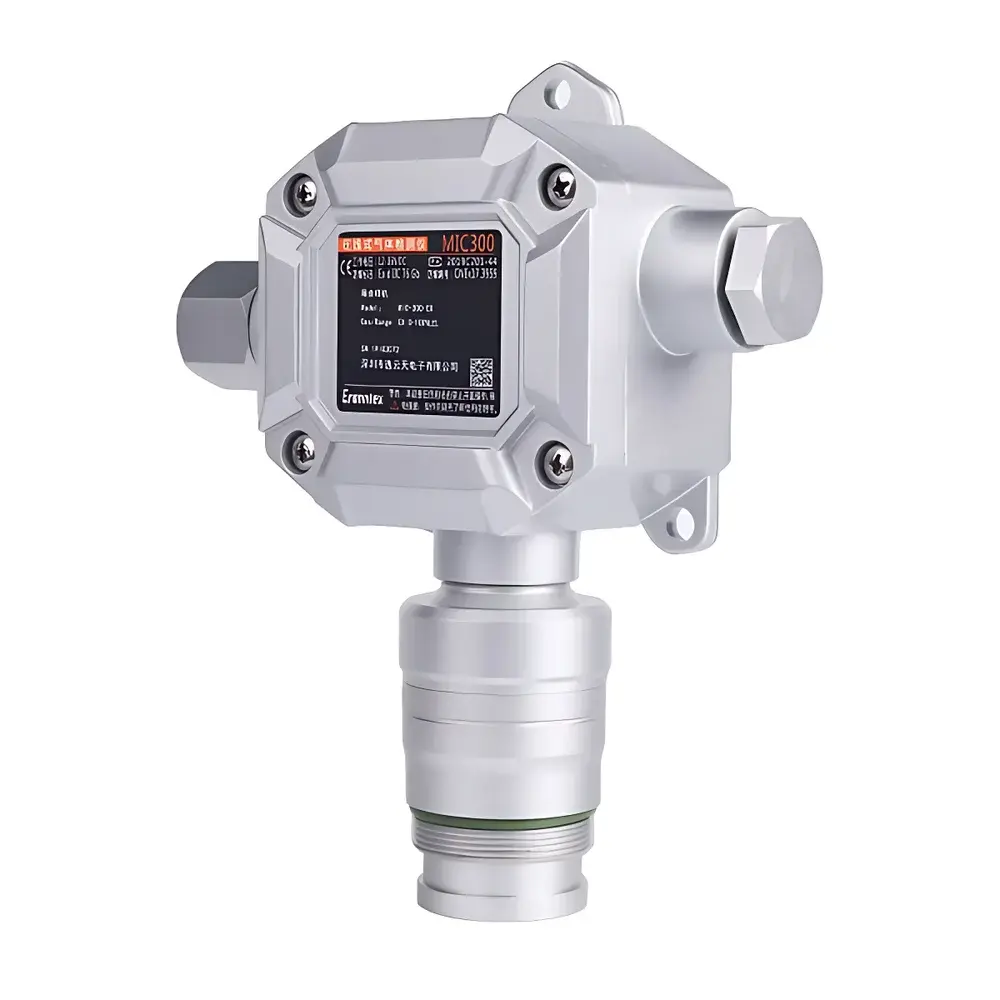
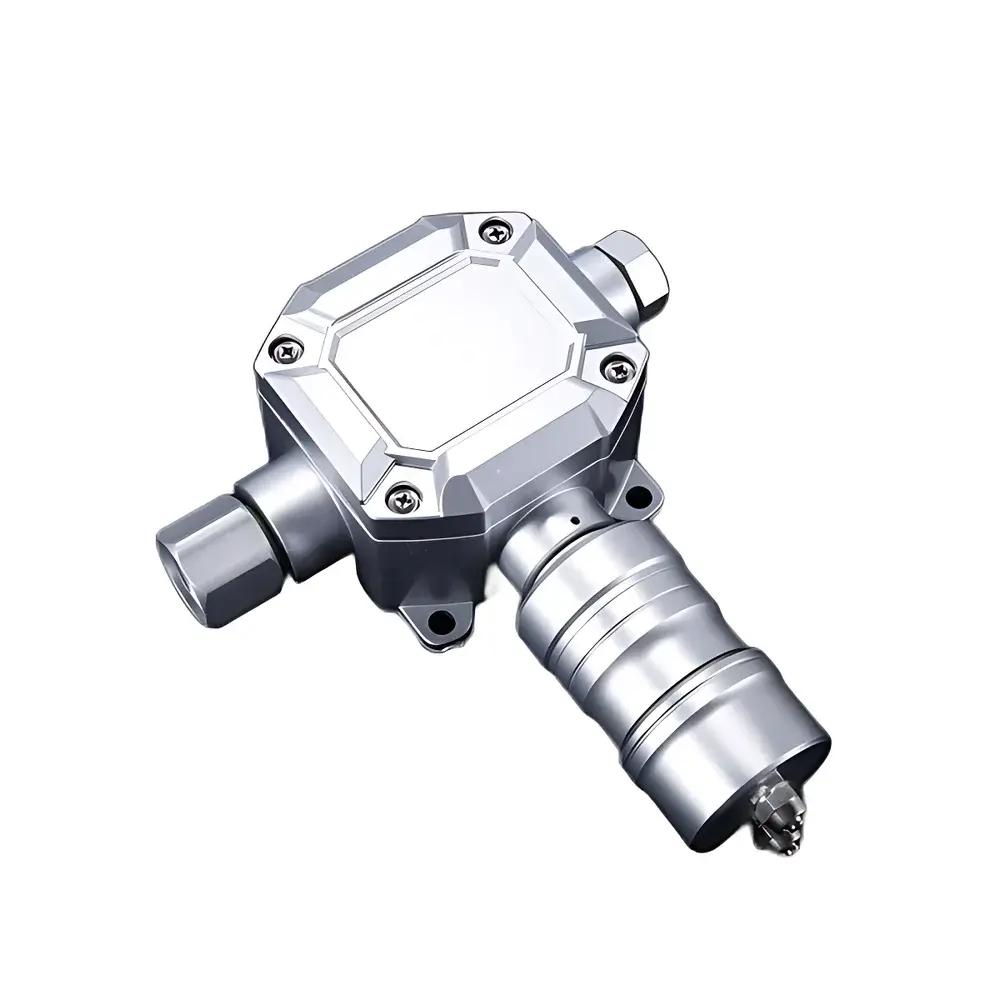
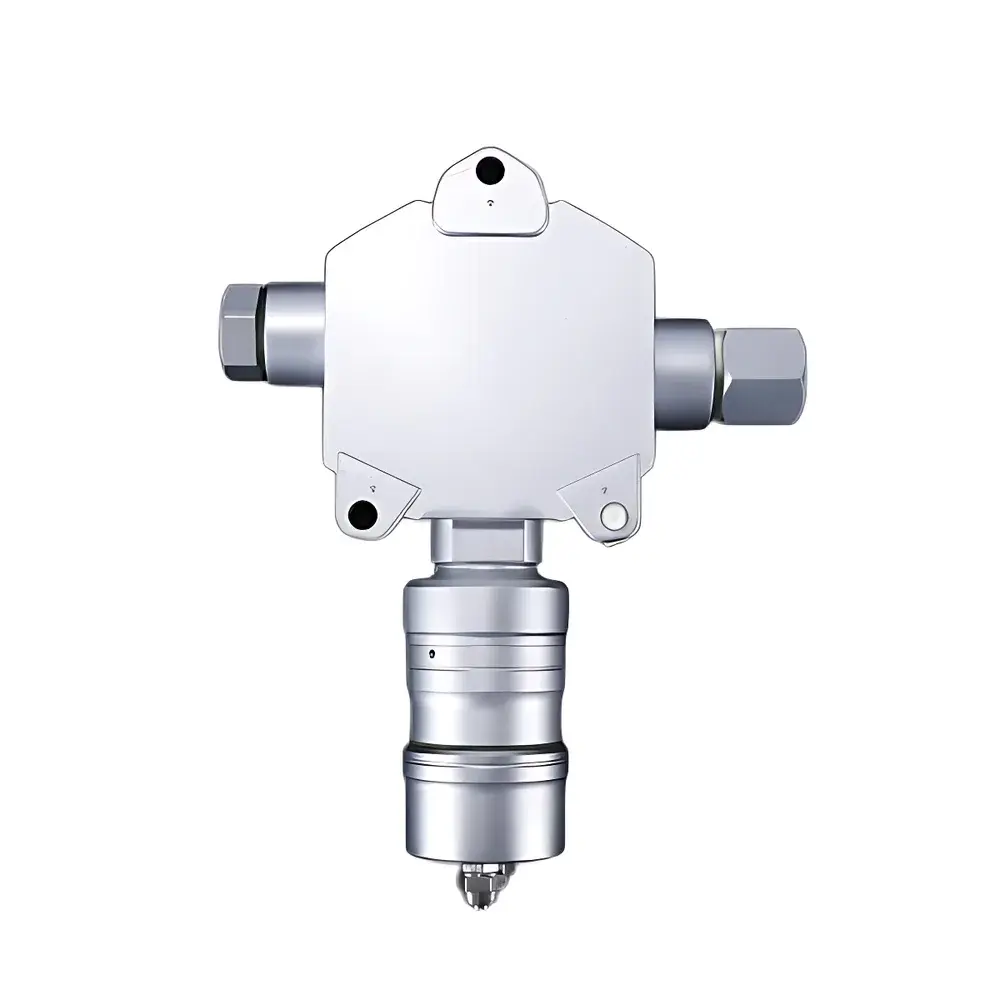
Eranntex MIC-300-H2 Hydrogen Gas Transmitter
| Brand | Eranntex |
|---|---|
| Origin | Shenzhen, China |
| Manufacturer Type | OEM/ODM Manufacturer |
| Country of Origin | China |
| Model | MIC-300-H2 |
| Hydrogen Generation Principle | Electrochemical & Thermal Conductivity |
| Output Flow Rate | 600 mL/min |
| Output Pressure | 0–100 ppm (Note: This is a typographical inconsistency in source |
| Hydrogen Purity | 99.99% |
| Power Consumption | 100 W |
| Detection Principle (Transmitter) | Electrochemical & Thermal Conductivity |
| Measurement Range | 0–100 ppm / 0–1000 ppm / 0–50,000 ppm / 0–100% LEL / 0–99.99% vol (configurable) |
| Resolution | 0.01 ppm (0–100 ppm), 0.1 ppm (0–1000 ppm), 1 ppm (>1000 ppm), 0.01% vol |
| Accuracy | ≤±3% FS |
| Response Time (T90) | ≤30 s |
| Operating Temperature | −40°C to +70°C |
| Humidity Range | 10–95% RH (non-condensing) |
| Output Signals | 4–20 mA (3-wire), RS485 Modbus RTU, optional 0–5 V / 0–10 V / 1–5 V |
| Explosion Protection | Ex d IIC T6 Gb (Certificate No.: CNEx17.3959) |
| IP Rating | IP65 |
| Dimensions (L×H×W) | 203×180×65 mm (without beacon) |
| Weight | 1.0 kg |
Overview
The Eranntex MIC-300-H2 Hydrogen Gas Transmitter is an intrinsically robust, fixed-mount gas detection instrument engineered for continuous, real-time monitoring of hydrogen (H₂) concentration in industrial and laboratory environments. Unlike portable or spot-check analyzers, the MIC-300-H2 integrates dual-sensor architecture—electrochemical and thermal conductivity detection principles—to deliver cross-validated, high-reliability readings across diverse hydrogen concentration ranges (ppm to % vol). Its design adheres to fundamental metrological requirements for fixed gas detection systems under ISO 10156, IEC 60079-29-1, and GB/T 50493 (China’s Design Standard for Detectors and Alarm Systems of Flammable and Toxic Gases). The transmitter operates as part of a distributed safety monitoring network, providing standardized analog (4–20 mA) and digital (RS485 Modbus RTU) outputs compatible with PLCs, DCS, SCADA, and centralized safety management platforms. It is not a standalone hydrogen generator but functions as the sensing and signal-conversion module within hydrogen generation, purification, and utilization systems—particularly where leak detection, process control, and overpressure alarm integrity are mission-critical.
Key Features
- Explosion-proof housing certified to Ex d IIC T6 Gb (CNEx17.3959), suitable for Zone 1 hazardous areas handling Class I, Group C gases (including H₂).
- Dual-principle detection: electrochemical sensors for low-range precision (0–100 ppm), thermal conductivity sensors for wide-range linearity (up to 99.99% vol), minimizing cross-sensitivity to CO, CH₄, or ambient humidity.
- Auto-zero tracking algorithm compensates for baseline drift under long-term operation, ensuring measurement stability without manual recalibration intervals shorter than 6 months.
- Triple-output configuration: standard 4–20 mA (3-wire), RS485 Modbus RTU (RTU frame format), and configurable relay outputs (2 dry-contact channels, programmable for low/mid/high alarms).
- EMI/EMC-hardened circuitry compliant with IEC 61000-4-2/3/4/6, including surge immunity up to 4 kV (line-to-ground), enabling reliable operation near variable-frequency drives, welding equipment, or high-voltage switchgear.
- IP65-rated enclosure with stainless-steel mounting bracket options (wall, pipe, flange), supporting installation in outdoor, high-dust, or washdown-prone locations when paired with optional rain hood or heated sampling probe.
Sample Compatibility & Compliance
The MIC-300-H2 is validated for direct diffusion-mode sampling of ambient air or process stream gas containing hydrogen. It supports optional sample conditioning modules—including particulate filters, Nafion™ dryers for high-humidity streams, and catalytic scrubbers for hydrocarbon interference mitigation—enabling deployment in refinery off-gas lines, PEM electrolyzer purge vents, fuel cell stack exhaust manifolds, and pharmaceutical inerting atmospheres. Regulatory compliance includes mandatory certification under China’s Administrative Measures on Metrological Instruments (Order No. 165), CCC marking for explosion protection, and conformity with GB 3836.1–2010 and GB 12358–2006. While not FDA 21 CFR Part 11–compliant out-of-the-box, audit-ready data logging (via external SCADA historian or Eranntex’s optional cloud gateway) supports GLP/GMP traceability when integrated with time-stamped, user-access-controlled HMI systems.
Software & Data Management
The transmitter communicates natively via Modbus RTU over RS485, allowing integration into third-party supervisory software (e.g., Ignition, Siemens Desigo, Honeywell Experion) without proprietary drivers. Eranntex provides a Windows-based configuration utility (MIC-ConfigTool v3.2) for zero/span calibration, alarm threshold setting, relay logic programming, and firmware updates. All operational parameters—including sensor voltage output, temperature compensation status, relay activation history, and power-on counter—are accessible via register mapping. Optional wireless telemetry kits (LTE-M/NB-IoT) enable encrypted MQTT transmission to cloud dashboards with TLS 1.2 encryption, supporting remote diagnostics, predictive maintenance alerts (based on signal noise variance >5% over 72 h), and automated report generation (PDF/CSV) aligned with ISO/IEC 17025 documentation requirements.
Applications
- Hydrogen production facilities: real-time monitoring of electrolyzer vent gas, PSA tail gas, and compressor inter-stage leakage.
- Power-to-gas infrastructure: safety interlock verification at H₂ blending points in natural gas grids (EN 16726-compliant mixing ratios).
- Research laboratories: closed-loop atmosphere control in gloveboxes (O₂/H₂ balance), catalysis reactors, and metal hydride storage testing rigs.
- Pharmaceutical manufacturing: validation of nitrogen-hydrogen purge cycles during lyophilizer chamber evacuation and inert blanketing of API synthesis vessels.
- Automotive R&D: fuel cell vehicle refueling station leak detection (NFPA 2 and SAE J2601 alignment), battery dry room H₂ accumulation surveillance.
- Chemical processing: continuous monitoring of hydrogenation reactor headspace, catalyst regeneration off-gas, and distillation column overheads containing trace H₂.
FAQ
Is the MIC-300-H2 certified for use in ATEX Zone 0 environments?
No. It carries Ex d IIC T6 Gb certification, which authorizes use only in Zone 1 (not Zone 0). For Zone 0 applications, an intrinsically safe (Ex ia) variant must be specified at order entry.
Can the transmitter operate continuously at −40°C without heater augmentation?
Yes—the internal circuitry and sensor housing are rated for −40°C ambient operation. However, condensation-induced measurement error may occur below 0°C in high-humidity conditions; optional heated sampling probe (−40°C to +85°C operating range) is recommended for sub-zero dew point streams.
What is the recommended calibration interval under ISO 61040 guidelines?
Initial calibration is required before commissioning. Subsequent verification should occur every 6 months for critical safety applications or annually for non-safety process monitoring, using traceable NIST-certified H₂ standards (e.g., 50 ppm in N₂, ±2% uncertainty).
Does the device support HART communication protocol?
No. The MIC-300-H2 uses native 4–20 mA with digital superimposition disabled. HART-capable variants (MIC-300-H2-HART) are available under separate model number and require factory configuration.
How is sensor lifetime affected by exposure to siloxanes or sulfur compounds?
Electrochemical sensors exhibit irreversible poisoning when exposed to >10 ppb siloxanes or >50 ppb H₂S. Thermal conductivity sensors remain unaffected. For biogas or syngas applications, upstream activated carbon filtration is mandatory per ISO 8573-1 Class 2 particulate and Class 3 oil vapor requirements.



