
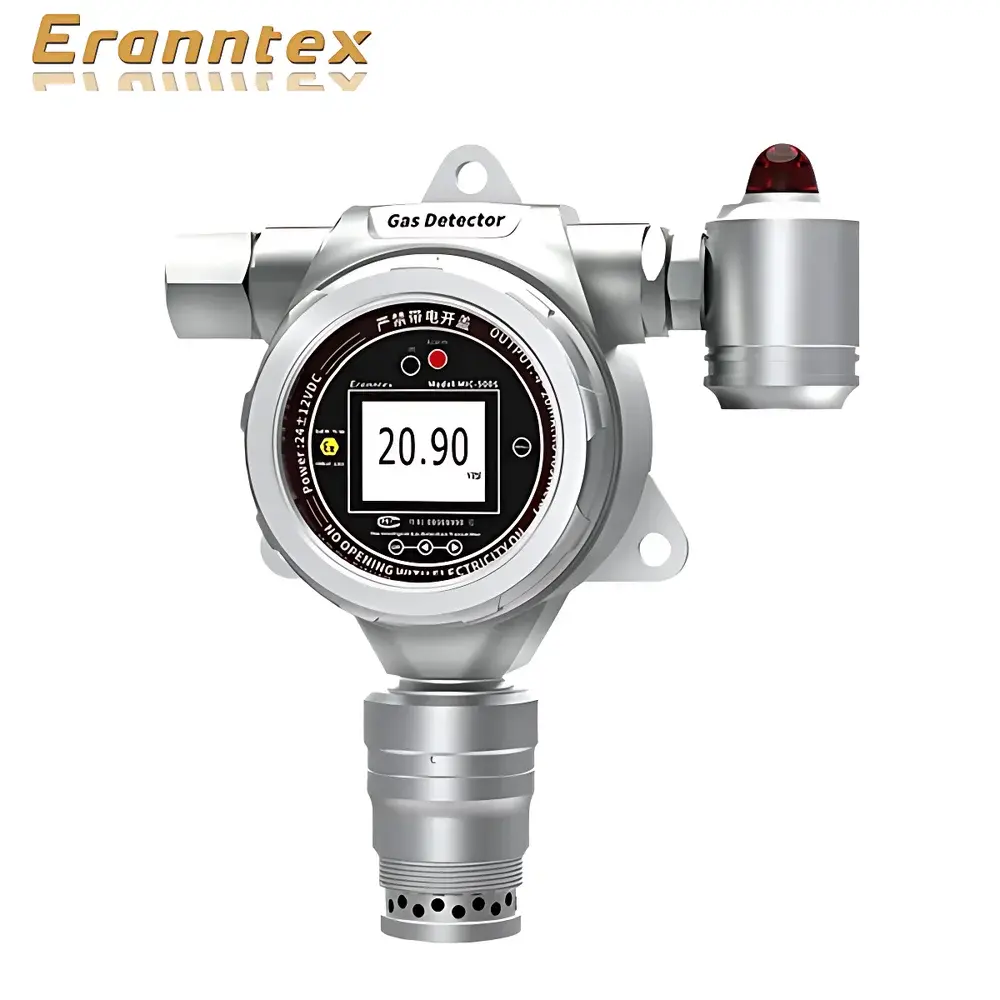
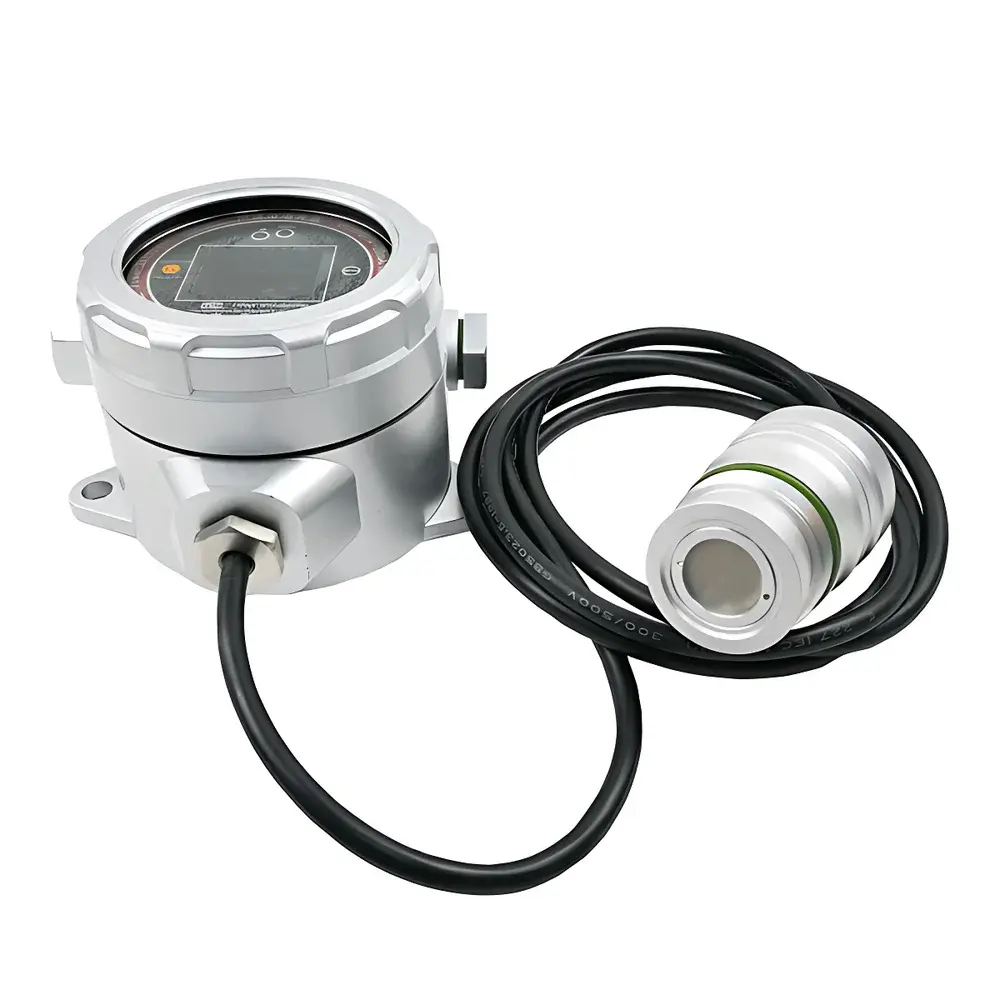
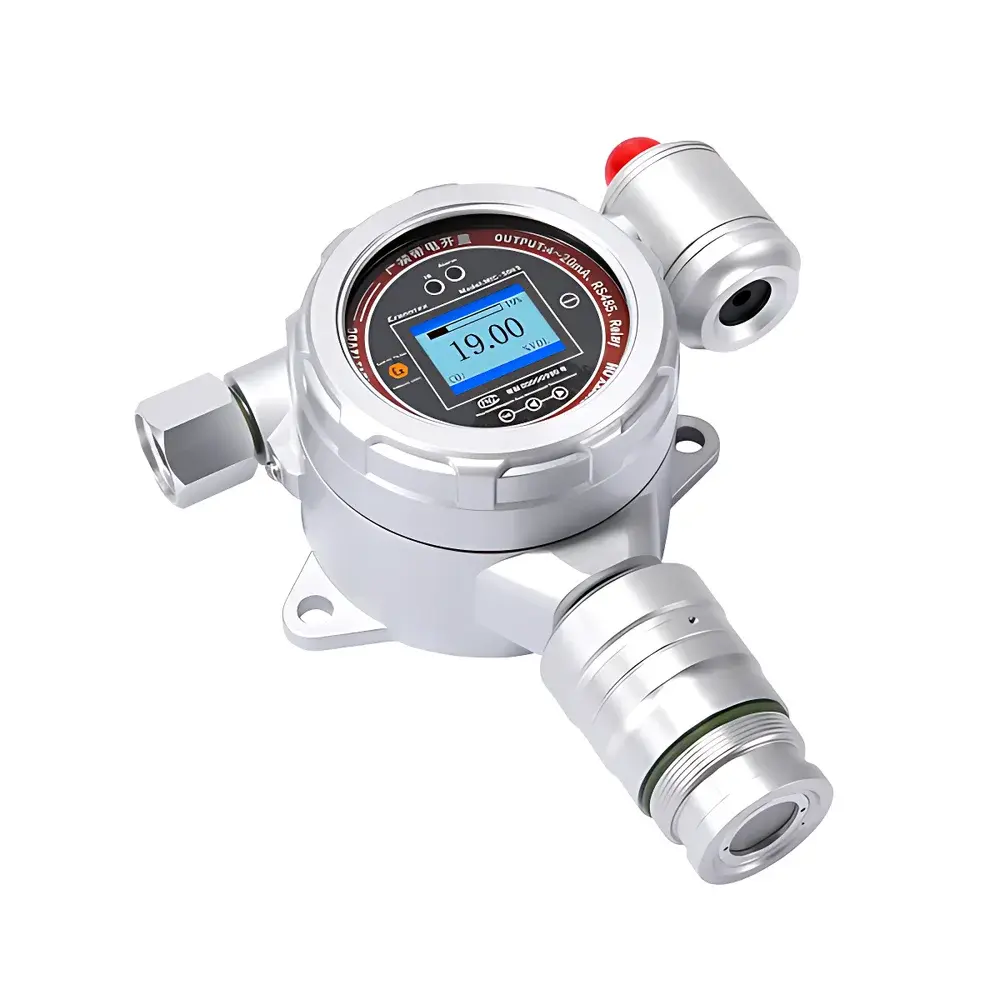
Eranntex MIC-500S-NH3 Online Ammonia (NH₃) Gas Detector
| Brand | Eranntex |
|---|---|
| Origin | Guangdong, China |
| Manufacturer Type | Manufacturer |
| Product Category | Domestic |
| Model | MIC-500S-NH3 |
| Instrument Type | Online Gas Detector |
| Output Options | 4–20 mA (2-/3-/4-wire), 0–5/0–10 V, RS485 (Modbus RTU), Relay Outputs (2 × SPDT) |
| Certifications | CMC License, Ex d IIB T6 Gb Explosion Protection Certification |
| Communication | Wired (RS485), LAN, Internet, Wireless (433 MHz, GPRS, Wi-Fi, Custom RF up to 5 km) |
| Remote Operation | Infrared remote control (15 m, no-open-cover configuration & calibration) |
| Calibration | Auto-zero tracking, multi-point calibration support, OEM/ODM available |
| Compliance | GB/T 34007–2017, GB 3836.1–2010, GB 3836.2–2010, JJG 555–1996 |
Overview
The Eranntex MIC-500S-NH3 is an industrial-grade online ammonia (NH₃) gas detector engineered for continuous, real-time monitoring in fixed-location applications across wastewater treatment plants, chemical manufacturing facilities, refrigeration systems, livestock barns, and semiconductor cleanrooms. It employs electrochemical sensing technology with a high-selectivity NH₃-specific electrode, delivering stable, low-drift measurement performance under variable ambient conditions. The sensor operates on the principle of amperometric detection: NH₃ diffuses through a hydrophobic membrane into an electrolyte layer, where it undergoes oxidation at the working electrode, generating a current linearly proportional to gas concentration (measured in ppm). Designed for permanent wall- or duct-mounted installation, the MIC-500S-NH3 integrates signal conditioning, temperature compensation, and digital diagnostics within a single robust housing—enabling reliable operation in environments subject to humidity fluctuations, particulate exposure, and electromagnetic noise.
Key Features
- Explosion-proof enclosure certified to Ex d IIB T6 Gb per GB 3836.1–2010 and GB 3836.2–2010—suitable for Zone 1 and Zone 2 hazardous areas classified under IEC 60079.
- Comprehensive electrical protection: reverse polarity protection, lightning surge suppression (IEC 61000-4-5 Level 3), ESD immunity (IEC 61000-4-2 ±8 kV contact), and conducted/radiated EMC compliance (IEC 61326-1).
- Flexible analog and digital outputs: configurable 4–20 mA (2-/3-/4-wire), 0–5 V / 0–10 V DC, dual SPDT relays (rated 250 VAC / 3 A), and isolated RS485 interface supporting Modbus RTU protocol.
- Infrared remote configuration and zero/span calibration—eliminates need for physical access to electronics compartment in classified zones.
- Auto-zero tracking algorithm continuously adjusts baseline reference to mitigate long-term drift; supports multi-point calibration using certified NH₃ standard gases (e.g., 10 ppm, 50 ppm, 100 ppm).
- Expandable communication architecture: optional integration with SCADA, DCS, or cloud-based platforms via wired Ethernet, local Wi-Fi, GPRS cellular modem, or proprietary 433 MHz RF transceivers (up to 5 km line-of-sight range).
Sample Compatibility & Compliance
The MIC-500S-NH3 is optimized for gaseous NH₃ detection in ambient air streams with operating temperature ranging from −20 °C to +50 °C and relative humidity up to 95% RH (non-condensing). It maintains accuracy in presence of common interferents including CO₂, H₂S, NO₂, and VOCs at typical industrial concentrations, owing to its cross-sensitivity-compensated electrochemical cell design. Regulatory conformance includes mandatory Chinese metrological certification (CMC license No. X permit), explosion-proof certification issued by CNEx (China National Explosion Protection Inspection Center), and alignment with national standards GB/T 34007–2017 (Performance Requirements for Fixed Gas Detectors) and JJG 555–1996 (Verification Regulation for Gas Analyzers). While not intrinsically safe (IS), its flameproof construction satisfies safety requirements for Class I, Division 1 installations under NEC 500 and permits use in facilities governed by GB 50493–2019 (Design Code for Gas Detection and Alarm Systems in Petrochemical Enterprises).
Software & Data Management
The detector supports bidirectional communication via Modbus RTU over RS485, enabling seamless integration with industry-standard supervisory software (e.g., Ignition SCADA, Siemens Desigo CC, or custom LabVIEW/HMI interfaces). Eranntex provides a Windows-compatible PC utility for local configuration, firmware updates, data logging (CSV export), and calibration history archiving—including timestamps, operator ID, and deviation metrics. All calibration events and alarm triggers are logged with audit-trail capability compliant with GLP principles. Optional cloud gateway modules provide MQTT/HTTPS telemetry upload to time-series databases (e.g., InfluxDB) or visualization dashboards (e.g., Grafana), supporting traceability and remote diagnostics without requiring on-site IT infrastructure.
Applications
- Continuous emission monitoring (CEM) of NH₃ slip from selective catalytic reduction (SCR) systems in thermal power plants.
- Process safety interlocks in ammonia synthesis and urea production units (ISO 13849-1 PL e validation support available upon request).
- Odor control verification in municipal wastewater headworks and sludge dewatering buildings.
- Occupational exposure limit (OEL) compliance monitoring in cold storage facilities using NH₃-based refrigerants (per GBZ 2.1–2019, TLV–TWA = 25 ppm).
- Real-time ventilation control in poultry and swine confinement operations to maintain animal welfare thresholds (recommended <20 ppm).
- Leak detection along ammonia transport pipelines and storage tank bund areas.
FAQ
What is the measurement range and resolution of the MIC-500S-NH3?
Standard configuration covers 0–100 ppm NH₃ with 0.1 ppm resolution; extended ranges (e.g., 0–500 ppm or 0–1000 ppm) are available upon request.
Does the device support HART protocol?
No—HART is not implemented; only 4–20 mA analog output with digital RS485/Modbus RTU is provided.
Can the detector operate in sub-zero outdoor environments?
Yes, with optional heated sampling probe and enclosure heater kit (operating down to −40 °C).
Is FDA 21 CFR Part 11 compliance supported?
The base unit does not include electronic signature or audit trail features required for Part 11; however, third-party SCADA platforms integrated via Modbus may provide such functionality.
What maintenance intervals are recommended?
Electrochemical sensor lifespan is typically 24 months; zero/span verification every 3 months and full calibration every 6 months are advised under continuous operation.







