
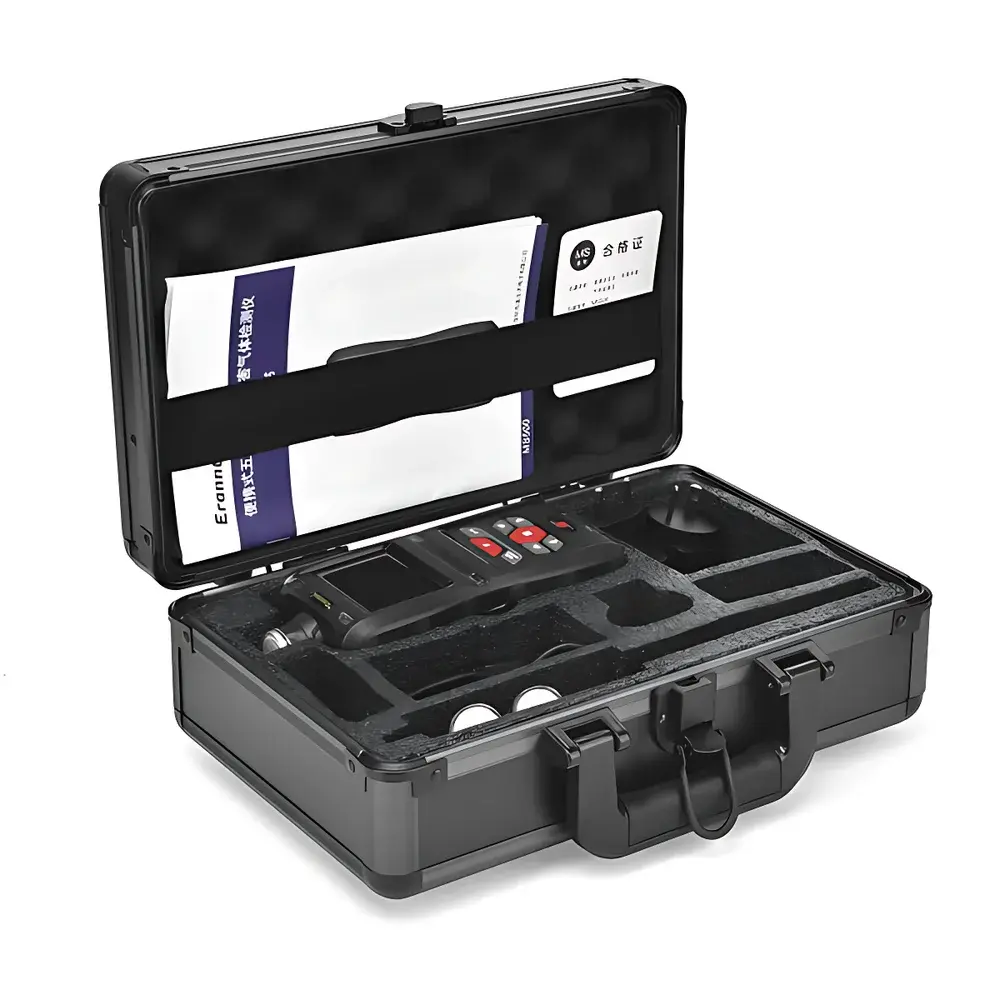
Eranntex MS500-O2 Portable Oxygen Analyzer
| Brand | Eranntex |
|---|---|
| Model | MS500-O2 |
| Origin | Guangdong, China |
| Manufacturer Type | OEM/ODM Manufacturer |
| Country of Origin | China |
| Detection Principle | Electrochemical (standard for O₂), optional IR/PID/catalytic bead/thermal conductivity |
| Detection Range | 0–10 ppm / 0–100 ppm / 0–1000 ppm / 0–200% vol (customizable) |
| Resolution | 0.001 ppm (0–10 ppm), 0.01 ppm (0–100 ppm), 0.1 ppm (0–1000 ppm), 1 ppm (>1000 ppm), 0.01 mg/L (0–200 mg/L), 0.01% vol |
| Accuracy | ≤±2% FS (higher accuracy available upon customization) |
| Operating Temperature | −40 °C to +70 °C (with ±0.5 °C temperature measurement accuracy, optional) |
| Humidity Measurement | 0–100% RH (±3% RH accuracy, optional) |
| Sampling Method | Integrated pump suction (500 mL/min), extendable sampling distance >10 m |
| Display | 2.5″ 320×240 color TFT screen |
| Data Storage | 100,000 records (expandable) |
| Communication | USB, RS232, Bluetooth (optional) |
| Power Supply | Rechargeable 3.7 V / 6000 mAh Li-polymer battery with overcharge/overdischarge/short-circuit/overtemperature protection |
| Enclosure Rating | IP66 |
| Explosion Protection | Exia II CT4 (intrinsic safety) |
| Dimensions | 195 × 77 × 46 mm (L×W×H) |
| Weight | 350 g |
Overview
The Eranntex MS500-O2 Portable Oxygen Analyzer is a field-deployable, multi-parameter gas detection instrument engineered for precise, real-time quantification of oxygen concentration in ambient air, confined spaces, process pipelines, and industrial exhaust streams. Unlike fixed-installation analyzers, the MS500-O2 employs an electrochemical sensing cell as its primary transduction method for O₂—selected for its high selectivity, stability under variable humidity, and compliance with ISO 10156 and ASTM D6245 standards for portable gas monitoring. The device supports dual-mode operation: passive diffusion and active pump-assisted sampling (500 mL/min), enabling reliable measurement even in low-flow or stagnant environments. Its modular sensor architecture allows co-detection of up to four additional gases—including CO, H₂S, SO₂, or VOCs—using interchangeable electrochemical, infrared (NDIR), PID, catalytic bead, or thermal conductivity modules, making it suitable for cross-contamination screening and background gas composition verification (e.g., O₂ purity assessment in nitrogen-blanketed systems). All firmware and signal processing algorithms are developed in-house and certified under China’s CMC (China Metrology Certification) framework, ensuring traceability to national metrological standards.
Key Features
- Intrinsically safe design certified to Exia II CT4 for use in hazardous Class I, Division 1 environments—fully compliant with IEC 60079-0 and GB 3836.1–2010.
- IP66-rated enclosure with integrated hydrophobic particulate filter and desiccant chamber, enabling continuous operation in high-humidity (>95% RH) and high-dust environments without sensor fouling.
- Multi-modal display interface: simultaneous quad-gas view, large-font single-channel mode, or real-time concentration trend graphing—with user-selectable auto/manual cycling and configurable min/max value annotation.
- Advanced data integrity architecture: timestamped logging with audit-trail metadata (including calibration events, alarm triggers, and fault codes); supports GLP-compliant record retention via encrypted USB export or RS232 serial dump.
- Intelligent power management: 6000 mAh Li-polymer battery delivers >18 hours continuous pump-on operation; USB hot-swap charging enables uninterrupted monitoring during recharge.
- Configurable alarm logic: programmable low/high/interval/weighted-average thresholds with concurrent audible (85 dB), visual (dual-color LED), and haptic feedback—each independently enabled or suppressed per channel.
- Auto-zero tracking and multi-point span calibration routines validated against NIST-traceable gas standards; built-in calibration lockout prevents unauthorized parameter modification.
Sample Compatibility & Compliance
The MS500-O2 is validated for direct sampling of ambient air, flue gas (with optional high-temperature probe rated to 800 °C), and inert gas matrices such as nitrogen or argon—critical for verifying O₂ residual levels in pharmaceutical purge validation or semiconductor inerting processes. It meets EN 50104 (oxygen deficiency warning devices), OSHA 1910.134 (respiratory protection), and EU Directive 2014/34/EU (ATEX) requirements. When equipped with optional temperature and humidity sensors, it performs automatic cross-sensitivity compensation per ISO 8573-1 Annex B, improving long-term repeatability in fluctuating environmental conditions. All firmware revisions undergo functional safety review per IEC 61508 SIL 2 principles, and calibration certificates include uncertainty budgets per ISO/IEC 17025.
Software & Data Management
Data acquisition and reporting are managed through Eranntex’s proprietary PC-based software suite, compatible with Windows 10/11 and supporting FDA 21 CFR Part 11-compliant electronic signatures, audit trails, and role-based access control. Raw datasets export in CSV or XML formats with embedded metadata (device ID, operator ID, GPS coordinates if enabled, environmental conditions). The software enables statistical analysis (mean, SD, CV%), alarm summary reports, and customizable PDF certificate generation—including pass/fail determination against user-defined acceptance criteria (e.g., USP <1231> oxygen limits for sterile packaging). Firmware updates are delivered via signed OTA packages with SHA-256 hash verification to prevent unauthorized modification.
Applications
- Confined space entry monitoring per OSHA 1910.146—verifying O₂ levels ≥19.5% and ≤23.5% vol prior to personnel entry.
- Pharmaceutical cleanroom and isolator qualification—tracking O₂ ingress during nitrogen purging cycles and validating seal integrity.
- Environmental emissions testing—measuring stack O₂ for combustion efficiency calculation (per EPA Method 3A or ISO 10849).
- Industrial safety auditing in petrochemical facilities—continuous monitoring near cryogenic storage tanks, hydrogen piping, or catalyst regeneration units.
- Research-grade atmospheric chemistry studies—field deployment for diurnal O₂ profiling in urban or forested microclimates.
- Medical gas quality assurance—spot-checking O₂ concentration in hospital pipeline systems per ISO 8573-7 and NFPA 99.
FAQ
What detection principle is used for oxygen measurement?
The standard configuration uses a three-electrode electrochemical cell optimized for O₂ detection in air and inert backgrounds. Infrared (NDIR) and paramagnetic options are available for applications requiring zero oxygen cross-sensitivity or extended service life.
Can the instrument measure oxygen in high-temperature exhaust streams?
Yes—when paired with the optional high-temperature sampling probe (rated to 800 °C) and integrated thermoelectric cooler, the MS500-O2 maintains measurement integrity across extreme thermal gradients while preventing condensate formation.
Is the device compliant with FDA 21 CFR Part 11 for regulated laboratories?
The hardware and bundled software support Part 11 requirements including electronic signatures, audit trails, and secure user authentication—provided system validation documentation is completed per organizational SOPs.
How often does the oxygen sensor require calibration?
Electrochemical O₂ sensors exhibit typical drift of <2% FS/year; we recommend quarterly bump testing with certified 20.9% O₂ in air and full 2-point calibration every six months—or after exposure to sensor poisons (e.g., H₂S, Cl₂, or silicone vapors).
Does the unit support data export for LIMS integration?
Yes—via RS232 ASCII protocol or USB CDC virtual COM port, enabling direct ingestion into laboratory information management systems using standard HL7 or ASTM E1384 message framing.



