
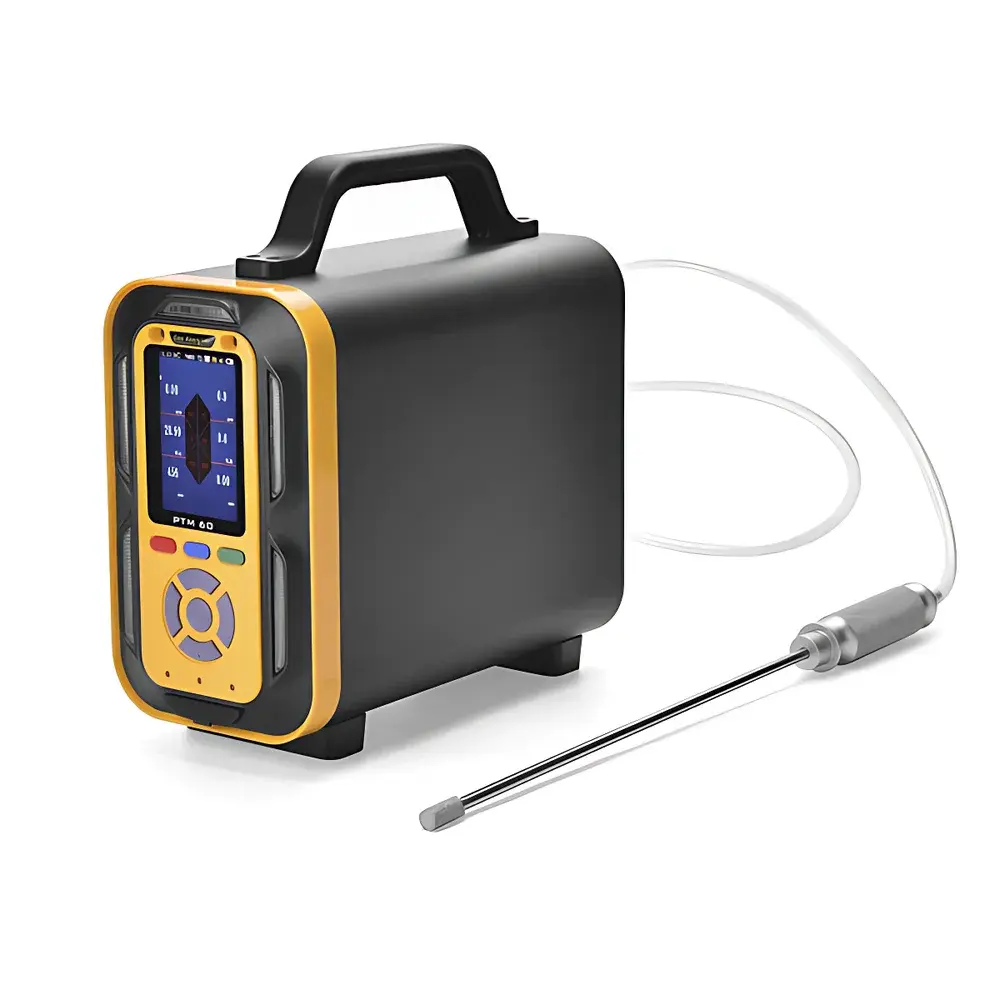
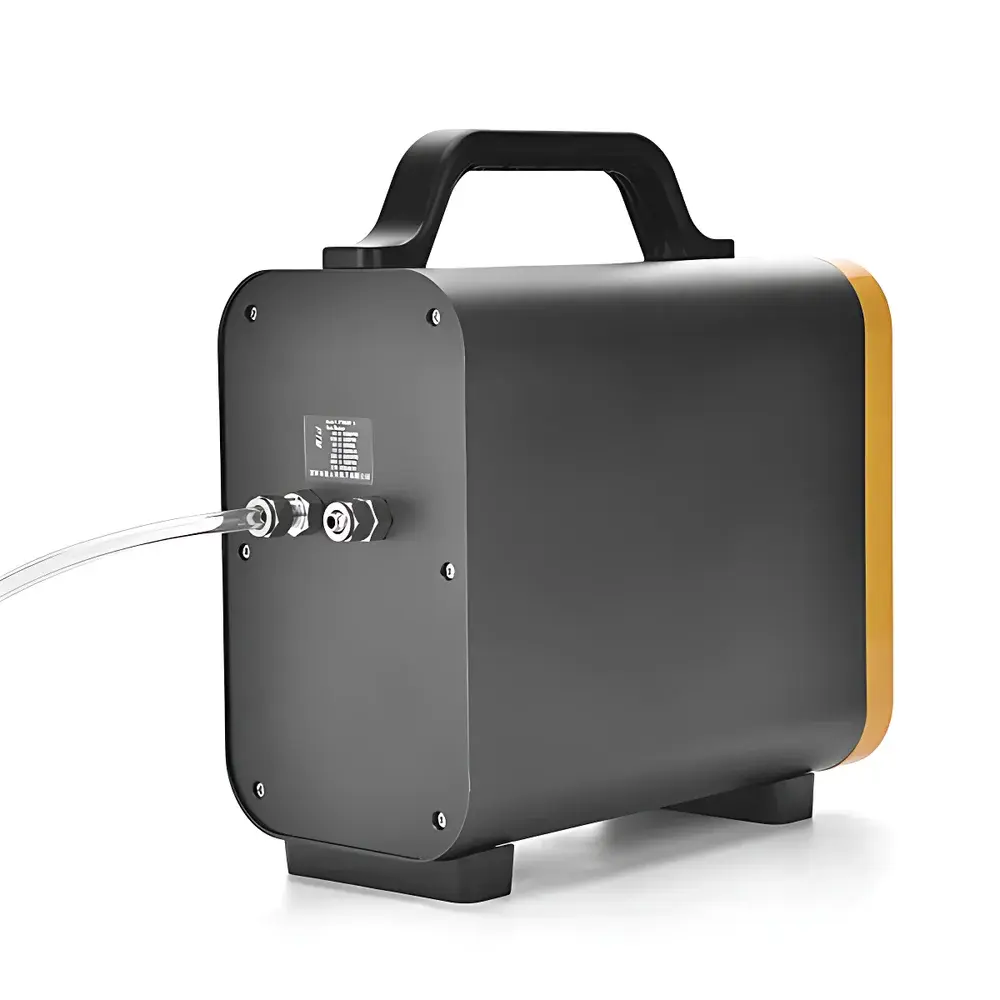
Eranntex PTM600-N2O Portable Nitrous Oxide (N₂O) Analyzer
| Brand | Eranntex |
|---|---|
| Origin | Guangdong, China |
| Manufacturer Type | OEM/ODM Manufacturer |
| Country of Origin | China |
| Model | PTM600-N2O |
| Detection Principle | Infrared (IR), Electrochemical (EC), PID, Catalytic Combustion, Thermal Conductivity |
| Detection Range (N₂O) | 0–100 ppm / 0–5000 ppm / 0–100% Vol (IR-based, selectable at order) |
| Resolution | 0.001 ppm (0–10 ppm), 0.01 ppm (0–100 ppm), 0.1 ppm (0–1000 ppm), 0.001% Vol (0–99.999% Vol) |
| Accuracy | ≤±2% FS |
| Response Time (T90) | ≤20 s |
| Recovery Time | ≤30 s |
| Sampling Method | Integrated pump suction (800 mL/min) with particulate/moisture filter |
| Display | 3.5″ color TFT LCD (320×240) |
| Operating Temperature | −40°C to +70°C |
| IP Rating | IP66 |
| Explosion Protection | Exia II CT4 (Intrinsically Safe) |
| Battery | 3.7 VDC, 10800 mAh Li-polymer (rechargeable, with overcharge/overdischarge/short-circuit/thermal protection) |
| Data Storage | Standard 100,000 records |
| Communication | Bluetooth v5.0, USB, RS232 (auto-recognizing) |
| Certifications | CMC (China Metrology Accreditation), GB standard-compliant |
Overview
The Eranntex PTM600-N2O Portable Nitrous Oxide (N₂O) Analyzer is a field-deployable, multi-sensor gas detection platform engineered for quantitative analysis of nitrous oxide in ambient air, confined spaces, process ducts, and emission stacks. It operates primarily on non-dispersive infrared (NDIR) spectroscopy for N₂O—selected for its high specificity, long-term stability, and immunity to cross-interference from CO₂, CH₄, or H₂O when equipped with optical filtering and temperature-compensated detection cells. Optional sensor modalities—including electrochemical (EC), photoionization (PID), catalytic bead (LEL), thermal conductivity (TC), and metal oxide semiconductor (MOS)—enable simultaneous monitoring of up to six gases (expandable to 24 with firmware update), making the PTM600-N2O suitable for comprehensive environmental screening, occupational hygiene surveys, and industrial leak detection. Its intrinsic safety design (Exia II CT4) and IP66-rated enclosure permit reliable operation in hazardous locations per IEC 60079-0 and IEC 60529 standards.
Key Features
- Intrinsically safe circuit architecture compliant with IEC 60079-11, certified for Zone 0/1 use in flammable atmospheres containing hydrocarbons, solvents, or hydrogen.
- Integrated dual-stage sampling system: motorized diaphragm pump (800 mL/min flow rate) paired with replaceable hydrophobic particulate/moisture filters—enabling stable operation in high-humidity (>95% RH) and dusty environments without sensor drift.
- Multi-range N₂O detection capability: three IR channel configurations (0–100 ppm, 0–5000 ppm, 0–100% Vol) with automatic range switching; resolution as low as 0.001 ppm at sub-ppm levels, supporting both trace-level environmental monitoring and high-concentration purity verification.
- Real-time environmental compensation: integrated Swiss-made capacitive digital hygrometer and thermistor array provide concurrent temperature (−40°C to +70°C, ±0.5°C) and humidity (0–100% RH, ±3% RH) measurements, feeding dynamic correction algorithms to maintain measurement linearity across wide thermal gradients.
- Robust data integrity framework: onboard storage of 100,000 timestamped records (concentration, T/RH, battery status, alarm flags); optional SD card or U-disk logging enables GLP/GMP-compliant audit trails with configurable sampling intervals (1 s to 24 h).
- Regulatory-ready connectivity: USB, RS232, and Bluetooth 5.0 interfaces support bidirectional communication with validated PC software (included), enabling calibration log export, firmware updates, and report generation aligned with ISO/IEC 17025 documentation requirements.
Sample Compatibility & Compliance
The PTM600-N2O accommodates gaseous samples from diverse matrices: ambient air, nitrogen- or oxygen-balanced process streams, exhaust flue gas (with optional high-temperature sampling handle rated to 1300°C), and vacuum-assisted headspace analysis. Its NDIR sensor exhibits minimal cross-sensitivity to CO₂ (<2% signal interference at 10,000 ppm CO₂) and negligible response to common VOCs under standard conditions. The analyzer meets China’s JJG 551–2016 verification regulation for gas analyzers and carries CMC (China Metrology Certification) approval. While not pre-certified to EN 15267 or EPA Method TO-15, its hardware architecture supports method adaptation for regulatory stack testing when paired with NIST-traceable calibration gases and documented SOPs. All firmware and calibration routines comply with ALCOA+ principles for data reliability.
Software & Data Management
The bundled Windows-based PC software provides full instrument control, including zero/span calibration, sensor health diagnostics, alarm threshold configuration, and user-accessible audit logs (calibration history, fault events, battery cycles). Data exports are generated in CSV and PDF formats—with optional inclusion of instrument ID, operator name, location tag, and GPS metadata (when connected via Bluetooth-enabled mobile device). The software enforces 21 CFR Part 11-compliant electronic signatures for calibration actions and supports role-based access control (administrator/operator modes). Raw time-series data can be imported into MATLAB, Python (Pandas), or LabVIEW for advanced statistical analysis, trend modeling, or integration into SCADA systems via Modbus RTU over RS232.
Applications
- Environmental compliance monitoring: quantification of N₂O emissions from wastewater treatment plants, agricultural soil flux studies, and landfill gas collection systems per IPCC Tier 2 reporting guidelines.
- Occupational safety: real-time exposure assessment in dental clinics, surgical suites, and pharmaceutical manufacturing facilities where N₂O is used as an anesthetic or propellant.
- Industrial process control: verification of N₂O purity in electronics-grade gas supply lines, cryogenic liquid phase analysis, and leak detection in refrigeration circuits using tracer-gas methodology.
- Research & development: laboratory-scale kinetics studies involving N₂O decomposition catalysts, combustion byproduct characterization, and atmospheric chemistry simulation chambers.
- Hazardous area surveying: confined space entry pre-checks in chemical storage tanks, reactor vessels, and biogas digesters where N₂O may accumulate alongside H₂S, CH₄, or CO.
FAQ
What N₂O detection principle does the PTM600-N2O use by default?
The standard configuration employs non-dispersive infrared (NDIR) spectroscopy optimized for the 2223 cm⁻¹ absorption band of N₂O, offering superior selectivity, 5–10 year sensor lifetime, and minimal drift under field conditions.
Can the instrument measure N₂O in high-temperature exhaust streams?
Yes—when equipped with the optional high-temperature sampling handle (rated to 1300°C) and active cooling module, the PTM600-N2O supports direct in-stack measurement with built-in thermal quenching and particulate filtration.
Is the device compatible with international calibration standards?
It accepts NIST-traceable calibration gases (e.g., Air Liquide N₂O/N₂ blends) and supports multi-point calibration protocols required by ISO 12039 and ASTM D6522 for fixed-source emission analyzers.
Does the analyzer meet FDA or EU regulatory requirements for pharmaceutical use?
While not pre-validated for GMP cleanroom applications, its data logging, audit trail, and calibration management features align with Annex 11 and 21 CFR Part 11 expectations—subject to site-specific IQ/OQ/PQ validation.
How is sensor cross-sensitivity managed during multi-gas detection?
Each sensor channel operates independently with dedicated signal conditioning; intelligent baseline drift correction and algorithmic interference compensation (e.g., H₂O vapor pressure subtraction for EC sensors) are applied in real time.
Related Products







