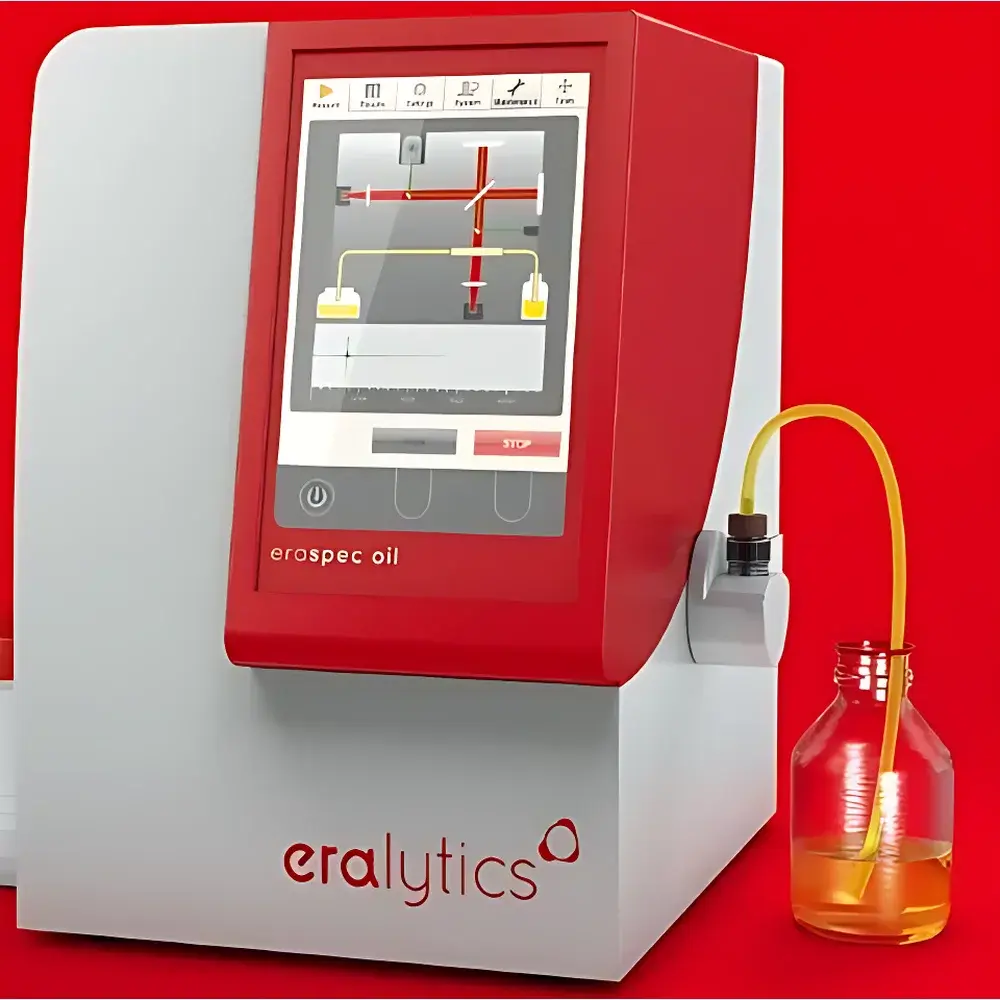
ERASPEC OIL Fourier Transform Infrared (FTIR) Lubricant Analyzer
| Brand | ERALYTICS |
|---|---|
| Origin | Austria |
| Model | ERASPEC OIL |
| Compliance | ASTM E2412, D2688, D7412–D7418, D7624 |
| Measurement Principle | Mid-IR Absorption Spectroscopy with Fixed-Path Transmission Cell |
| Sample Volume | 10 mL |
| Flow Path Cell Thickness | 100 µm |
| Viscosity Range | 0–2000 cSt (at 20 °C) |
| Analysis Time | 60–120 s (viscosity-dependent) |
| Warm-up Time | ≤30 s |
| Auto-sampling | Integrated precision peristaltic pump |
| Auto-cleaning | Solvent or next-sample flush |
| Display | 7-inch capacitive touchscreen |
| Connectivity | Ethernet (RJ45), USB 2.0, RS-232 |
| Data Storage | ≥3000 full spectral reports with metadata |
| Remote Access | Yes, via Ethernet-enabled diagnostic and service interface |
| Alarm Logging | Timestamped event tracking with result correlation |
| Software Compliance | Audit-trail capable |
Overview
The ERASPEC OIL is a benchtop-to-field deployable Fourier Transform Infrared (FTIR) spectrometer engineered specifically for in-service lubricant condition monitoring. Operating in the mid-infrared region (typically 4000–600 cm⁻¹), it employs fixed-path transmission spectroscopy through a precisely machined 100 µm flow cell to deliver laboratory-grade quantitative and qualitative analysis of used oils. Unlike portable ATR-based instruments, the ERASPEC OIL’s transmission geometry ensures high photometric accuracy and reproducibility—critical for detecting subtle chemical changes such as carbonyl formation (oxidation), sulfate/sulfone peaks (sulfidation), nitro-aromatic signatures (nitration), and hydroxyl absorbance shifts (hydrolysis). Its optical architecture is calibrated against NIST-traceable standards and validated per ASTM E2412 for spectral acquisition and data processing. Designed for integration into predictive maintenance programs, the instrument delivers rapid, operator-independent results without sample dilution or solvent extraction—enabling real-time decisions on oil drain intervals, component wear severity, and contamination ingress.
Key Features
- Compliance with 14 internationally recognized lubricant testing standards—including ASTM D2688 (oxidation), D7412–D7418 (additive depletion, soot, glycol, water, nitration), D7624 (TAN estimation), and DIN 51452/51453 (FTIR-based oil analysis)
- Automated fluid handling system featuring a programmable peristaltic pump capable of metering 10 mL samples across a viscosity range of 0–2000 cSt at 20 °C
- Self-cleaning flow path: automatic rinse between analyses using either the next sample or dedicated solvent flush—eliminating carryover and reducing maintenance downtime
- Onboard chemometric engine with user-expandable spectral libraries; supports multivariate calibration models for TAN, TBN, kinematic viscosity (ASTM D445), oxidation number, nitration index, sulfation index, and additive-specific quantitation (e.g., phenolic/amine antioxidants, ZDDP)
- Embedded 7-inch industrial-grade touchscreen with intuitive workflow navigation, real-time spectral overlay, and trend visualization tools
- Full audit trail functionality compliant with FDA 21 CFR Part 11 requirements—including electronic signatures, user access levels, and immutable log records for all measurements, calibrations, and alarms
Sample Compatibility & Compliance
The ERASPEC OIL accepts undiluted mineral, synthetic, and semi-synthetic lubricants—including engine oils, turbine oils, hydraulic fluids, gear oils, and compressor oils. It reliably detects key degradation markers and contaminants: water (OH stretch, ~3400 cm⁻¹), glycol (C–O stretch, ~1050–1150 cm⁻¹), soot (broad C=C absorption, ~1600 cm⁻¹), fuel dilution (aliphatic C–H bands, ~2900–2850 cm⁻¹), oxidation products (carbonyl C=O, ~1710 cm⁻¹), nitration (NO₂ asymmetric stretch, ~1540 cm⁻¹), and sulfation (S=O, ~1380 cm⁻¹). All reported parameters are traceable to reference methods defined in ASTM D664 (TAN), D4739 (TBN), and D2270 (viscosity index)—with chemometric models developed and verified using statistically representative used-oil sample sets. The instrument meets ISO/IEC 17025 preconditions for in-house method validation and supports GLP and GMP documentation requirements.
Software & Data Management
The embedded firmware runs ERALYTICS’ proprietary OilVision™ software suite, which includes spectral preprocessing (baseline correction, atmospheric compensation, normalization), peak integration, and multivariate regression modeling. Data files (.spc, .csv, .pdf) are stored locally with full metadata (operator ID, timestamp, instrument serial, calibration status, raw spectrum, processed result). Up to 3000 test records—including full interferograms and derivative spectra—are retained onboard. Export options include LIMS-compatible ASCII formats, direct Ethernet transfer to enterprise servers, and hardcopy output via USB-connected printers. Remote diagnostics and software updates are supported over secure Ethernet connections—enabling OEM-level technical support without onsite visits. All data modifications are logged with user attribution and timestamp, satisfying regulatory expectations for data integrity under FDA 21 CFR Part 11 and EU Annex 11.
Applications
- Condition-based oil change scheduling for diesel/gasoline engines, gas turbines, steam turbines, and marine propulsion systems
- Early detection of abnormal wear mechanisms (e.g., elevated copper/iron ratios inferred from additive depletion kinetics)
- Verification of lubricant mixing errors or incorrect top-up fluids in multi-lubricant fleets
- Monitoring additive package stability during extended drain intervals in wind turbine gearboxes
- Root-cause analysis of field failures linked to coolant ingress, fuel dilution, or thermal degradation
- Supporting ISO 4406 particle count correlation studies via complementary FTIR-derived soot/water indices
FAQ
Does the ERASPEC OIL require external calibration standards for routine operation?
No. Factory-installed primary calibrations are stable for 12 months under normal use. Optional annual verification kits (NIST-traceable polystyrene film, water-in-oil standards) are available for internal QC checks.
Can the instrument be integrated into an existing CMMS or SAP PM module?
Yes. Through its Ethernet interface and configurable ASCII/CSV export protocols, the ERASPEC OIL supports automated data ingestion into CMMS platforms using standard middleware or custom API adapters.
Is temperature control of the sample cell available?
The flow cell operates at ambient temperature. For viscosity-sensitive applications, users may precondition samples to 40 °C or 100 °C offline per ASTM D445 guidelines prior to injection.
What level of technical training is required to operate the system?
Minimal. Operators require <2 hours of hands-on instruction to perform daily startup, calibration verification, sample measurement, and report generation. Advanced chemometric model management is reserved for designated lab personnel.
How is spectral data protected against unauthorized modification?
All spectra and derived results are write-protected upon acquisition. Modifications (e.g., baseline adjustment) generate new versioned records with full provenance tracking—ensuring original data immutability per ALCOA+ principles.