
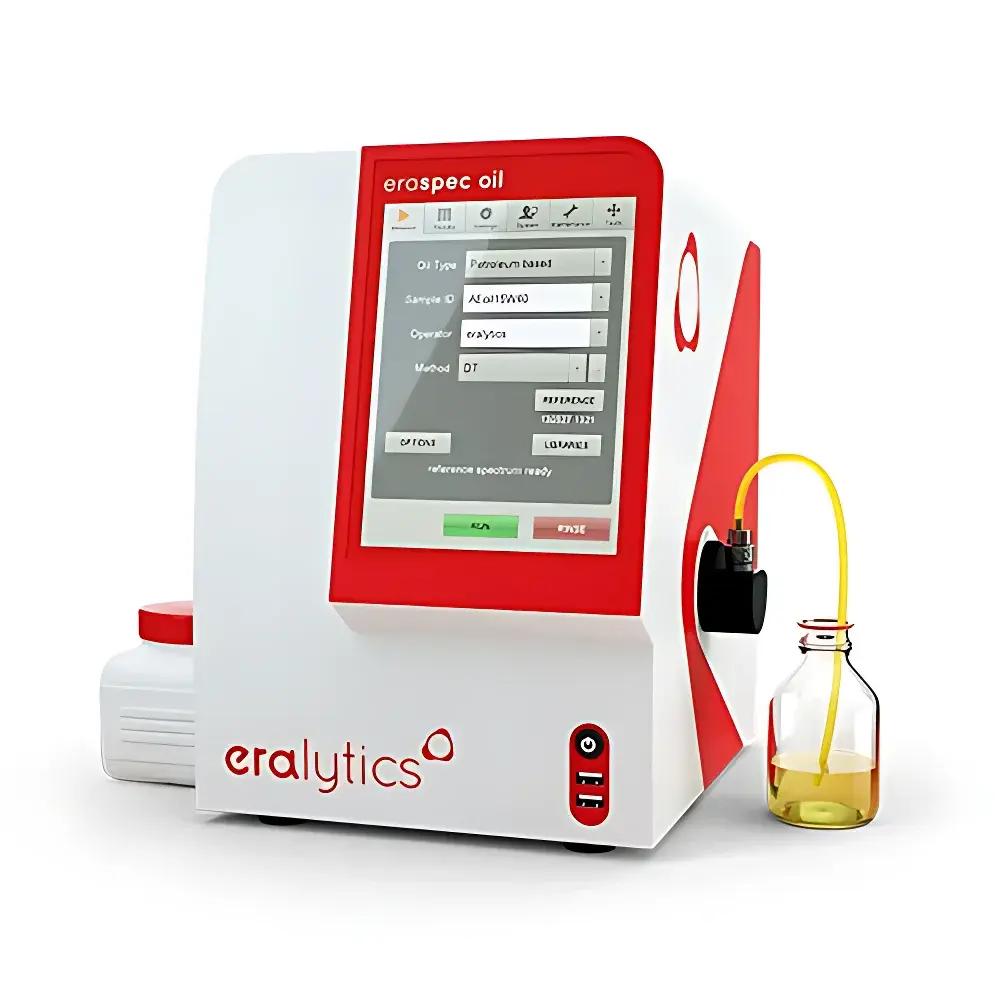
ERASPEC OIL Portable Mid-IR Lubricating Oil Analyzer by ERALYTICS
| Brand | ERALYTICS |
|---|---|
| Origin | Austria |
| Model | ERASPEC OIL |
| Product Type | Portable Instrument |
| Detection Parameters | Oxidation, Nitration, Sulfation, Ester Degradation, Phosphorylation, Anti-wear Additives, Antioxidants, Water, Ethylene Glycol, Gasoline, Diesel, TAN, TBN, Viscosity (40 °C & 100 °C) |
| Compliance | ASTM E2412, ASTM D7412, D7414, D7415, D7418, D7624, JOAP, DIN 51452, DIN 51453 |
| Sample Volume | 10 mL |
| Spectral Range | 450–7000 cm⁻¹ |
| Data Points | 16,384 |
| Measurement Time | 60 s |
| Display | 7″ Color Touchscreen |
| Power Supply | 85–264 V AC / 12 V DC (7 A) |
| Dimensions | 22 × 32 × 28 cm |
| Weight | 8 kg |
| Interfaces | 5× USB, 1× Ethernet, 1× RS232, LIMS-ready |
Overview
The ERASPEC OIL Portable Mid-IR Lubricating Oil Analyzer is an engineered solution for real-time, field-deployable condition monitoring of in-service lubricants. Based on patented Fourier Transform Infrared (FTIR) spectroscopy operating in the mid-infrared range (450–7000 cm⁻¹), the instrument delivers molecular-level fingerprinting of oil chemistry without solvent dilution or sample derivatization. Its core measurement principle relies on quantitative absorption band analysis—specifically targeting functional group vibrations associated with oxidation (C=O stretch at ~1710 cm⁻¹), nitration (~1630 cm⁻¹), sulfation (~1370 cm⁻¹), hydrolysis products, additive depletion, and contaminant ingress. With 16,384 data points per scan and active laser and temperature stabilization, spectral reproducibility meets stringent requirements for trend-based asset health assessment across rotating machinery, hydraulic systems, and engine fleets.
Key Features
- True portable architecture: Integrated pump, flow cell, and solvent rinse system enable fully automated analysis in laboratory, workshop, or mobile environments—no external peripherals required.
- Zero-sample-prep workflow: Direct injection of 10 mL undiluted used oil; built-in 80 µm stainless-steel filter prevents particulate interference.
- Single-touch operation: Fully guided user interface with context-sensitive prompts reduces operator dependency and minimizes training overhead.
- Multi-standard compliance: Pre-validated chemometric models align with ASTM E2412 (FTIR for used lubricant analysis), ASTM D7412–D7418 (oxidation/nitration/sulfation), ASTM D7624 (glycol detection), JOAP-06-01, and DIN 51452/51453 (oxidation stability and additive quantification).
- Robust connectivity: Five USB ports, Gigabit Ethernet, and RS232 support direct integration with LIMS, SCADA, or CMMS platforms; remote diagnostics and firmware updates via secure Ethernet link.
- Multi-language interface: On-device display supports English, German, French, Spanish, Portuguese, Russian, and Simplified Chinese—configured per user profile.
- Embedded data governance: Audit-trail enabled logging of all measurements, alarms, calibration events, and operator IDs (≥100 users); full traceability compliant with GLP and internal QA protocols.
Sample Compatibility & Compliance
The ERASPEC OIL is validated for mineral-, synthetic-, and semi-synthetic-based lubricants including engine oils (SAE 0W–60), hydraulic fluids (HL, HV, HS), turbine oils (ISO-L-TGA), gear oils (EP types), and compressor lubricants. It accommodates viscosity ranges from 400 cSt at 40 °C without dilution. All reported parameters—including TAN (ASTM D664 correlation), TBN (ASTM D2896 correlation), and kinematic viscosity (ASTM D445 correlation)—are derived via multivariate regression against reference methods, not direct physical measurement. Regulatory alignment includes full adherence to ASTM E2412’s spectral acquisition and data processing criteria, JOAP’s spectral library structure, and DIN 51452’s oxidation index calculation methodology. No method deviation or instrument-specific normalization is applied—results are directly comparable across global maintenance databases.
Software & Data Management
Onboard firmware implements ISO/IEC 17025-aligned data handling: raw interferograms and processed spectra are stored with timestamp, GPS coordinates (optional), operator ID, and environmental metadata (ambient temperature, humidity). The internal database retains ≥3000 full reports—including baseline-subtracted spectra, peak-area integrals, and trend charts—with export in CSV, PDF, and ASTM E2412-compliant .spc formats. Software supports spectral subtraction, overlay comparison, and auto-alert thresholds configurable per parameter (e.g., water > 0.1% triggers immediate notification). For regulated environments, optional 21 CFR Part 11 mode enforces electronic signature, role-based access control, and immutable audit logs—fully compatible with FDA-audited maintenance programs.
Applications
- Predictive maintenance of gas turbines, diesel generators, and wind turbine gearboxes via oxidation/nitration trending.
- Early detection of coolant leakage (ethylene glycol) in heavy-duty engine oils before catastrophic failure.
- Monitoring additive package depletion (ZDDP, phenolic antioxidants) in aviation turbine oils per JOAP-06-01.
- Field verification of oil change intervals in mining and marine fleets using TAN/TBN ratio analysis.
- Verification of lubricant interchangeability and counterfeit detection via spectral library matching.
- Supporting ISO 55001 asset management frameworks through standardized, auditable oil health metrics.
FAQ
Does the ERASPEC OIL require daily recalibration?
No. Factory calibration using NIST-traceable reference oils remains stable for ≥12 months under normal use; performance verification is conducted automatically prior to each measurement using internal reference standards.
Can it analyze greases or solid contaminants?
No. The system is designed exclusively for liquid lubricants; grease analysis requires solvent extraction and is outside its validated scope.
Is spectral data export compatible with third-party chemometric software?
Yes. Raw interferograms (.ifg) and processed absorbance spectra (.spc) are exported without proprietary encryption, enabling import into Unscrambler®, Pirouette®, or custom Python-based PLS models.
What power sources are supported for field deployment?
Dual-mode operation: 85–264 V AC (50/60 Hz, 70 W) or 12 V DC (7 A), enabling direct connection to vehicle batteries or portable power stations.
How is measurement repeatability ensured across different operators?
Operator-independent fluid handling: integrated peristaltic pump, fixed-pathlength flow cell, and automated solvent flush eliminate manual pipetting variability—RSD ≤1.8% for oxidation index across 5 operators (n=30, ASTM D7414 protocol).





