
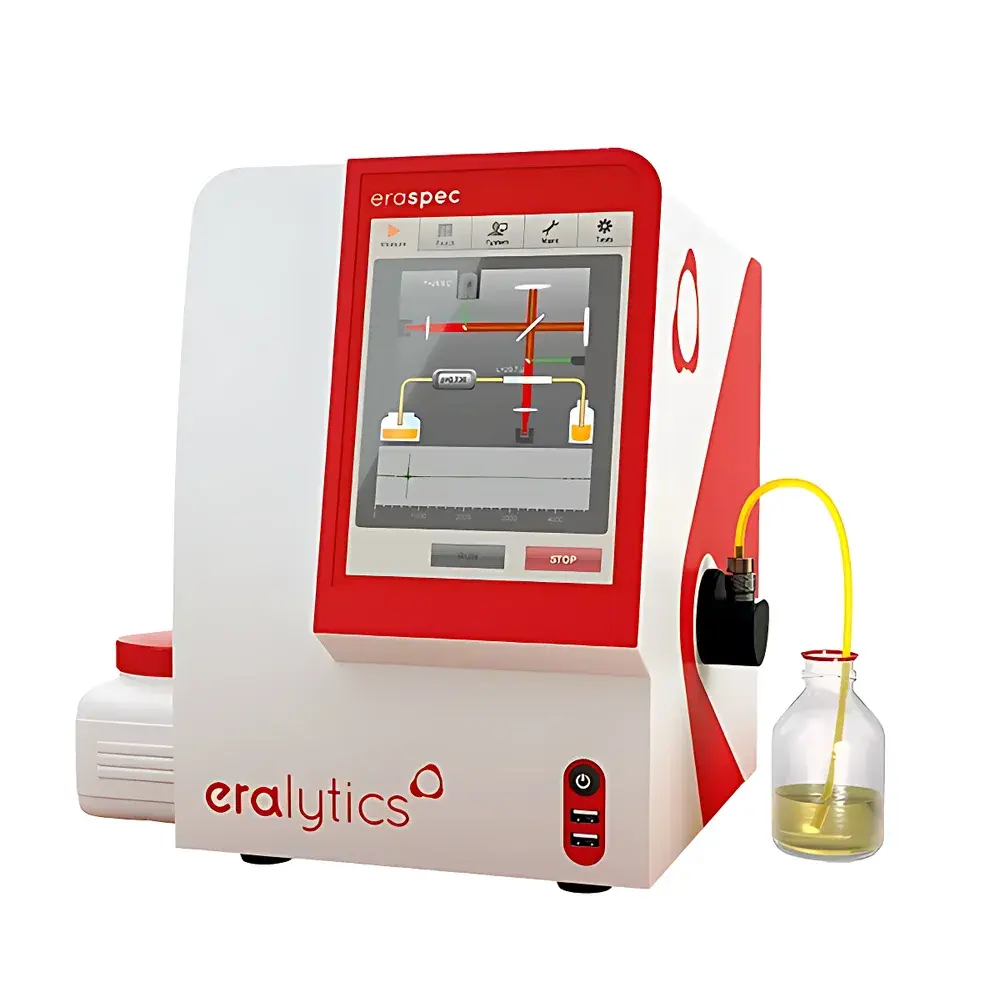
ERASPEC PYNN Mid-Infrared Jet Fuel Analyzer
| Brand | ERALYTICS |
|---|---|
| Origin | Austria |
| Model | PYNN ERASPEC |
| Sample Volume | 10 mL |
| Measurement Time | 1 min |
| Spectral Range | 4000–400 cm⁻¹ |
| Spectral Resolution | 3000 data points per scan |
| Density Accuracy | ±0.0001 g/cm³ (integrated Anton Paar density module) |
| Power Supply | 85–263 VAC, 47–63 Hz, 70 W |
| DC Power Option | 12 V / 4 A |
| Dimensions | 220 × 320 × 280 mm |
| Weight | 8 kg |
| Connectivity | 3× USB, 1× Ethernet, 1× RS232, LIMS interface |
| Data Storage | ≥2000 test records |
| Display | 6.5″ color touchscreen (Chinese UI) |
| Compliance | ASTM D1655, ASTM D7462, ASTM D7845, ISO 13739, IP 359, DEF STAN 91-91 |
Overview
The ERASPEC PYNN Mid-Infrared Jet Fuel Analyzer is an integrated, field-deployable FTIR-based analytical platform engineered for rapid, standardized physicochemical characterization of aviation turbine fuel (Jet A, Jet A-1, JP-5, JP-8) and related hydrocarbon streams. Operating on the principle of Fourier-transform infrared spectroscopy with full-spectrum acquisition (4000–400 cm⁻¹), the instrument delivers simultaneous quantification of critical quality parameters—including freeze point, flash point, kinematic viscosity, distillation profile (T10/T50/T90), density, aromatic content, and olefin content—within a single 60-second measurement cycle. Unlike conventional wet-chemistry or standalone ASTM methods requiring thermal equilibration, solvent calibration, or manual sample preparation, the ERASPEC PYNN employs real-time background referencing and automated liquid-phase sampling, eliminating warm-up delays and external calibration standards such as cyclohexane. Its ruggedized military-grade chassis, low-power architecture (70 W AC / 12 V DC), and compact footprint (220 × 320 × 280 mm) support both laboratory benchtop operation and mobile deployment in refueling hubs, airfield quality control labs, or onboard service vehicles.
Key Features
- True one-minute multi-parameter analysis: Freeze point, flash point, kinematic viscosity, density, distillation endpoints, aromatics, and olefins—all derived from a single 10 mL sample injection.
- Integrated Anton Paar density module delivering ±0.0001 g/cm³ repeatability, traceable to NIST-certified reference materials.
- High-fidelity spectral acquisition with 3000 discrete data points across the mid-IR range, enabling robust chemometric modeling and high correlation with reference ASTM procedures (e.g., ASTM D2386, D56, D445, D1298, D86).
- Automated fluid handling: Self-contained syringe-driven sampling, dual-phase (liquid/gas) cleaning cycle, and sealed optical path minimize carryover and operator intervention.
- Embedded Chinese-language GUI with 6.5″ capacitive touchscreen; no external PC required for routine operation.
- Multi-interface connectivity: Three USB ports (for printer, keyboard, and data export via USB flash drive), Ethernet for LIMS integration, RS232 for legacy instrumentation, and native support for 21 CFR Part 11-compliant audit trails when paired with optional software modules.
- Field-ready power architecture: Operates on standard AC mains or vehicle-mounted 12 V DC supply—validated for continuous duty under MIL-STD-810G environmental conditions.
Sample Compatibility & Compliance
The ERASPEC PYNN is validated for use with aviation turbine fuels meeting ASTM D1655, DEF STAN 91-91, and NATO F-34 specifications. It also supports cross-compatibility testing for diesel (ASTM D975), gasoline (ASTM D4814), and blended fuels containing up to 50% synthetic hydrocarbons (e.g., Fischer–Tropsch jet fuel per ASTM D7566 Annex A1). All quantitative calibrations are developed using certified reference materials traceable to NIST SRMs and undergo periodic verification per ISO/IEC 17025 internal quality control protocols. The system meets electromagnetic compatibility requirements per EN 61326-1 and carries CE marking for use within the European Economic Area. For regulated environments, optional firmware enables GLP/GMP-compliant data integrity features including user-level access control, electronic signatures, and immutable audit logs.
Software & Data Management
The analyzer runs on embedded Linux-based firmware with a dedicated chemometric engine optimized for petroleum matrixes. Raw interferograms and processed spectra are stored locally with timestamp, operator ID, and instrument configuration metadata. Up to 2000 test records are retained on-device; data export is supported via USB mass storage (CSV, PDF, and proprietary .ersp formats) or network transfer (SFTP, HTTP POST). Optional ERASPEC Connect software provides centralized fleet management, method versioning, remote diagnostics, and seamless integration into enterprise LIMS platforms via ASTM E1384 or HL7-compliant APIs. All spectral libraries and calibration models are digitally signed and version-controlled to ensure method reproducibility across instruments and time.
Applications
- Routine quality assurance at refinery off-gas lines and blending facilities prior to pipeline shipment.
- On-site verification of fuel conformity at military airbases, commercial airports, and third-party storage terminals per IATA Guidance Material and ICAO Annex 16 Vol II requirements.
- Detection and quantification of diesel or gasoline contamination in jet fuel batches—critical for preventing cold-flow impairment or combustion instability.
- Support of accelerated aging studies and additive stability monitoring under simulated storage conditions (per ASTM D877 and D2274).
- Technical due diligence during fuel procurement audits and dispute resolution involving specification non-conformance.
FAQ
Does the ERASPEC PYNN require daily calibration with cyclohexane or other external standards?
No. The system uses dynamic internal background referencing and factory-established chemometric models; no routine solvent-based recalibration is needed.
Can the instrument be used to analyze fuels outside the jet fuel specification?
Yes—it supports validated methods for diesel, gasoline, and synthetic blendstocks, with optional method packs available for customization.
Is the density measurement traceable to international standards?
Yes. The integrated Anton Paar DMA module is calibrated against NIST SRM 1828 (water) and SRM 2779 (kerosene), with full uncertainty budgets documented per ISO/IEC 17025.
What level of cybersecurity compliance does the device support?
The firmware supports TLS 1.2 encrypted communications, role-based authentication, and audit log export compliant with NIST SP 800-53 Rev. 4 controls for medium-impact systems.
How is method validation performed for new fuel types or regulatory updates?
ERALYTICS provides method development services—including PLS regression model training, cross-laboratory round-robin validation, and formal IQ/OQ documentation—under ISO 17025-accredited processes.





