
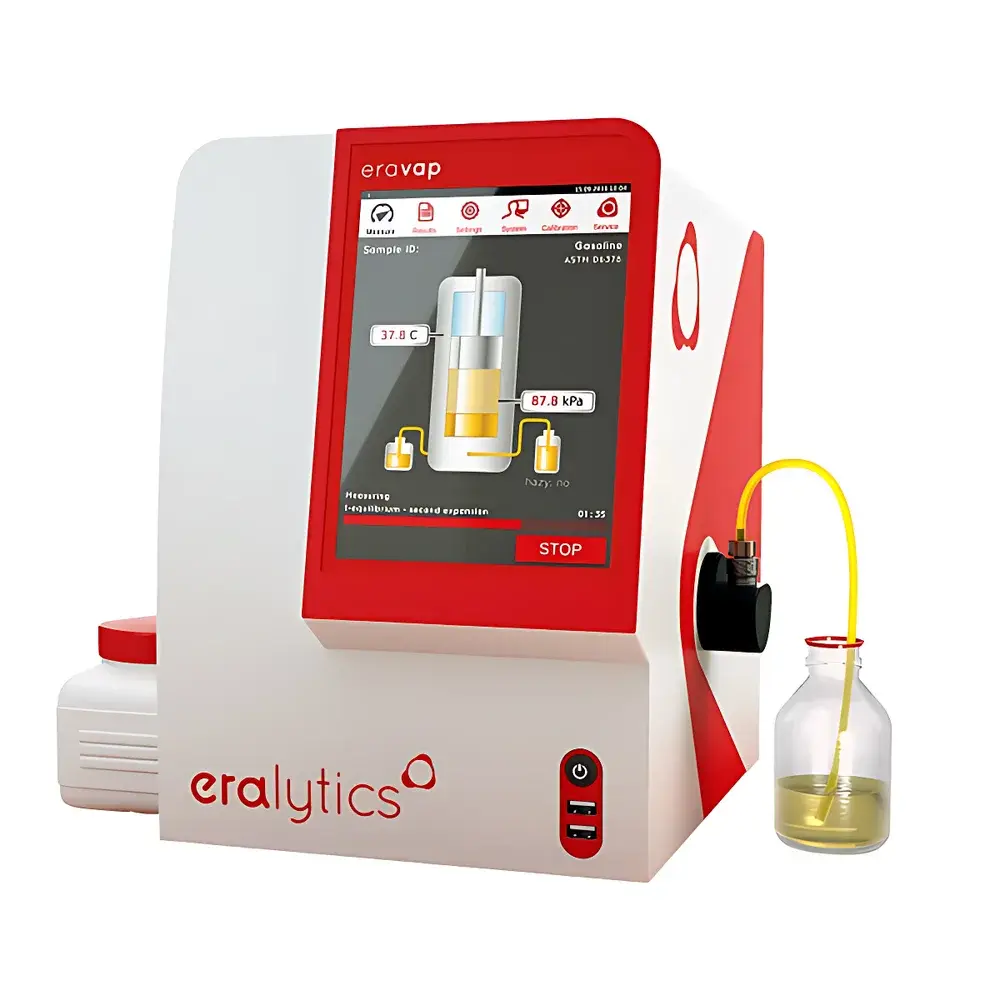
ERAVAP Automated Micro Vapor Pressure Analyzer by ERALYTICS
| Brand | ERALYTICS |
|---|---|
| Origin | Imported |
| Manufacturer Type | Authorized Distributor |
| Model | ERAVAP |
| Analysis Method | Three-Stage Expansion Method |
| Pressure Range | 0–2000 kPa |
| Temperature Range | −20–120 °C |
Overview
The ERALYTICS ERAVAP Automated Micro Vapor Pressure Analyzer is a precision-engineered instrument designed for the accurate, reproducible, and fully automated determination of vapor pressure of petroleum products—including gasoline, crude oil, liquefied petroleum gas (LPG), and distillates—according to globally recognized regulatory and standardization frameworks. It operates on the fundamental thermodynamic principle of equilibrium vapor pressure measurement via the three-stage expansion method, a technique rigorously validated for its ability to minimize phase separation artifacts and preserve sample integrity during rapid equilibration. Unlike conventional static or dynamic vapor pressure testers, the ERAVAP implements a patented piston-driven sequential expansion protocol that enables true thermodynamic equilibrium assessment under controlled isothermal conditions. This methodology forms the technical basis for ASTM D6378 (Standard Test Method for Determination of Vapor Pressure of Crude Oil: VPCRx) and ASTM D6377 (Standard Test Method for Determination of Vapor Pressure of Petroleum Products (Micro Method)), both of which are codified in U.S. EPA regulations (40 CFR Part 79, 58 Fed. Reg. 14478, March 17, 1993). The system is also compliant with ISO 3015, EN 13016-1, IP 394, IP 409, ASTM D5191, D4953, and D323, as well as SH/T 0769–2005—the Chinese national standard for vapor pressure testing of crude oil.
Key Features
- Patented three-stage piston expansion technology ensures high-fidelity vapor–liquid equilibrium (VLE) establishment with minimal sample disturbance and no requirement for pre-conditioning or degassing.
- True micro-volume operation: single test consumes only 1 mL of sample; total fluidic volume per cycle (including cleaning) is 2.2 mL—reducing hazardous waste generation and operational cost.
- Integrated oscillation module for homogenization of crude oil emulsions and asphaltene-stabilized suspensions prior to measurement—critical for representative TVP (True Vapor Pressure) and bubble point determination.
- Pure Sampling™ valve architecture eliminates carryover between analyses through positive-seal, low-dead-volume fluidic routing and automatic gas/liquid purge cycles.
- Configurable temperature control from −20 °C to 120 °C (with optional EV01-COOL cryo-module); thermal stability ±0.01 °C over full range.
- High-resolution pressure transduction with ±0.01 kPa accuracy across dual-range capability: 0–1000 kPa (standard) and 0–2000 kPa (LPG configuration).
- Adjustable gas-to-liquid ratio (0.02:1 to 100:1) supporting discrete-point, multi-point, and continuous pressure–temperature curve acquisition for thermodynamic modeling.
- Compact benchtop footprint (290 × 350 × 340 mm), lightweight design (9.7 kg), and DC power option (12 V / 4 A) enable deployment in mobile labs, refinery field stations, and QA/QC environments with space or infrastructure constraints.
Sample Compatibility & Compliance
The ERAVAP is validated for use with volatile hydrocarbon matrices including reformulated gasoline, oxygenated blends, naphthas, light crudes, condensates, and LPG fractions. Its compliance portfolio covers statutory requirements for fuel certification (EPA Tier 3, EU Fuel Quality Directive 2009/30/EC), refinery process control (ASTM D86, D1160 correlation support), and custody transfer verification (API RP 2570). All firmware and data handling protocols adhere to GLP and GMP principles, with full audit trail functionality—including timestamped alarm logs, operator ID tagging, and event-driven metadata capture—designed to meet FDA 21 CFR Part 11 electronic record and signature requirements when integrated into regulated laboratory information management systems (LIMS).
Software & Data Management
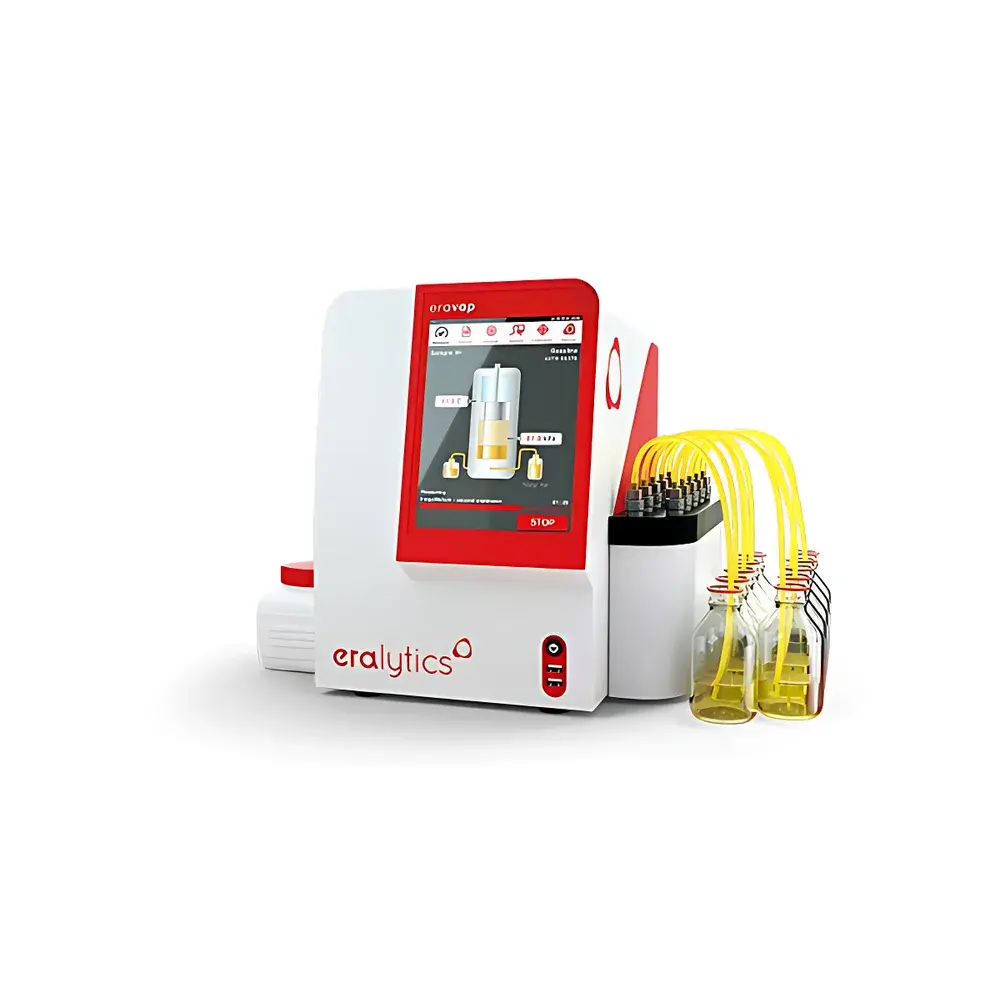
The ERAVAP runs on embedded Linux-based firmware with an intuitive 8.4-inch capacitive touchscreen interface (English-language UI available). Measurement data—including raw pressure–time curves, equilibrium values, temperature profiles, and diagnostic flags—are stored locally in a relational database capable of retaining >100,000 test records. Export formats include CSV (for statistical analysis in Excel or R) and PDF (for certified reports with digital signatures). Connectivity options include Ethernet (TCP/IP), RS-232, dual USB ports (front/rear), and LAN-based LIMS integration. Remote diagnostics and software updates are supported via secure SSH tunneling. Optional ten-position autosampler (ERASAM-10) extends throughput for unattended batch analysis of crude or LPG samples using floating-piston sample cylinders.
Applications
- Determination of Reid Vapor Pressure (RVP), True Vapor Pressure (TVP), and Bubble Point Pressure (BPP) for crude assay and blending optimization.
- Regulatory compliance testing for gasoline volatility specifications (e.g., seasonal RVP limits per EPA 40 CFR §80.27).
- Process monitoring of stabilization units, fractionators, and flash drums in upstream and midstream operations.
- Research-grade vapor–liquid equilibrium (VLE) characterization for equation-of-state (EOS) model validation (e.g., Peng–Robinson, SRK).
- Quality assurance of LPG composition (propane/butane ratios) and vapor pressure consistency across storage and transport cycles.
FAQ
What regulatory standards does the ERAVAP satisfy?
The ERAVAP complies with ASTM D6377, D6378, D5191, D4953, D323; EN 13016-1; IP 394, IP 409; ISO 3015; and SH/T 0769–2005. It is referenced in U.S. EPA 40 CFR Part 79 and accepted for regulatory submissions under federal fuel programs.
Can the ERAVAP measure crude oil without sample preparation?
Yes—its integrated oscillation module homogenizes crude samples in situ, eliminating centrifugation, filtration, or heating steps required by conventional methods.
Is remote maintenance and calibration verification supported?
Yes—Ethernet connectivity enables secure remote access for firmware updates, diagnostic logging, and real-time sensor health monitoring by authorized service engineers.
What is the minimum sample volume required per test?
Only 1 mL of liquid sample is consumed per analysis; total fluidic usage per cycle (including automated gas/liquid purge) is 2.2 mL.
Does the system support audit-trail compliance for regulated laboratories?
Yes—full electronic record retention includes operator ID, timestamped alarms, parameter change history, and immutable result export—fully aligned with 21 CFR Part 11 and ALCOA+ data integrity principles.





