
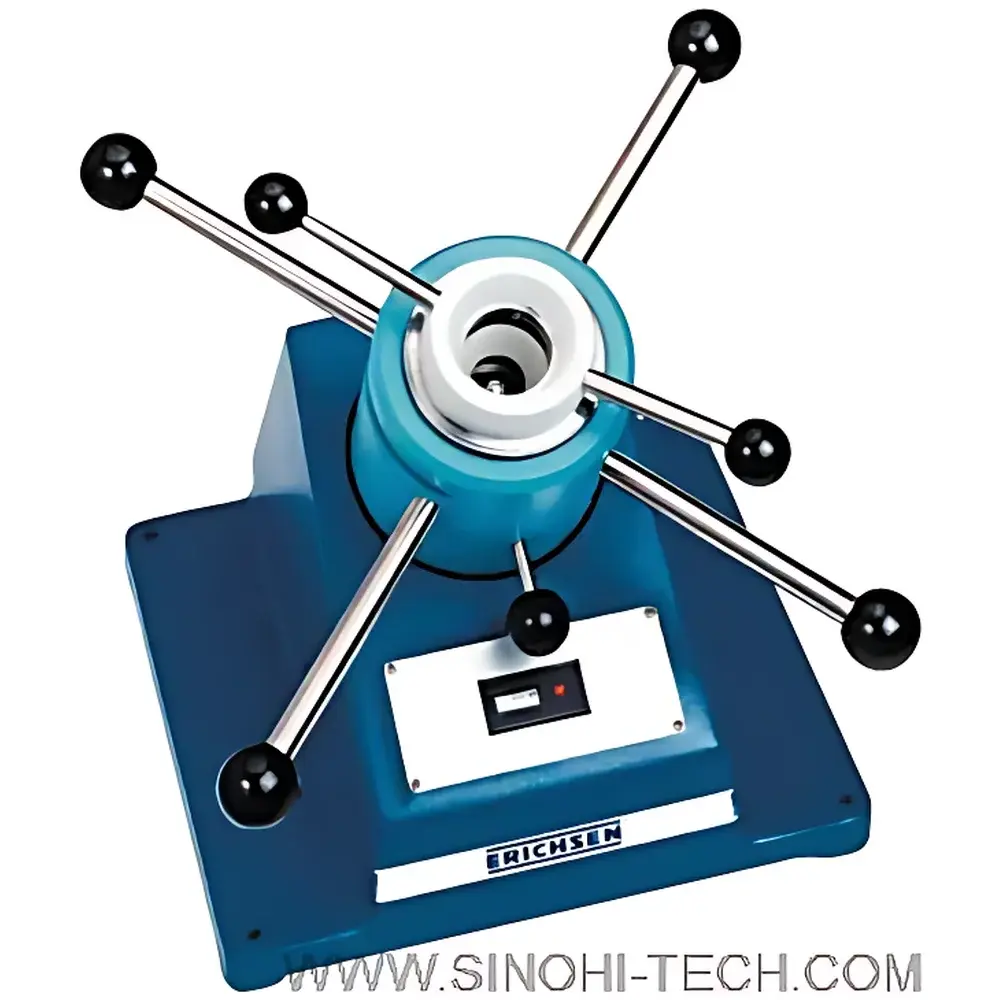
Erichsen #200 Manual Erichsen Cupping Tester
| Origin | Germany |
|---|---|
| Manufacturer Type | Authorized Distributor |
| Origin Category | Imported |
| Model | #200 |
| Pricing | Upon Request |
Overview
The Erichsen #200 Manual Erichsen Cupping Tester is a precision-engineered benchtop instrument designed to evaluate the ductility, adhesion, and cohesive integrity of organic coatings—such as lacquers, paints, plastic coatings, and vitreous enamels—applied to metallic substrates. Based on the standardized Erichsen cupping principle (a form of controlled biaxial stretching), the device deforms a flat coated metal specimen using a spherical punch (8 mm diameter) until coating failure occurs—manifested as cracking, flaking, or delamination. The depth of indentation at failure—measured in millimeters—is the primary quantitative metric, directly correlating with coating flexibility, substrate bonding strength, and resistance to mechanical deformation during forming or service. This test method is fundamentally rooted in ISO 1520 (identical to DIN ISO 1520, BS 3900-E4, NF T 30-019, and SIS 18 41 77), ensuring global comparability and regulatory acceptability in quality assurance workflows across automotive, appliance, and coil-coating industries.
Key Features
- Robust cast-iron frame with vertical column-mounted test head for high mechanical stability and minimal deflection during loading
- Manually operated lever-and-gear mechanism enabling precise, repeatable displacement control without external power supply
- Digital depth indicator with 0.1 mm resolution, directly mounted on the punch carriage for real-time, parallax-free reading
- Adjustable clamping system accommodating specimen widths of 70–90 mm (standard) or 30–60 mm (optional narrow-specimen kit)
- Integrated visual observation window beneath the die support plate, facilitating real-time monitoring of crack initiation and propagation in the coating layer
- Modular accessory compatibility—including Erichsen Test Tool No. 27 (spare punch/die set), narrow-specimen handling kit (Order No. 0001.01.32), and 10× illuminated stereo microscope (Order No. 540140341) for high-magnification failure analysis
Sample Compatibility & Compliance
The #200 tester accepts flat, rectangular metallic specimens with yield strength up to 400 N/mm² and thickness ≤1.25 mm. Standard specimen dimensions are 70–90 mm wide × ≥100 mm long; optional tooling supports narrower samples (30–60 mm width). Coated surfaces must be free of edge defects and uniformly applied. The instrument fully complies with ISO 1520:2016 (“Paints and varnishes — Determination of cupping resistance by the Erichsen test”), including requirements for punch geometry (R4 mm spherical tip), die aperture (20 mm diameter), and loading rate consistency (manual operation inherently satisfies the standard’s non-dynamic displacement stipulation). It is routinely deployed in GLP-compliant laboratories and supports audit-ready documentation when used alongside traceable calibration artifacts and controlled environmental conditions (23 ± 2 °C, 50 ± 5 % RH per ISO 2812-1).
Software & Data Management
As a purely mechanical, analog-operated tester, the #200 does not incorporate embedded electronics or digital data logging. All measurements are recorded manually from the digital counter and documented in laboratory notebooks or LIMS-integrated spreadsheets. For laboratories requiring electronic records compliant with FDA 21 CFR Part 11 or EU Annex 11, users may integrate external USB-digital calipers or vision-based measurement systems (e.g., calibrated CCD imaging with image-analysis software) to capture and timestamp indentation depth values. Calibration verification follows ISO/IEC 17025 guidelines, with annual verification against certified gauge blocks traceable to national metrology institutes (e.g., PTB, UKAS).
Applications
- Quality control of coil-coated steel and aluminum for architectural cladding and HVAC components
- Routine screening of automotive primer-surfacer-topcoat systems prior to stamping validation
- Comparative evaluation of crosslink density in thermosetting acrylic and polyester coatings
- Supplier qualification testing for enamel-coated cookware and industrial appliances
- Research into coating-substrate interfacial mechanics under biaxial strain states
- Failure analysis root-cause investigations following field adhesion loss or blistering incidents
FAQ
What standards does the Erichsen #200 comply with?
ISO 1520:2016, DIN ISO 1520, BS 3900-E4, NF T 30-019, and SIS 18 41 77.
Can it test specimens thicker than 1.25 mm?
No—the maximum supported substrate thickness is strictly 1.25 mm, as defined by ISO 1520 for valid cupping interpretation.
Is the 8 mm punch replaceable?
Yes; spare punches and matching dies are available as Erichsen Test Tool No. 27 (Order No. 0004.01.32).
Does the instrument require electrical power?
No—it operates entirely via manual rotation of the handle; no electricity, air, or hydraulic supply is needed.
How is measurement repeatability ensured?
Through rigid cast-iron construction, zero-backlash gear train, consistent operator technique training, and routine verification using certified depth standards.
Related Products



