
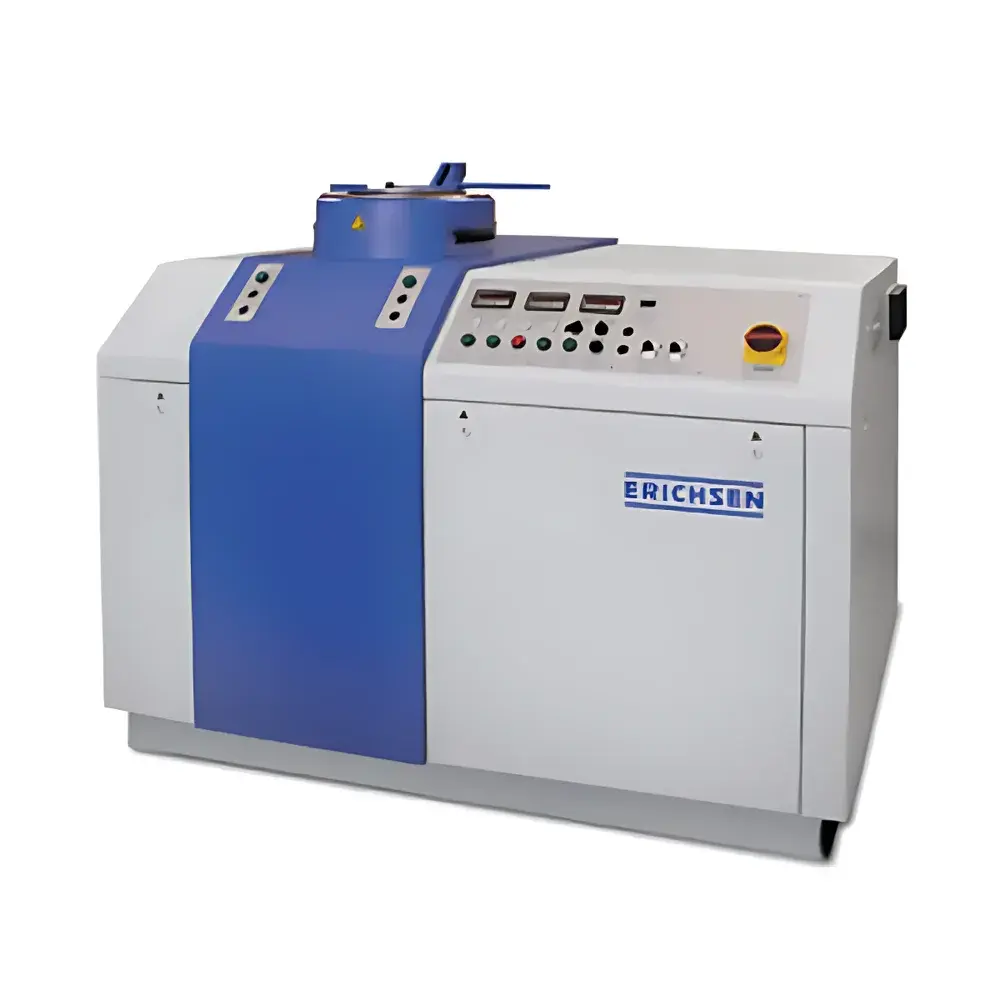
ERICHSEN Model 145-60/100 Automatic Sheet Metal Forming Testing Machine
| Brand | ERICHSEN |
|---|---|
| Origin | Germany |
| Model | 145-60 / 145-100 |
| Maximum Punch Force | 600 kN / 1000 kN |
| Maximum Blank Holder Force | 600 kN / 1000 kN |
| Maximum Shearing Force | 700 kN / 1000 kN |
| Max. Punch Diameter | 100 mm |
| Max. Stroke | 150 mm (250 mm optional) |
| Blank Holder Stroke | 38 mm |
| Ejection Stroke | 150 mm |
| Max. Specimen Diameter | 220 mm |
| Punch Speed | up to 750 mm/min |
| Cupping Test Thickness Range | 0.1–6.0 mm |
| Deep Drawing Thickness Range | 0.2–3.0 mm (up to 6.0 mm for 145-100) |
| Hole Expansion Thickness Range | 0.2–3.0 mm |
| Operating Temperature | up to 550 °C (high-temp module available) |
| Control Mode | Manual & PC-based real-time control |
| Safety Compliance | EN ISO 13857, EN 692 |
Overview
The ERICHSEN Model 145-60/100 is a fully automatic, high-capacity sheet metal forming testing machine engineered for precision mechanical characterization of metallic thin sheets and strips under complex deformation regimes. Based on the fundamental principles of uniaxial and biaxial plastic deformation, this system enables standardized and non-standardized evaluation of formability, strain localization, fracture initiation, and lubrication performance across a wide spectrum of industrial materials—including cold-rolled steels, aluminum alloys, stainless grades, coated substrates, and advanced high-strength steels (AHSS). Its dual-force configuration (600 kN and 1000 kN variants) supports both routine quality control and advanced research applications, such as Forming Limit Curve (FLC) determination, bulge testing, and high-temperature deep drawing up to 550 °C. The machine’s rigid C-frame architecture, integrated hydraulic power unit, and servo-controlled blank holder system ensure exceptional force reproducibility and positional accuracy—critical for compliance with ASTM E2234, ISO 12004-2, ISO 20482, and EN 10162.
Key Features
- Two configurable force ratings: Model 145-60 (600 kN punch / 600 kN blank holder) and Model 145-100 (1000 kN punch / 1000 kN blank holder), enabling scalability from laboratory validation to full-scale production qualification.
- High-precision hydraulic blank holder with real-time pressure regulation, essential for controlled strain path experiments including reverse draw, counter-pressure deep drawing, and FLC mapping.
- Modular tooling interface supporting standardized Erichsen cupping dies (ISO 20482), Olsen-type cups, Swift specimens, Fukui test fixtures, Engelhardt setups, LDH (Limit Dome Height) tooling, and custom-designed punches up to 100 mm diameter.
- Integrated digital control panel displaying real-time values for punch force, blank holder force, punch velocity, and stroke position—traceable via timestamped data logging.
- Optional high-speed actuation package extending punch velocity to 30 mm/min for dynamic strain-rate studies, and high-temperature furnace module rated to 550 °C for hot-forming simulation.
- Comprehensive safety architecture compliant with EN ISO 13857 (safety distances) and EN 692 (hydraulic press safety), featuring light curtains, emergency stop circuits, and interlocked guarding.
Sample Compatibility & Compliance
The Model 145-60/100 accommodates flat sheet specimens up to 220 mm in diameter and thicknesses ranging from 0.1 mm (for cupping) to 6.0 mm (deep drawing, 145-100 variant). It supports material classes including bare and pre-coated steel, aluminum-magnesium alloys, titanium foils, and multi-layer welded blanks (tailor-welded or patchwork configurations). All test methods align with internationally recognized standards: Erichsen cupping per ISO 20482 and ASTM E643; deep drawing per ISO 11531; hole expansion per ISO 16630; bulge testing per ISO 16808; and FLC generation per ISO 12004-2 Annex B. For regulated environments, the system supports audit-ready data export and optional 21 CFR Part 11-compliant software modules with electronic signatures and change control logs.
Software & Data Management
ERICHSEN’s proprietary FORMTEST software provides synchronized acquisition of force-displacement curves, real-time blank holder load feedback, and automated calculation of key metrics—including cup height, dome height, fracture strain, and localized thinning. Raw data is exported in CSV and XML formats compatible with MATLAB, Python (NumPy/Pandas), and commercial CAE platforms (e.g., LS-DYNA, AutoForm, PAM-STAMP). The software includes built-in templates for ASTM, ISO, and VDA-compliant reporting, with configurable pass/fail thresholds and statistical process control (SPC) charts. Optional GLP/GMP modules enable user access management, instrument calibration tracking, and full audit trail generation for laboratory accreditation (ISO/IEC 17025).
Applications
- Determination of Forming Limit Curves (FLCs) for AHSS grade certification and stamping line feasibility analysis.
- Evaluation of coating adhesion and crack resistance during cupping of painted or galvanized steel sheets (Erichsen Paint Test).
- Quantification of lubricant performance under varying contact pressures and sliding velocities using standardized friction test inserts.
- Characterization of anisotropic behavior via directional cupping and Swift tests across rolling, transverse, and diagonal orientations.
- High-temperature deep drawing simulation for hot-stamping process development (e.g., 22MnB5 at 550 °C).
- Validation of finite element models through direct correlation of experimental load-stroke curves with simulated outputs.
- Quality assurance of laser-welded blanks (LWBs) and resistance spot-welded assemblies using modified cupping geometries.
FAQ
What standards does the ERICHSEN Model 145-60/100 support?
It complies with ISO 20482 (Erichsen cupping), ISO 12004-2 (FLC), ISO 16630 (hole expansion), ISO 16808 (bulge testing), ASTM E643, ASTM E2234, and EN 10162 for sheet metal classification.
Can the system perform tests above room temperature?
Yes—optional high-temperature furnace modules enable deep drawing and cupping tests up to 550 °C, with thermocouple-integrated tooling and thermal drift compensation algorithms.
Is the machine suitable for testing tailor-welded blanks (TWBs)?
Yes—the 220 mm specimen capacity and programmable blank holder force profile allow reliable cupping and FLC testing of multi-material welded configurations.
How is data traceability ensured for regulated industries?
With optional 21 CFR Part 11 software, users obtain electronic signatures, immutable audit trails, role-based access control, and calibrated instrument metadata embedded in every exported dataset.
What maintenance intervals are recommended?
Hydraulic fluid analysis every 12 months, blank holder seal inspection every 6 months, and annual calibration of load cells and displacement transducers per ISO 376 and ISO 7500-1.



