
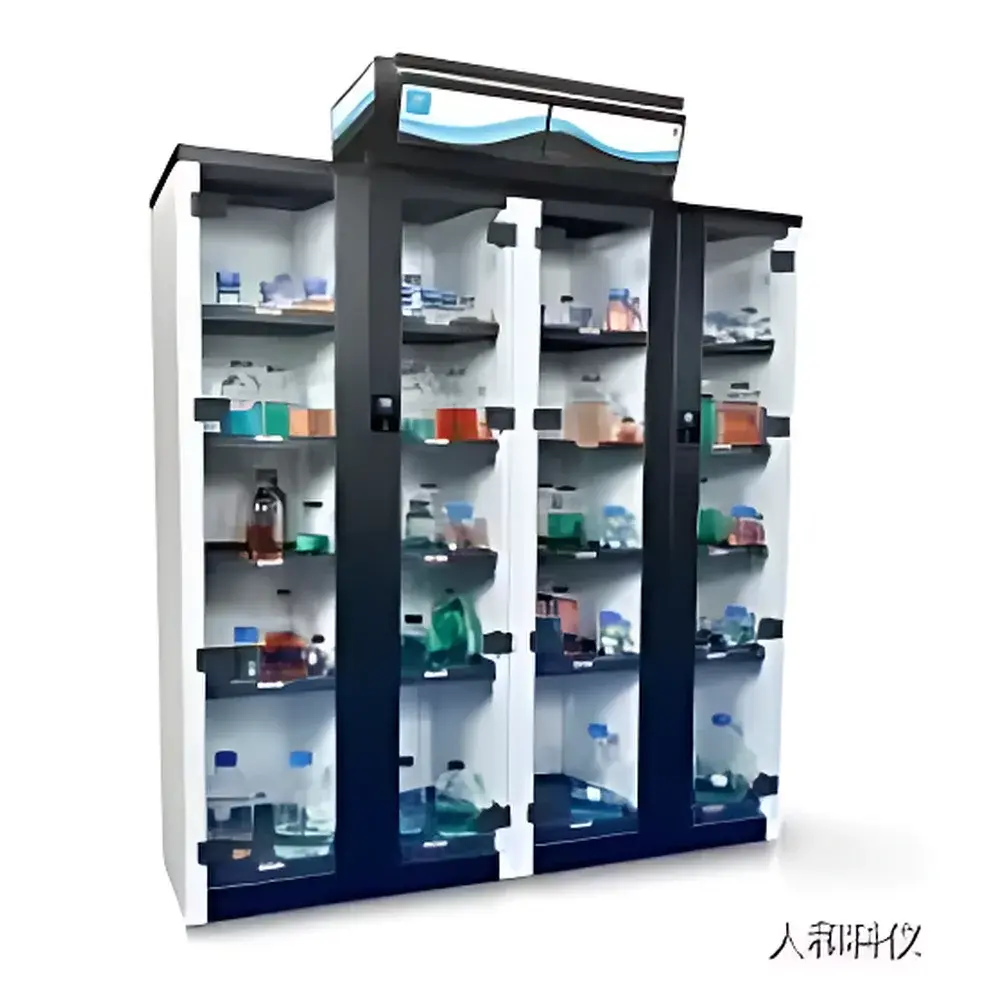
Erlab Captair 1634 Smart Plug-in Air-Scrubbing Chemical Storage Cabinet
| Brand | Erlab |
|---|---|
| Origin | France |
| Model | Captair 1634 Smart |
| Dimensions (L×W×H) | 1802 × 530 × 2172–2358 mm |
| Airflow Capacity | 220 m³/h |
| Input Voltage/Frequency | 100–240 V AC, 50–60 Hz |
| Internal Circuit | 24 V DC |
| Cabinet Material | Chemically resistant transparent polypropylene panels + acid-resistant polymer-coated galvanized steel |
| Filter Frame Material | Polypropylene (PP) |
| Filtration Technology | Patented modular dual-layer filter system (primary + safety filter) |
| Filter Types | GF4 BE+ (organic & inorganic vapors), GF4 AS (organic vapors only), GF4 F (formaldehyde), GF4 K (ammonia), GF4 HP (HEPA H14/U17 particulates per EN 1822:1998) |
| Compliance | JG/T 385–2012 (China), ANSI Z9.5–2012 (USA), AFNOR NF X 15-211:2009 (France), SEFA 9 (USA), BS 7989 (UK), DIN 12927 (Germany), CE marked |
| Safety Certification Reports | TÜV SÜD (formerly Intertek) test report per NF X 15-211, SGS report per SEFA 9, Tongji University report per JG/T 385–2012 |
| Face Velocity Monitoring | Integrated electronic anemometer |
| Filter Saturation Detection | Molecode® S (organics), Molecode® A (inorganics), Molecode® F (formaldehyde) |
| Exhaust Air Quality | Residual chemical concentration < 1% of OSHA/ACGIH TLV–TWA values |
| eGuard Remote Monitoring | Real-time status, configuration, audit log, push alerts via iOS/Android/web |
| Security | Dedicated access lock system |
| Storage Configurations | Open-front or 1–4 sliding doors |
Overview
The Erlab Captair 1634 Smart is a certified plug-in air-scrubbing chemical storage cabinet engineered for continuous, recirculating purification of laboratory air during the safe containment and storage of hazardous chemicals. Unlike ducted fume hoods or passive cabinets, the Captair 1634 Smart employs a closed-loop, forced-air filtration architecture based on validated adsorption kinetics and laminar airflow management. Air is drawn through the storage compartment at a controlled face velocity (monitored in real time), passed sequentially through a primary high-capacity activated carbon or HEPA/ULPA filter module, then through a redundant safety filter positioned upstream of the fan assembly — ensuring zero breakthrough even during primary filter saturation. This dual-stage, fail-safe filtration design complies with international performance benchmarks for chemical containment, including ISO/IEC 17025-aligned validation protocols and the stringent adsorption capacity thresholds defined in AFNOR NF X 15-211 and JG/T 385–2012. The cabinet operates independently of building HVAC infrastructure, eliminating ductwork costs and enabling flexible deployment in laboratories, cleanrooms, pharmacy preparation areas, and quality control suites.
Key Features
- Patented dual-layer modular filtration system: Primary filter (e.g., GF4 BE+, GF4 F) + integrated safety filter (same media type), both housed in PP frames for corrosion resistance and rapid field replacement.
- Real-time face velocity monitoring via embedded electronic anemometer, compliant with ANSI Z9.5–2012 and SEFA 9 requirements for dynamic airflow verification.
- Intelligent status indication via RGB LED halo ring: Steady glow = nominal operation; pulsing patterns + distinct audible tones (1–3 beeps) indicate specific fault conditions — fan failure, door ajar, low face velocity, or filter saturation.
- Molecode® intelligent saturation detection: Chemoselective sensor modules (Molecode S/A/F/K) provide quantitative, compound-specific end-of-service-life alerts based on breakthrough modeling — not generic time-based estimates.
- eGuard cloud-connected software platform: Enables remote monitoring (iOS, Android, web), firmware updates, configuration changes, and full audit-trail logging — supporting FDA 21 CFR Part 11-compliant record retention when deployed with appropriate IT governance.
- Structural integrity: Cabinet shell constructed from UV-stabilized transparent polypropylene and acid-resistant polymer-coated galvanized steel, rated for long-term exposure to solvents, acids, bases, and aldehydes.
Sample Compatibility & Compliance
The Captair 1634 Smart accommodates diverse chemical forms — volatile organic compounds (VOCs), inorganic acids (e.g., HCl, HNO₃), formaldehyde, ammonia, and fine particulates — through interchangeable, application-optimized filter cartridges. Each GF4-series filter is validated against >600 substances listed in the Erlab Chemical Compatibility Handbook, with adsorption capacities reported at the 1% TLV–TWA breakthrough threshold. Independent third-party certification confirms compliance with JG/T 385–2012 (China), AFNOR NF X 15-211:2009 (France), ANSI Z9.5–2012 (USA), SEFA 9 (North America), BS 7989 (UK), and DIN 12927 (Germany). All HEPA/ULPA variants meet EN 1822:1998 (H14/U17 classification), and electrical safety conforms to IEC 61000-6-3/6-4. Full traceability is provided via test reports from TÜV SÜD (formerly Intertek), SGS, and Tongji University.
Software & Data Management
The eGuard platform delivers secure, role-based access to real-time cabinet telemetry: fan RPM, face velocity, cumulative runtime, filter loading status, and event logs. Configuration parameters — such as alarm thresholds, notification preferences, and user permissions — are adjustable remotely. All data transmissions use TLS 1.2 encryption; local storage retains 90 days of operational history. When integrated into enterprise laboratory information management systems (LIMS) or environmental health & safety (EHS) dashboards, eGuard supports GLP/GMP-aligned workflows, including electronic signatures, change control tracking, and automated report generation for internal audits or regulatory inspections.
Applications
This cabinet is deployed where persistent chemical vapor exposure poses occupational risk: analytical chemistry labs storing GC/MS solvents; pharmaceutical QC labs handling reference standards and cytotoxic agents; university research facilities managing legacy reagent inventories; hospital pharmacies preparing sterile admixtures; and industrial R&D centers handling catalysts and monomers. Its recirculating operation reduces HVAC load by up to 85% versus ducted alternatives, while maintaining air quality below 1% of permissible exposure limits — critical for chronic exposure mitigation per ACGIH TLV guidelines.
FAQ
How does the dual-filter architecture prevent chemical breakthrough?
The primary filter captures >99.99% of target contaminants under rated airflow; the secondary safety filter — identical in composition and installed upstream of the fan — remains inert until primary saturation, then immediately assumes full duty without airflow interruption.
Can filter saturation be predicted for mixed chemical exposures?
Yes. Molecode® sensors apply multi-analyte kinetic models derived from ASTM D5228 and ISO 10121 test methods, adjusting saturation forecasts dynamically based on real-time concentration profiles and co-adsorption interference factors.
Is eGuard compatible with existing IT security policies?
Yes. It supports SAML 2.0 single sign-on, LDAP/Active Directory integration, and configurable data residency (EU-hosted instances available). Audit logs include ISO/IEC 27001-aligned metadata: timestamp, user ID, action type, and IP origin.
What maintenance documentation is supplied?
Each unit ships with a factory calibration certificate, filter installation guide, Molecode® sensor validation report, and a digital copy of the Erlab Chemical Compatibility Handbook — updated biannually and accessible via QR code on the cabinet label.
Does the cabinet require annual third-party certification?
Per JG/T 385–2012 and AFNOR NF X 15-211, performance verification (face velocity, containment, filter efficiency) must be conducted annually by an accredited testing body — Erlab provides certified service partners in 28 countries to support this requirement.



