
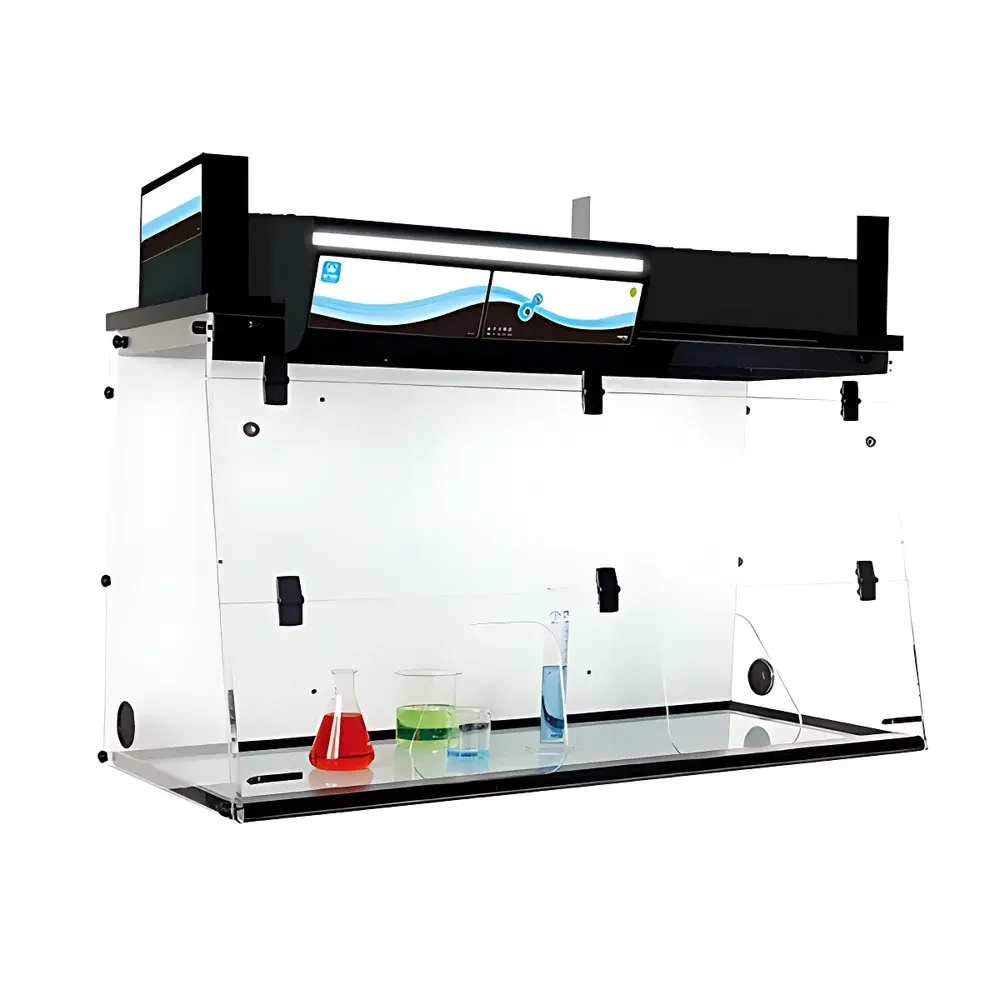
Erlab Captair 632 Smart Ductless Fume Hood
| Brand | Erlab |
|---|---|
| Origin | Jiangsu, China |
| Manufacturer Type | Authorized Distributor |
| Product Category | Domestic |
| Model | Captair 632 Smart |
| Price Range | USD 7,000–14,000 (FOB) |
| Construction Material | Polypropylene (PP) |
| Design Type | Ductless (Recirculating) Fume Hood |
| Air Intake Configuration | Make-up Air (Front-Intake) |
| Primary Application | Chemical Handling |
| Exhaust Position | Top Exhaust |
| Ducting | None Required |
| Dimensions (W×D×H) | 1606 mm × 615 mm × 1107–1289 mm (adjustable sash height) |
| Average Face Velocity | 0.4–0.6 m/s |
| Airflow Volume | 440 m³/h |
| Lighting | Integrated LED Tubes |
| Rated Power | 125 W |
| Net Weight | 55.7 kg |
| User Capacity | 1–2 Operators |
Overview
The Erlab Captair 632 Smart is a certified ductless fume hood engineered for precision chemical containment and operator safety in modern laboratories where infrastructure constraints or sustainability goals preclude traditional ducted exhaust systems. It operates on the principle of active recirculation: ambient laboratory air is drawn across the work surface at a controlled face velocity (0.4–0.6 m/s), passed through a multi-stage, application-specific filtration system, and returned to the room as purified air. This closed-loop design eliminates external ductwork while maintaining rigorous performance compliance with international standards—including ANSI/ASHRAE Z9.5-2012 (USA), AFNOR NFX 15-211 (France), and JG/T 385-2012 (China)—for Class I and Class II chemical containment. The unit integrates Erlab’s proprietary ESP (Erlab Safety Protocol), a documented safety framework encompassing suitability assessment, operational certification, and usage traceability—supporting GLP/GMP-aligned lab practices and facilitating internal audits.
Key Features
- Modular, field-replaceable filter cartridges optimized for targeted capture of organic vapors, inorganic acids, aldehydes (e.g., formaldehyde), and particulates—including mixed-phase hazards.
- Real-time saturation monitoring via integrated electrochemical sensors: independent alarms trigger for activated carbon exhaustion (organics), impregnated alumina depletion (acids), and formaldehyde-specific media saturation.
- Dual-filter redundancy: a secondary safety filter remains active after primary filter saturation, providing continued protection during scheduled maintenance windows.
- Digital anemometer with continuous face velocity logging—calibrated per ISO 10793-1—and visual/audible alerts for deviations beyond ±10% of setpoint.
- Smart status ring illumination system: color-coded LED halo indicates operational mode (green = normal), filter saturation (amber), airflow anomaly (red flash), or fan failure (rapid red pulse).
- Adjustable sash height (1107–1289 mm) with smooth counterbalanced mechanism and ergonomic stop positions; full-height sash provides unobstructed visibility and access.
- Energy-efficient DC motor-driven blower (125 W rated power) reduces annual operating costs by up to 65% versus comparable ducted hoods requiring HVAC makeup air conditioning.
Sample Compatibility & Compliance
The Captair 632 Smart is validated for routine use with low-to-moderate volatility chemicals, including acetone, ethanol, hydrochloric acid (≤37%), nitric acid (≤65%), formaldehyde solutions (200 °C boiling point). All filter configurations undergo third-party testing per EN 14175-3 and ANSI Z9.5 Annex D for breakthrough time, efficiency retention, and pressure drop stability. Unit certification documentation includes test reports for each installed filter module, traceable to batch numbers and expiration dates—supporting FDA 21 CFR Part 11-compliant electronic recordkeeping when integrated with Erlab’s CloudConnect platform.
Software & Data Management
The Captair 632 Smart embeds Erlab’s CloudConnect firmware, enabling secure TLS 1.2–encrypted remote access via web dashboard or mobile app. Logged parameters include cumulative runtime, total airflow volume, face velocity history (sampled every 30 seconds), filter saturation trends, and alarm event timestamps with severity classification. Audit trails are immutable and exportable as CSV/PDF for regulatory review. Optional integration with laboratory information management systems (LIMS) supports automated work order generation upon filter expiry or alarm escalation—aligning with ISO/IEC 17025 Clause 7.9 (nonconforming work) and CAP accreditation requirements.
Applications
This hood serves analytical chemistry labs performing routine titrations, sample preparation, and reagent dispensing; QC/QA environments handling raw material verification and stability testing; teaching laboratories requiring flexible, relocatable containment; and R&D facilities conducting early-stage synthesis where chemical profiles evolve frequently. Its PP construction ensures resistance to corrosion from acidic and alkaline splashes, while the compact footprint (1.6 m width) enables installation in retrofit spaces, mobile labs, or modular cleanrooms without structural modification.
FAQ
What filter types are certified for use with the Captair 632 Smart?
Erlab supplies four CE-marked, ISO 14644-1 Class 5–certified filter modules: Organic Vapor (OV), Inorganic Acid (IA), Formaldehyde (FA), and Particulate (PT). Mixed-hazard applications require dual-cartridge configurations (e.g., OV+IA), validated per EN 14175-3.
Can this unit be used for perchloric acid digestion?
No. Perchloric acid, hot concentrated phosphoric acid, and other oxidizing agents generating explosive residues are strictly prohibited due to fire and explosion risk in recirculating systems.
How often must filters be replaced?
Replacement intervals depend on usage intensity and chemical load. Typical service life ranges from 6–12 months for organic vapor filters under moderate use (≤2 hrs/day, <100 mL/hr solvent evaporation); real-time sensor data determines exact timing.
Is third-party validation required before commissioning?
Yes. Erlab mandates initial performance verification by an accredited technician per ANSI Z9.5 Section 6.2—including face velocity mapping, tracer gas containment test (SF₆), and filter integrity check—prior to first use.
Does the unit support integration with building management systems (BMS)?
Via optional Modbus RTU or BACnet MS/TP gateway, the Captair 632 Smart can relay status signals (fan on/off, alarm state, filter life %) to centralized BMS platforms for facility-wide energy and safety monitoring.



