
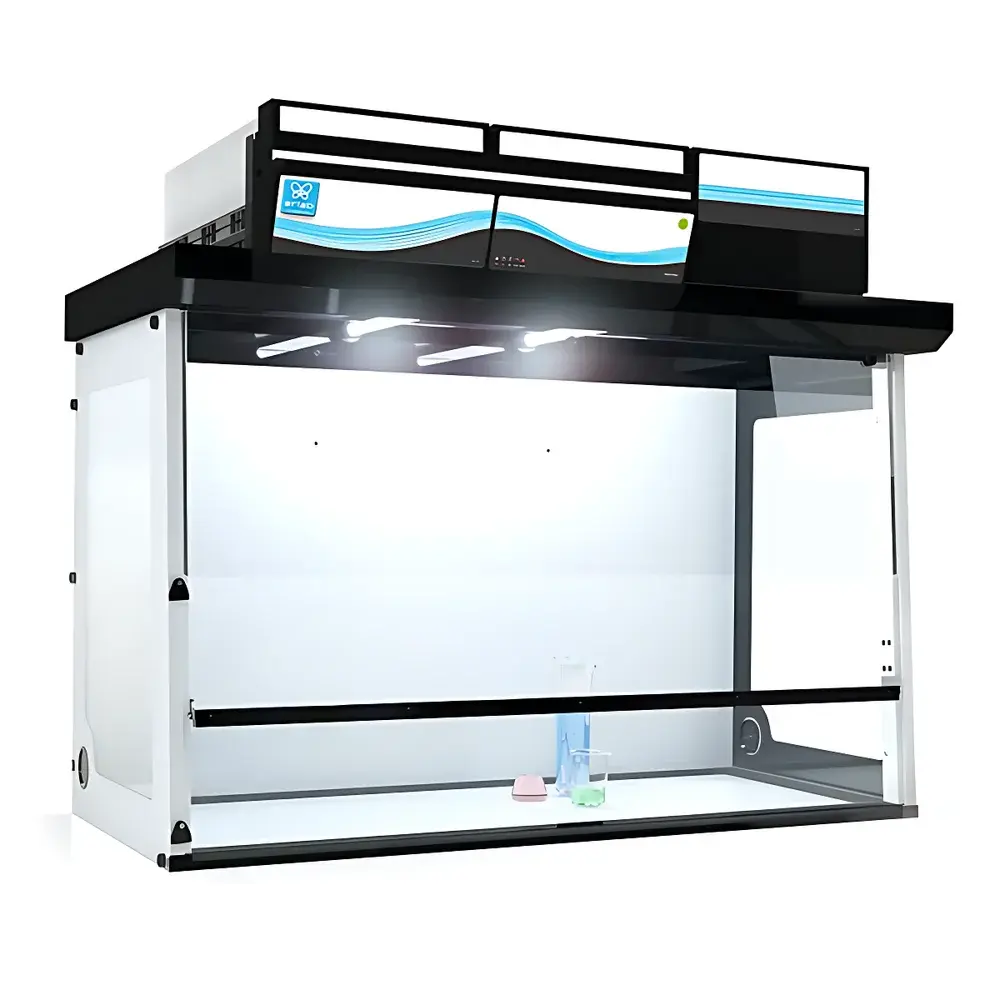
Erlab Captair 633 Smart Ductless Fume Hood
| Brand | Erlab |
|---|---|
| Origin | Jiangsu, China |
| Manufacturer Type | Authorized Distributor |
| Country of Origin | China |
| Model | Captair 633 Smart |
| Price Range | USD 7,000–14,000 (FOB) |
| Cabinet Material | Polypropylene (PP) |
| Type | Ductless (Recirculating) Fume Hood |
| Air Intake Configuration | Compensated (Make-up Air) Design |
| Primary Application | Chemical Handling |
| Ducting | None Required |
| Dimensions (W × D × H) | 1620 mm × 751 mm × 1332–1518 mm (adjustable sash height) |
| Average Face Velocity | 0.4–0.6 m/s |
| Airflow Volume | 660 m³/h |
| Lighting | Integrated LED Tubes |
| Rated Power | 160 W |
| Net Weight | 80.9 kg |
| User Capacity | 1–2 Operators |
Overview
The Erlab Captair 633 Smart is a high-performance ductless fume hood engineered for chemical containment and indoor air quality management in modern laboratories. Unlike conventional ducted hoods that exhaust conditioned air outdoors—imposing significant HVAC load—the Captair 633 Smart recirculates filtered air back into the laboratory environment after removing hazardous vapors and particulates via a multi-stage, application-tailored filtration system. Its operation relies on the principle of active carbon adsorption combined with optional particulate pre-filtration (e.g., HEPA or activated carbon impregnated filters), ensuring efficient removal of organic solvents, acids, bases, and low-concentration volatile compounds. Designed for compliance with international safety benchmarks—including SEFA 9 (2022), NF X15-211 (2017), BS 7989:2001, and JG/T 385–2012—the unit delivers consistent face velocity across its full sash range, maintaining operator protection under dynamic airflow conditions.
Key Features
- Modular, field-replaceable filter cartridges with real-time saturation monitoring via eGuard™ smart connectivity
- Adjustable sash height (1332–1518 mm) with smooth counterbalance mechanism and ergonomic stop positions
- Polypropylene (PP) construction providing broad chemical resistance to acids, bases, and halogenated solvents
- Compensated air intake design minimizing turbulence and ensuring stable face velocity (0.4–0.6 m/s) regardless of ambient room pressure fluctuations
- Integrated LED lighting (≥500 lux at work surface) with glare-free diffuser and energy-efficient driver
- eGuard™ IoT platform enabling remote status monitoring, filter life prediction, alarm notifications, and audit-ready usage logs
- No external ductwork required—reducing installation time, structural modifications, and long-term energy overhead from HVAC makeup air conditioning
Sample Compatibility & Compliance
The Captair 633 Smart is validated for use with low-to-moderate volatility chemicals commonly encountered in academic research, QC testing, and pharmaceutical formulation labs—including acetone, ethanol, methanol, hydrochloric acid (dilute), sodium hydroxide solutions, and formaldehyde (200 °C boiling point) without customized filtration. All units undergo factory-certified performance verification per ANSI/ASHRAE 110–2016 tracer gas containment testing (SF₆ method) and meet SEFA 9 Class I criteria for operator protection. Documentation supports GLP-compliant lab environments, including traceable calibration records, filter change logs, and eGuard™ data export compatible with 21 CFR Part 11–enabled LIMS integration.
Software & Data Management
The embedded eGuard™ firmware provides secure, encrypted Wi-Fi or Ethernet connectivity to local networks or cloud-based dashboards. Users access real-time metrics—including fan RPM, filter differential pressure, cumulative runtime, and estimated remaining service life—via web browser or mobile app. System-generated PDF reports support internal audits and regulatory inspections. Audit trails record all user-initiated actions (e.g., sash position changes, filter resets, alarm acknowledgments) with timestamp, IP address, and operator ID where configured. Data retention complies with ISO/IEC 27001-aligned storage policies; no raw sensor data is stored externally without explicit user consent.
Applications
- Chemical dispensing and dilution in analytical chemistry labs
- Weighing and preparation of reference standards under controlled atmosphere
- Small-scale synthesis and reaction monitoring involving volatile organics
- Sample preparation for GC, HPLC, and ICP-MS workflows
- Education labs requiring flexible, relocatable containment without infrastructure retrofitting
- Pharmaceutical R&D labs pursuing LEED certification or ISO 14001 environmental management alignment
FAQ
What types of chemicals can be safely handled in the Captair 633 Smart?
It is certified for common organic solvents, aqueous acids/bases (pH 2–12), and aldehydes at concentrations below occupational exposure limits (OELs). Consult Erlab’s Filter Selection Guide and conduct site-specific risk assessment prior to use with novel or mixed-stream vapors.
Does this unit require external exhaust ducting?
No. The Captair 633 Smart operates as a fully recirculating system—no ducting, roof penetrations, or dedicated exhaust fans are needed.
How often must filters be replaced?
Filter service intervals depend on usage intensity and chemical profile; typical replacement ranges from 6–18 months. eGuard™ provides predictive alerts based on cumulative airflow and adsorption modeling.
Can multiple units be managed centrally?
Yes. eGuard™ supports fleet-wide dashboard views, group-level alerts, and bulk firmware updates across heterogeneous Captair installations.
Is the unit compliant with U.S. OSHA or EU REACH requirements?
While not directly regulated under REACH or OSHA 1910.1450, its performance aligns with recognized engineering controls referenced in both frameworks—particularly when deployed as part of a comprehensive chemical hygiene plan.



