
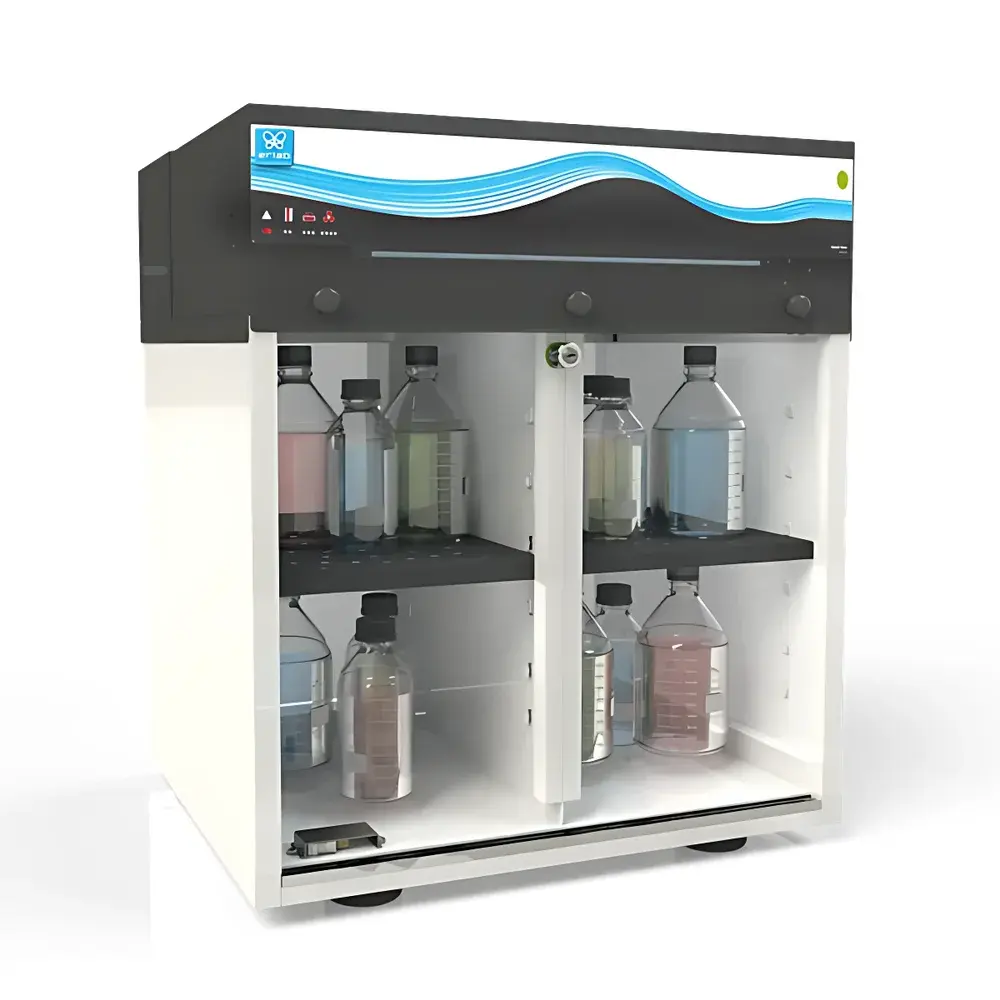
Erlab Captair 822 Smart Ductless Chemical Storage Cabinet
| Brand | Erlab |
|---|---|
| Model | Captair 822 Smart |
| Type | Ductless, Recirculating Chemical Safety Cabinet |
| Filtration Compliance | AFNOR NF X 15-211 (Class 1 & 2), ANSI Z9.5-2012, JG/T 385-2012 |
| Noise Level | ≤45 dB(A) |
| Installation Flexibility | Benchtop or Under-Bench |
| Airflow Monitoring | Real-time face velocity sensing with visual LED status ring |
| Remote Management | eGuard mobile/web application with push alerts |
| Filter Types | Activated carbon + HEPA (optional), modular configuration for vapors, particulates, or combined contaminants |
| Construction | Polypropylene-coated steel chassis, chemical-resistant interior surfaces |
| Power Supply | 100–240 V AC, 50/60 Hz |
Overview
The Erlab Captair 822 Smart is a certified ductless chemical storage cabinet engineered for safe, localized containment and purification of volatile organic compounds (VOCs), acidic vapors, and fine particulates during routine pharmaceutical, analytical, and quality control operations. Unlike traditional fume hoods requiring complex ductwork and facility exhaust infrastructure, the Captair 822 Smart operates on a closed-loop recirculation principle: ambient laboratory air is drawn through a dual-stage filtration system—comprising activated carbon media for adsorption of gaseous contaminants and optional HEPA-grade particulate filtration—and returned as purified air directly into the workspace. This design eliminates cross-contamination risks associated with shared exhaust systems while maintaining ISO 14644-1 Class 5 cleanroom-compatible air quality in proximity to the unit. Its compact footprint and flexible mounting options (benchtop or under-bench) support modular lab layout optimization without compromising safety integrity.
Key Features
- Intelligent real-time status monitoring via a 360° programmable LED status ring: steady glow indicates nominal operation; pulsing patterns correspond to specific fault conditions—including low face velocity, fan failure, filter saturation, or unsecured sash position.
- Modular filtration architecture supporting interchangeable filter cartridges: standard configuration includes high-capacity granular activated carbon for broad-spectrum VOC capture; optional HEPA+carbon hybrid modules address co-emitted aerosols and vapors per AFNOR NF X 15-211 Class 2 requirements.
- eGuard cloud-based platform enabling remote diagnostics, filter life tracking, alarm history logging, and customizable notification thresholds across iOS, Android, and desktop browsers—fully compliant with GLP audit trails and FDA 21 CFR Part 11 electronic record requirements when deployed with user authentication and event timestamping.
- Chemical-resistant construction: powder-coated galvanized steel frame with polypropylene-lined interior surfaces rated for resistance against common solvents (e.g., acetone, methanol, hydrochloric acid vapor) per ASTM D543-20 standards.
- Ultra-quiet operation at ≤45 dB(A) measured at 1 m distance—enabling deployment in open-plan laboratories, QC rooms, and controlled environments where acoustic disturbance must be minimized.
Sample Compatibility & Compliance
The Captair 822 Smart is validated for storage and handling of ICH Q5A-class reagents, USP reference standards, and GMP-grade excipients. Its filtration performance meets or exceeds the removal efficiency benchmarks defined in AFNOR NF X 15-211 (Class 1: ≥99.9% for 100 ppm ethyl acetate; Class 2: ≥95% for 10 ppm formaldehyde + 0.3 µm particulates), ANSI Z9.5-2012 Section 6.3.2 (face velocity stability ±10% over 0.3–0.5 m/s range), and JG/T 385-2012 Clause 5.4.2 (leak-tightness test pass at 100 Pa static pressure differential). The unit is CE-marked and certified to EN 14175-3:2021 for ductless laboratory cabinets. It supports routine validation protocols including tracer gas testing (SF₆ or CO₂), breakthrough curve analysis, and filter capacity mapping per ISO 10121-1:2013.
Software & Data Management
The eGuard software suite provides role-based access control, encrypted data transmission (TLS 1.2+), and immutable audit logs capturing all operational events—including filter replacement timestamps, airflow deviations, alarm acknowledgments, and firmware update histories. All records are exportable in CSV/PDF formats for inclusion in internal SOP documentation or external regulatory submissions (e.g., MHRA, EMA, NMPA inspection packages). Integration with laboratory information management systems (LIMS) is supported via RESTful API endpoints, enabling automatic synchronization of cabinet status with sample storage metadata.
Applications
This cabinet serves critical functions across pharmaceutical R&D labs (storage of cytotoxic APIs and genotoxic impurities), QC/QA departments (secure holding of reference standards prior to HPLC/GC analysis), environmental testing facilities (handling of EPA Method 8270 analytes), and public health institutions (safe containment of WHO-recommended disinfectants and diagnostic reagents). Its adaptability extends to semiconductor fabrication cleanrooms (acid vapor mitigation near wafer inspection stations), museum conservation labs (low-level VOC sequestration during artifact treatment), and food & beverage testing centers (odorant and flavor compound isolation).
FAQ
How often must the filters be replaced?
Filter service intervals depend on usage intensity and chemical load; typical replacement occurs every 6–12 months under standard pharmaceutical storage conditions. eGuard calculates remaining filter life using real-time airflow resistance metrics and historical concentration exposure profiles.
Can the Captair 822 Smart be used for storing flammable liquids?
No—it is not rated for Class I flammable liquid storage per NFPA 30 or OSHA 1910.106. For such applications, Erlab recommends the Captair Flow series with explosion-proof components and spark-resistant motors.
Is third-party certification available for validation purposes?
Yes. Erlab provides factory-issued Certificate of Conformance (CoC) and optional IQ/OQ documentation packages aligned with Annex 15 of the EU GMP Guidelines and ASTM E2500-13 risk-based qualification frameworks.
Does the unit require annual recalibration?
No mechanical recalibration is needed; however, annual verification of face velocity uniformity and filter integrity testing (via sodium flame or dioctyl phthalate challenge) is recommended per ISO/IEC 17025:2017 Clause 6.4.3.
What happens during a power outage?
The unit enters fail-safe mode: the sash interlock automatically engages, and the LED ring flashes amber to indicate standby status. Upon power restoration, self-diagnostics initiate before resuming normal operation.



