
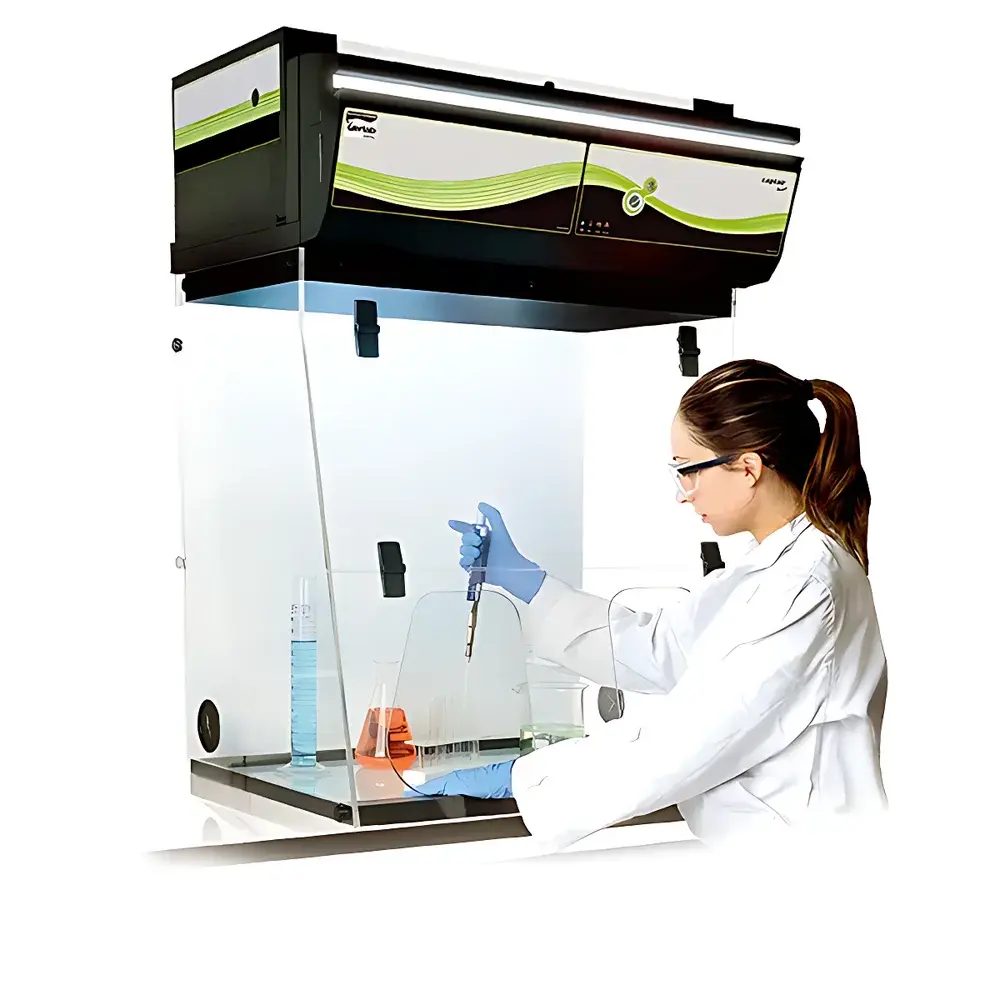
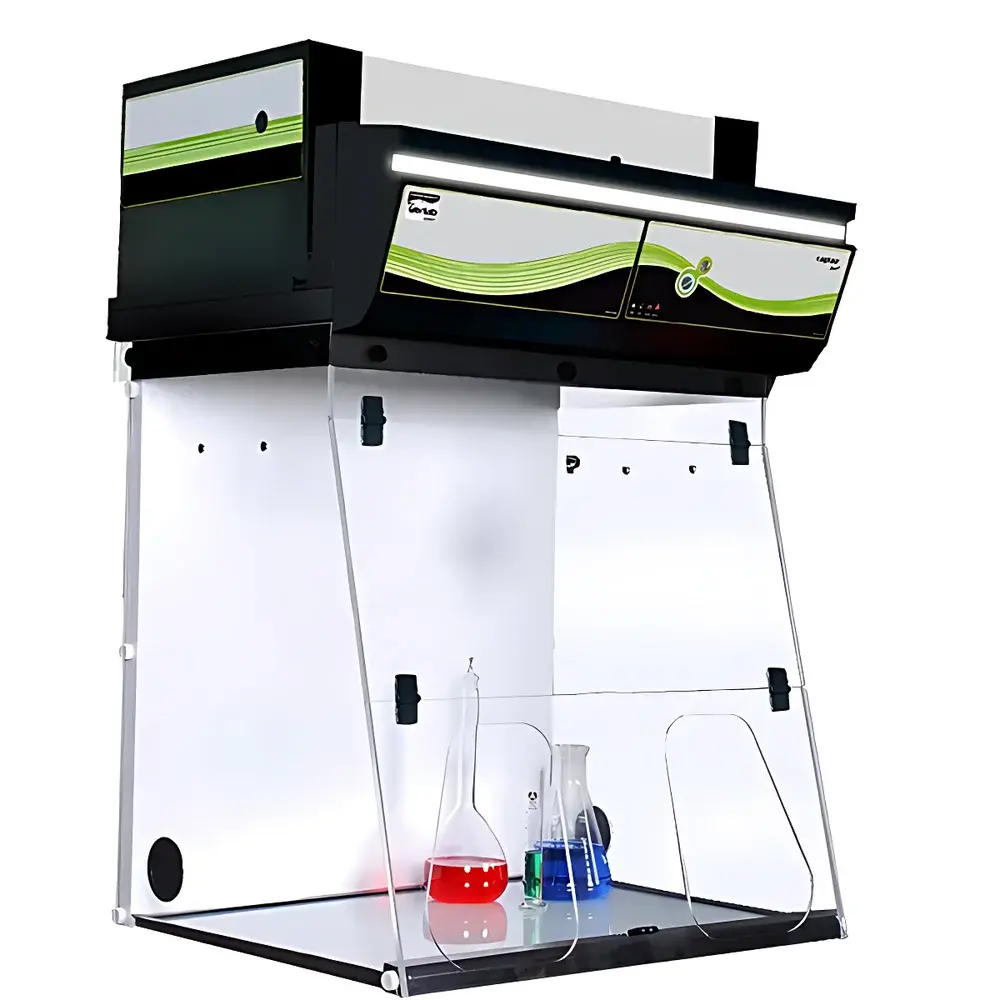
Erlab Captair Smart 321 Recirculating Fume Hood
| Brand | Erlab |
|---|---|
| Origin | France |
| Model | Captair 321 |
| Cabinet Construction | Single-Face Recirculating Fume Hood |
| Cabinet Material | Polypropylene (PP) Panels with Acid-Resistant Polymer-Coated Galvanized Steel Frame |
| Airflow Volume | 220 m³/h |
| Face Velocity Range | 0.4–0.6 m/s |
| Safety Compliance | JG/T 385-2012, SEFA 9, CE, ISO 9001:2008 |
| Filter Options | GF4 AS (Organic), GF4 BE+ (Organic + Inorganic), GF4 F (Formaldehyde), GF4 K (Ammonia), GF4 HP (Particulates) |
| Smart Monitoring | eGuard Software Integration, Molecode Saturation Sensors (S/A/F), RGB Status Halo Indicator |
| Electrical Supply | 100–240 V AC / 50–60 Hz |
| Internal Circuit | 24 V DC |
Overview
The Erlab Captair Smart 321 is a high-performance, single-face recirculating fume hood engineered for precision chemical containment and operator safety in modern laboratories. Unlike conventional ducted hoods, it operates on a closed-loop air recirculation principle: ambient laboratory air is drawn through the work area at a controlled face velocity (0.4–0.6 m/s), passed through a multi-stage, application-specific filter system, and returned to the room as purified air—eliminating external ductwork while maintaining rigorous occupational exposure limits. Its core architecture integrates aerodynamic chamber design, real-time airflow stability monitoring, and chemically resistant construction (PP panels + polymer-coated galvanized steel), ensuring long-term structural integrity under aggressive reagent exposure. The system complies fully with JG/T 385-2012 (China), SEFA 9 (USA), and CE directives, and is validated via third-party testing for SF₆ tracer gas leakage ≤0.5 ppm at the sash opening—meeting internationally recognized containment performance benchmarks.
Key Features
- Smart Halo Visual Status Indicator: A dynamically illuminated RGB ring provides immediate, intuitive feedback on operational status—steady green indicates optimal airflow and filter condition; pulsing amber signals potential airflow disturbance or fan anomaly; solid red alerts to filter saturation or critical fault.
- Modular Filter Architecture: Five certified filter configurations—GF4 AS (volatile organic compounds), GF4 BE+ (mixed organic/inorganic acids), GF4 F (formaldehyde), GF4 K (ammonia), and GF4 HP (sub-micron particulates)—can be deployed individually or in tandem to match specific chemical inventories and workflow requirements.
- Ergonomic Human-Centered Design: Elliptical sash opening and patented pivot-mounted flip-up sash enable flexible upper- or lower-position experimentation without compromising face velocity uniformity. The curved work surface edge reduces forearm fatigue during extended use.
- Integrated Molecode Sensor Suite: Electrochemical sensors (Molecode S, A, F) continuously monitor breakthrough concentrations of target analytes in real time, triggering audible/visual alerts and logging saturation events in eGuard for predictive maintenance planning.
- Self-Contained Power & Control: Operates on universal input voltage (100–240 V AC); internal 24 V DC circuitry ensures stable, low-noise fan control and sensor operation independent of mains fluctuations.
Sample Compatibility & Compliance
The Captair Smart 321 is validated for safe handling of >600 chemicals documented in the Erlab Chemical Compatibility Handbook—including isopropanol, cyclohexane, hydrochloric acid, formaldehyde, and ammonia—at concentrations up to 1% of their respective Threshold Limit Values (TLVs®). Filter adsorption capacity is quantified per JG/T 385-2012 Annex C methodology, with certified minimum service life data provided for each configured filter type. All units undergo factory calibration and third-party verification per SEFA 9 Section 5.3 (containment testing) and JG/T 385-2012 Clause 6.4 (leakage rate). Documentation packages include CE Declaration of Conformity, ISO 9001:2008 certification, and full 3Q validation support files (IQ/OQ/PQ templates) aligned with GLP and GMP facility requirements.
Software & Data Management
eGuard software enables secure, role-based remote monitoring across desktop, tablet, and mobile platforms. It logs real-time metrics—including face velocity, filter differential pressure, sensor saturation levels, runtime hours, and alarm history—with timestamped, tamper-evident records compliant with FDA 21 CFR Part 11 audit trail requirements. Customizable dashboards generate usage analytics (e.g., daily airflow volume, filter remaining life estimates, incident frequency heatmaps), supporting preventive maintenance scheduling and laboratory safety audits. Data exports are available in CSV and PDF formats; API integration supports enterprise LIMS and CMMS interoperability.
Applications
This recirculating hood is optimized for routine chemical synthesis, analytical sample preparation (HPLC, ICP-MS), pharmaceutical QC testing, educational lab instruction, and cleanroom-adjacent applications where duct installation is impractical. Its low-noise (<55 dB[A]) operation and zero external exhaust make it suitable for open-plan labs, renovation projects, and modular lab builds. The GF4 HP particulate filter variant meets ISO Class 5 cleanroom background air quality requirements when used with appropriate gowning and procedural controls.
FAQ
Does the Captair Smart 321 require external ducting?
No—it is a self-contained recirculating system; no wall or roof penetrations are needed.
Can filter types be changed in situ without tools?
Yes—modular filter cartridges feature tool-free bayonet mounting and integrated RFID tags for automatic configuration recognition by eGuard.
Is third-party test documentation available for JG/T 385-2012 compliance?
Yes—certified reports from CNAS-accredited laboratories are supplied with each unit upon request.
What is the expected service life of GF4 filters under typical academic lab usage?
Based on 8-hr/day operation and moderate solvent use, GF4 AS lasts 6–12 months; GF4 HP exceeds 24 months; exact duration is tracked and predicted by Molecode + eGuard analytics.
Does eGuard support multi-unit fleet management?
Yes—centralized dashboards allow simultaneous monitoring of up to 256 connected Captair units with group-level reporting and alert routing rules.
Related Products



