
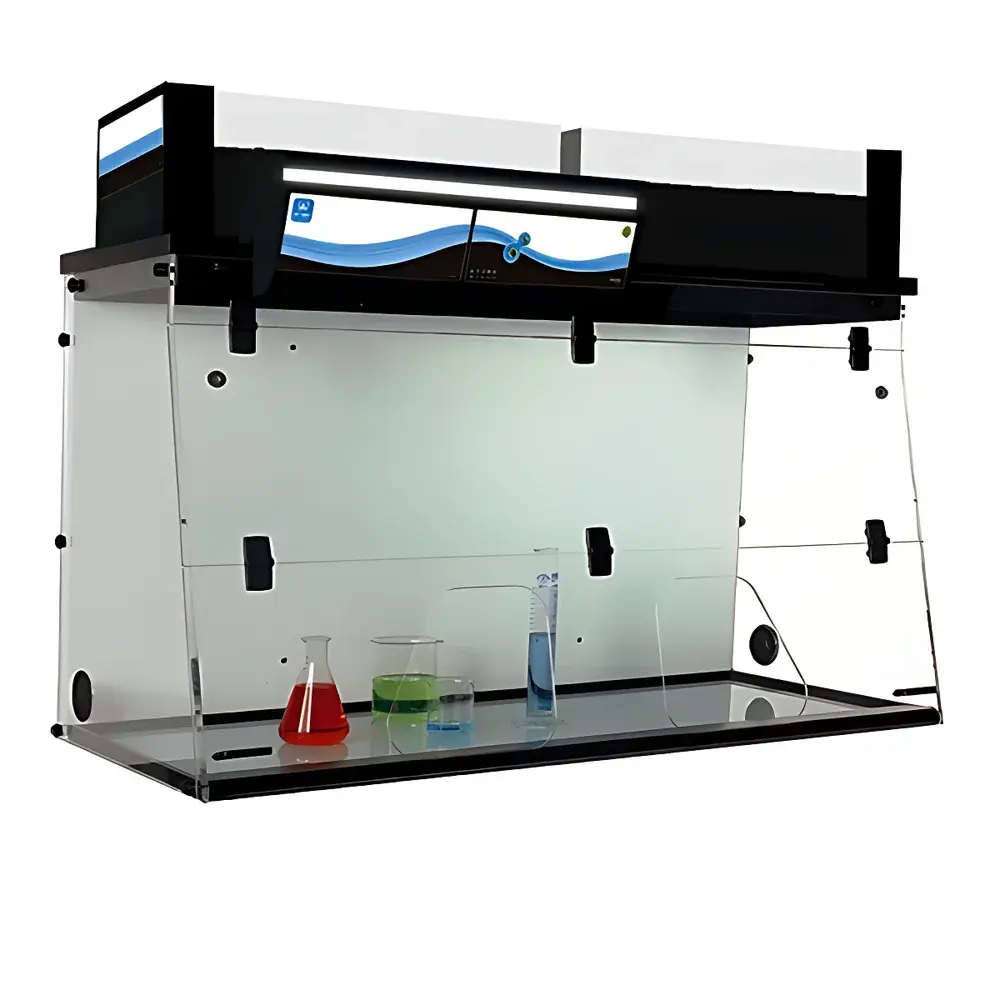
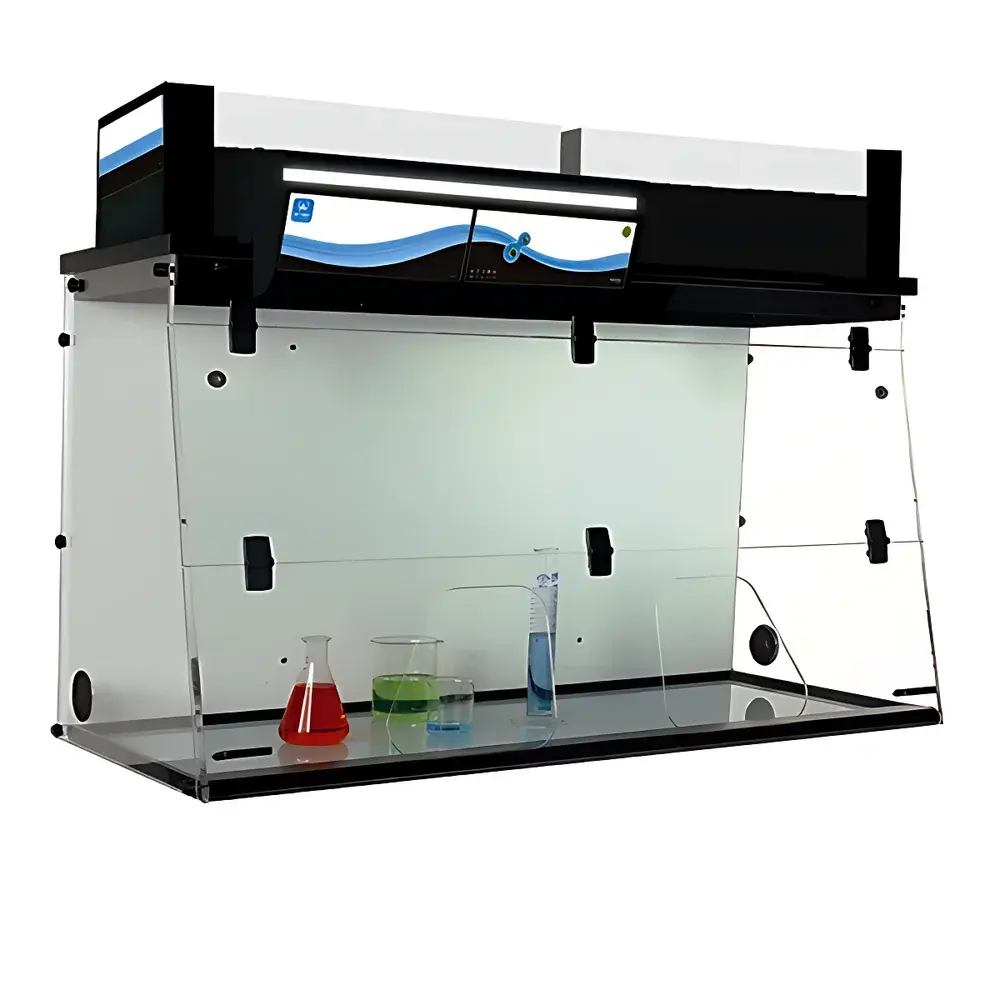
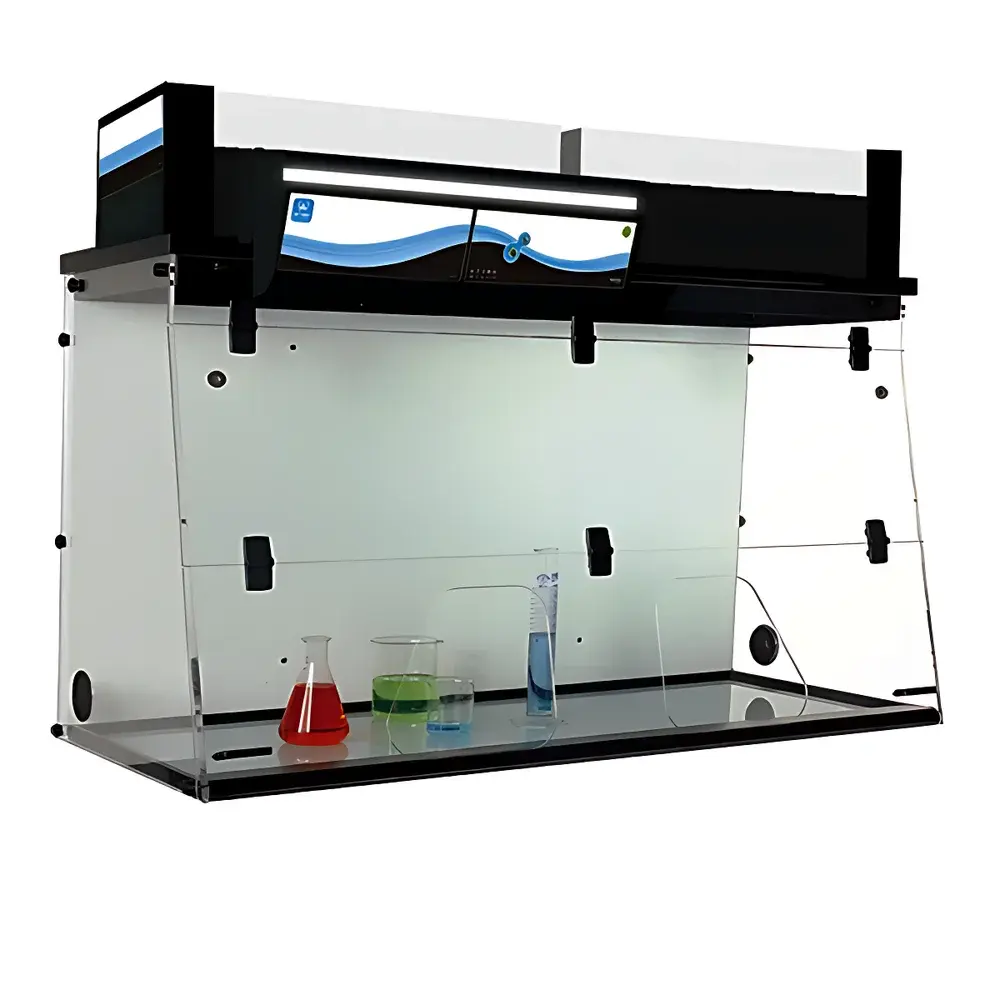
Erlab e632 Clean Air Fume Hood
| Brand | Erlab |
|---|---|
| Origin | Shanghai, China |
| Manufacturer Type | Authorized Distributor |
| Country of Origin | China |
| Model | e632 |
| Cabinet Construction | All-Steel |
| Ventilation Type | Ductless (Recirculating) |
| Air Intake Method | Compensated (Bypass) Design |
| Application Domain | Chemical Handling |
| Exhaust Position | Top Exhaust |
| Ducting Requirement | None (Self-Contained Filtration System) |
| Work Area Dimensions (W×D×H) | 1606 mm × 615 mm × 1107 mm |
| Overall Dimensions (W×D×H) | 1606 mm × 615 mm × 1107 mm |
| Average Face Velocity | 0.4–0.6 m/s |
| Airflow Volume | 440 m³/h |
| Lighting | Integrated LED Tubes |
| Rated Power | 125 W |
| Electrical Input | 100–240 V AC, 50–60 Hz |
| Internal DC Supply | 24 V |
| Filter Architecture | Modular Vertical Stack (FLEX Technology) Supporting Combined Activated Carbon + HEPA/ULPA Configurations |
| User Capacity | 1–2 Operators |
| Net Weight | 55.7 kg |
| Noise Level | Compliant with ISO 15714 and EN 14175-3 for Laboratory Ambient Acoustics |
| Water Connection | Not Required (No Utility Water Interface) |
| Compliance | Meets EN 14175-3 (2022), ASTM E1192-21, and OSHA 1910.1450 Requirements for Ductless Fume Control |
Overview
The Erlab e632 Clean Air Fume Hood is an all-steel, ductless laboratory fume containment system engineered for precision chemical handling in modern research, quality control, and teaching laboratories. Unlike conventional ducted hoods that rely on building exhaust infrastructure, the e632 employs a closed-loop recirculation architecture: ambient air is drawn across the work surface at a controlled face velocity (0.4–0.6 m/s), passed through a dual-stage, vertically stacked filtration module (FLEX Technology), and returned to the lab environment—free of hazardous vapors, particulates, and reactive gases. This design eliminates structural ductwork, reduces HVAC load by up to 85% compared to traditional systems, and enables rapid deployment in retrofit or modular lab spaces. The unit complies fully with EN 14175-3:2022 (Fume Hood Performance Testing), ASTM E1192-21 (Standard Guide for Selection and Use of Ductless Fume Hoods), and aligns with OSHA 1910.1450 requirements for laboratory chemical hygiene. Its compact footprint (1606 × 615 × 1107 mm) and low power draw (125 W) support energy-conscious facility planning without compromising containment integrity.
Key Features
- All-steel construction with epoxy-powder-coated finish for corrosion resistance and cleanroom-compatible surface integrity.
- FLEX modular filtration architecture: vertically oriented, tool-free filter cartridges allow simultaneous integration of activated carbon (for organic vapors, acids, aldehydes) and HEPA/ULPA filters (for particulates down to 0.12 µm).
- Intelligent airflow monitoring with real-time face velocity feedback and automatic fan speed modulation to maintain stable 0.4–0.6 m/s operation under varying ambient conditions.
- eGuard™ cloud-connected platform: enables remote device status monitoring, filter life tracking, alarm notification (e.g., filter saturation, airflow deviation), and usage analytics via web dashboard or iOS/Android application.
- Integrated LED lighting (≥500 lux at work surface) with glare-reducing diffuser and independent switch control.
- Bypass-style air intake design ensures consistent inflow distribution across full sash height, minimizing turbulence and improving containment efficiency per EN 14175-3 containment class B performance criteria.
- Low-noise operation (<55 dB(A) at 1 m), validated per ISO 15714 and EN 14175-3 acoustic protocols, suitable for open-plan or shared lab environments.
Sample Compatibility & Compliance
The e632 is validated for safe handling of low-to-moderate volatility chemicals including solvents (acetone, ethanol, hexane), dilute mineral acids (HCl, HNO₃ <10%), bases (NaOH 200 °C). Filter configuration must be selected based on Safety Data Sheet (SDS) exposure limits and compound adsorption isotherms. Unit certification includes full conformance with EN 14175-3:2022 Type C (ductless) testing protocols—including tracer gas containment (SF₆), face velocity mapping, and cross-draft resistance evaluation. Documentation supports GLP/GMP audit readiness, including filter change logs, calibration records, and eGuard™ audit trail export (21 CFR Part 11-compliant when deployed with enterprise authentication).
Software & Data Management
The embedded eGuard™ firmware provides secure TLS 1.2 communication with Erlab’s EU-hosted cloud infrastructure. Each e632 generates timestamped operational data—including cumulative runtime, filter saturation index (%), average face velocity deviation, and alarm history—which persists for ≥12 months. Administrators may configure role-based access (lab manager, safety officer, technician) and generate PDF reports compliant with ISO/IEC 17025 clause 7.10. Data exports support CSV and XML formats for integration into LIMS or EHS platforms. Firmware updates are delivered over-the-air (OTA) with SHA-256 signature verification. No local server or database installation is required.
Applications
- Chemical synthesis and reagent dispensing in academic and pharmaceutical R&D labs.
- QC sample preparation involving volatile organic compounds (VOCs) and aqueous solutions.
- Electronics manufacturing: solder paste handling, flux fume capture, and PCB cleaning.
- Environmental testing labs performing EPA Method 8260/8270 sample prep.
- Teaching laboratories requiring flexible, plug-and-play containment without building modification.
- Field-deployable mobile labs and modular containerized facilities.
FAQ
What types of chemicals can be safely used in the e632?
The e632 is certified for use with low-to-moderate volatility chemicals listed in Erlab’s published filter compatibility matrix. Always consult the SDS and select appropriate filter combinations (e.g., acid gas + HEPA) prior to operation.
Does the e632 require external ductwork or exhaust piping?
No. It is a self-contained, ductless system with integrated filtration and recirculation. No wall penetrations or HVAC tie-ins are necessary.
How often must filters be replaced?
Filter service intervals depend on chemical type, concentration, and usage frequency. eGuard™ provides predictive alerts based on real-time adsorption modeling; typical ranges are 6–12 months for carbon and 12–24 months for HEPA under standard lab conditions.
Can multiple e632 units be managed centrally?
Yes. The eGuard™ platform supports fleet-wide monitoring, group-based reporting, and consolidated compliance documentation for institutions operating >10 units.
Is the e632 compliant with FDA or ISO 13485 requirements?
While the unit itself is not a medical device, its documentation package—including validation reports, calibration certificates, and audit-ready eGuard™ logs—supports QSR and ISO 13485 Annex A.2 laboratory process controls.



