
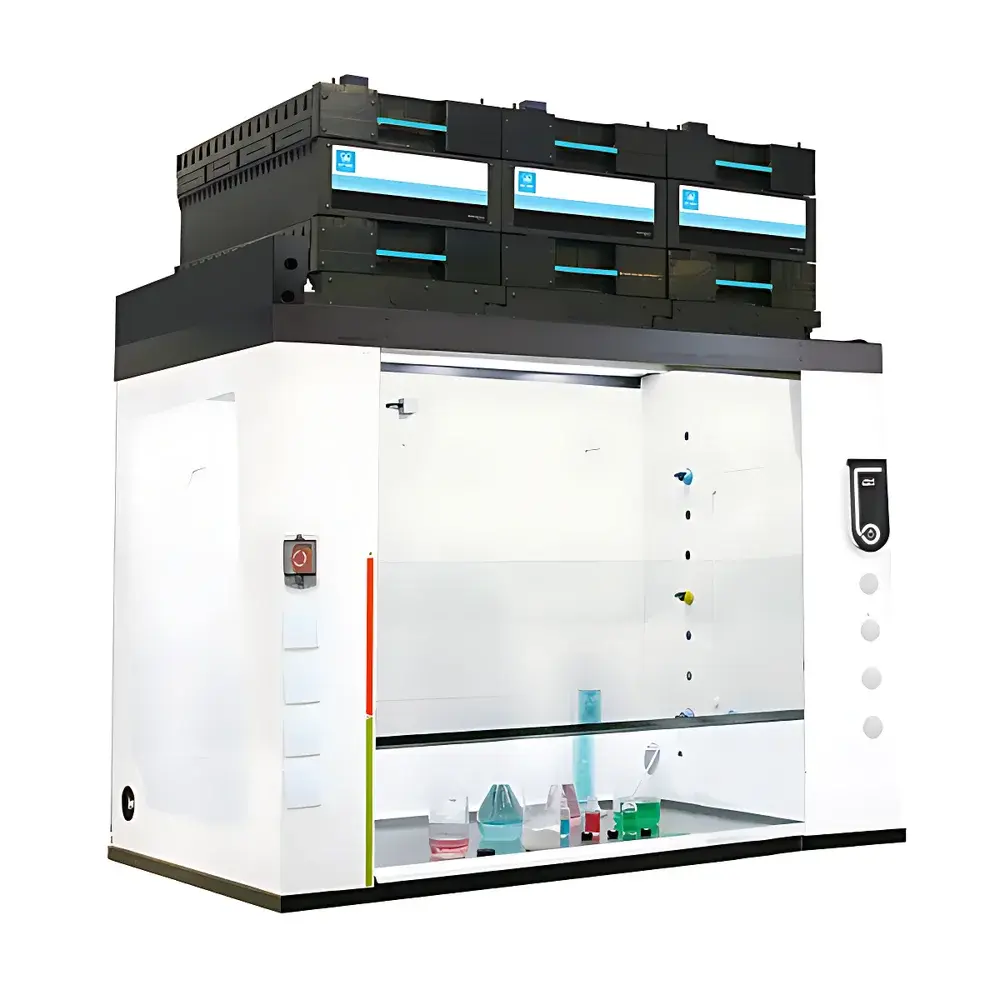
Erlab GreenFumeHood GFH 5300 Ductless Filtered Fume Hood
| Brand | Erlab |
|---|---|
| Origin | Jiangsu, China |
| Manufacturer Type | Authorized Distributor |
| Country of Origin | China |
| Model | GreenFumeHood GFH 5300 |
| Cabinet Material | Polypropylene (PP) |
| Configuration | Double-Sided Operation |
| Exhaust Type | Top-Exhaust Ductless Design |
| Application Domain | Chemical Handling |
| Work Area Dimensions (W×D×H) | 973 × 968 × 846 mm |
| Overall Dimensions (W×D×H) | 1433 × 968 × 1571 mm |
| Average Face Velocity | 0.4–0.6 m/s |
| Airflow Capacity | 660 m³/h |
| Illumination | 500 lux |
| Height from Work Surface to Floor | 900 mm |
| Rated Power | 200 W |
| Noise Level | ≤67 dB(A) |
| Net Weight | 200 kg |
| User Capacity | 2 Operators |
Overview
The Erlab GreenFumeHood GFH 5300 is a high-performance, ductless filtered fume hood engineered for precision chemical containment in modern laboratories where infrastructure flexibility, energy efficiency, and operator safety are critical design priorities. Unlike conventional ducted hoods that exhaust conditioned air outdoors—imposing significant HVAC load and energy penalties—the GFH 5300 employs a closed-loop recirculation system based on Erlab’s proprietary Neutrodine® multi-stage filtration technology. This system captures and neutralizes airborne contaminants at the source using chemically impregnated activated carbon and specialized acid-gas media, returning purified air directly into the laboratory environment. The hood operates on the principle of dynamic airflow management: its face velocity remains stable across the full sash travel range (0.4–0.6 m/s), verified per EN 14175-3 and ANSI/ASHRAE 110 test protocols, without requiring variable air volume (VAV) ductwork or building automation integration. Designed for dual-user operation and double-sided access, it supports safe handling of volatile organic compounds (VOCs), inorganic acids, bases, and mixed reagent systems under ISO 15195-accredited performance criteria.
Key Features
- Neutrodine® Filtration System: Patented, multi-layered sorbent media engineered over 50 years of R&D; achieves ≥99.9% removal efficiency for >200 common laboratory chemicals including acetone, methanol, HCl, HNO₃, NH₃, and formaldehyde.
- Dual-Sensor Saturation Monitoring: Two independent electrochemical sensors—one interstitial between filter layers, one ambient-air sensor mounted on the control panel—enable real-time, compound-specific detection of both organic vapors and acidic gases while minimizing false alarms via adjustable sensitivity calibration.
- RFID-Based Access Control: Role-defined user authentication (Operator / Administrator / Service Engineer) ensures accountability, audit-ready usage logging, and secure parameter configuration per GLP and ISO/IEC 17025 requirements.
- eGuard™ Remote Monitoring Platform: Web-enabled interface (compatible with Windows, macOS, and iOS/Android mobile devices) delivers live telemetry—including face velocity, filter saturation %, ambient VOC index, runtime hours, and alarm history—to centralized lab management dashboards.
- Polypropylene (PP) Construction: Fully welded, seamless cabinet body resistant to corrosion from aggressive solvents and mineral acids; compliant with UL 300A and CE marking for laboratory equipment safety.
- Energy-Efficient Operation: 200 W nominal power draw; recirculation mode reduces HVAC energy consumption by up to 70% versus traditional ducted hoods (per Erlab Life Cycle Assessment, 2022).
Sample Compatibility & Compliance
The GFH 5300 is validated for use with low-to-moderate volatility chemicals classified under GHS Categories 2–4 for acute toxicity, skin corrosion, and respiratory sensitization. It is not intended for perchloric acid, hydrofluoric acid, radioactive isotopes, or nanoparticles requiring HEPA/ULPA filtration. All filtration performance data are generated per ASTM D5209 (carbon adsorption capacity) and EN 14175-5 (ductless hood testing). The unit meets IEC 61000-6-3 (EMC), IEC 61000-6-2 (immunity), and carries CE, UKCA, and RoHS certifications. Filter replacement intervals are traceable and logged in accordance with FDA 21 CFR Part 11-compliant eGuard™ audit trails.
Software & Data Management
eGuard™ software provides role-based web access to real-time and historical operational data. Administrators configure alert thresholds, export CSV reports for internal QA review, and generate compliance summaries aligned with ISO/IEC 17025 Clause 8.7 (equipment monitoring) and EU Annex 11 (computerized system validation). All firmware updates are digitally signed and delivered via encrypted HTTPS channels. Data retention is configurable up to 36 months; local backup via USB is supported. No cloud storage is mandatory—on-premise deployment satisfies GDPR and HIPAA data sovereignty requirements.
Applications
Ideal for teaching labs, QC/QA environments, pharmaceutical development suites, and academic research facilities where duct installation is impractical or cost-prohibitive. Common applications include routine titrations, solvent-based sample preparation, reagent dispensing, chromatography solvent handling, and low-hazard synthesis workflows. Its double-sided configuration supports collaborative bench work and modular lab reconfiguration without structural modification.
FAQ
What types of chemicals can the GFH 5300 safely handle?
It is validated for organic solvents (e.g., ethanol, ethyl acetate), mineral acids (HCl, HNO₃, H₂SO₄), bases (NaOH, NH₃), and many halogenated compounds. A full compatibility matrix is available upon request.
How often must filters be replaced?
Under typical usage (6–8 hrs/day, moderate VOC load), Neutrodine® filters last 6–12 months; exact service life is dynamically calculated by eGuard™ based on real-time adsorption metrics.
Does the hood require external ductwork or make-up air systems?
No—its ductless design eliminates need for external exhaust piping, roof penetrations, or dedicated HVAC balancing.
Is the GFH 5300 suitable for ISO Class 5 cleanroom-adjacent areas?
Yes, provided ambient particulate levels remain <3,520 particles/m³ (≥0.5 µm); however, it does not provide particle filtration—only molecular contaminant removal.
Can usage logs be exported for regulatory audits?
Yes—eGuard™ supports PDF/CSV export of all operational events, including RFID login timestamps, sash position history, and filter saturation trends, with digital signature integrity verification.



