
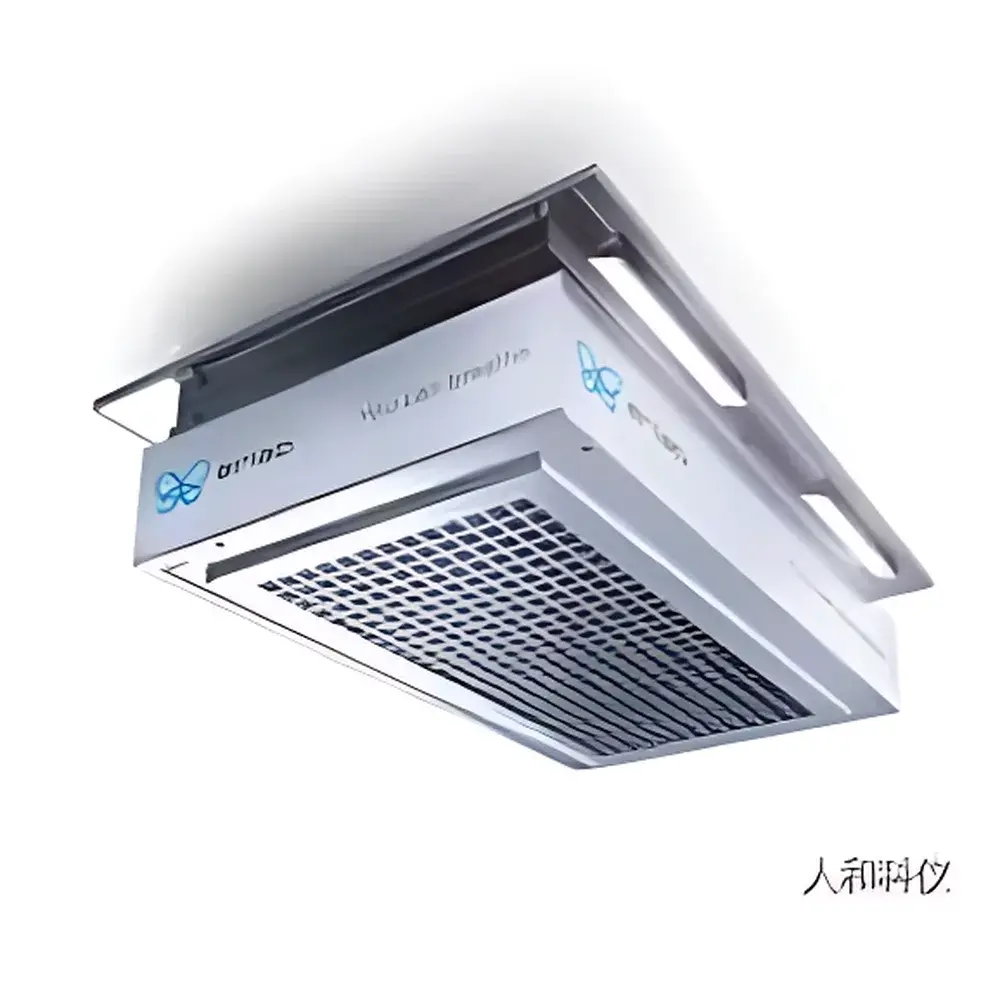
Erlab Halo Smart Laboratory Air Purifier
| Brand | Erlab |
|---|---|
| Origin | France |
| Model | Halo Smart |
| Airflow Capacity | Up to 220 m³/h |
| Filtration Technology | Ionized Cascade (Ion-Enhanced Multi-Stage Adsorption) |
| Power Consumption | 50 W |
| Operating Voltage/Frequency | 100–240 V / 50–60 Hz |
| Weight (incl. filters) | 31 kg |
| Installation | Ceiling-suspended via 4 lifting lugs or wall-mounted using 4 brackets |
| Connectivity | 1 × Ethernet port for e-Guard remote monitoring |
| Sensor Suite | Semiconductor sensor (VOCs), electrochemical sensors (acids, formaldehyde) |
| Control Interface | Visual status indicator (LED beam pulsing), mobile app integration via Erlab Smart platform |
| Compliance | Designed for GLP-compliant lab environments |
Overview
The Erlab Halo Smart is a CE-marked, Class II laboratory-grade air purification system engineered specifically for enclosed research and analytical workspaces where chemical fume hood exhaust recirculation or reduced air exchange rates are operationally or energetically constrained. Unlike standard HVAC-integrated or consumer-grade purifiers, the Halo Smart employs an ion-enhanced multi-stage adsorption architecture—termed “Ionized Cascade”—to neutralize and irreversibly capture airborne molecular contaminants at their source. This principle avoids catalytic oxidation or ozone generation, ensuring no secondary byproducts are introduced into sensitive experimental zones. The system operates independently of building ventilation infrastructure, delivering continuous, low-energy air treatment (50 W nominal) while maintaining ISO 14644-1 referenced particulate and gaseous cleanliness levels appropriate for Class 7–8 clean benches and controlled ambient labs. Its 220 m³/h volumetric airflow is calibrated to achieve ≥12 air changes per hour (ACH) in typical 18–20 m² lab modules—validated under steady-state ANSI/ASHRAE Standard 110 tracer gas testing protocols.
Key Features
- Ionized Cascade filtration: Combines pre-filtered coarse particle removal (≥99.9% @ 0.3 µm) with dual-stage chemisorption media—activated carbon impregnated with copper oxide (for organic vapors including acetone, ethanol, chloroform) and potassium permanganate-modified alumina (for inorganic acids, NOx, SO2, H2S).
- Real-time contaminant sensing: Integrated semiconductor VOC sensor (detection range: 0.01–100 ppm isopropanol-equivalent), dual electrochemical cells (HCHO: 0.01–5 ppm; acidic gases: 0.1–20 ppm), all factory-calibrated and traceable to NIST standards.
- e-Guard remote monitoring platform: Enables time-stamped, encrypted logging of airflow rate, filter saturation index, sensor outputs, and operational mode history via Ethernet connection—fully compliant with FDA 21 CFR Part 11 audit trail requirements when deployed with validated server configuration.
- Adaptive operation modes: Scheduled 24/7 continuous duty; day/night differential fan speed control; event-triggered high-flow response upon sensor threshold exceedance; manual override with min/max RPM lockout.
- Mechanically robust installation: Structural mounting via four certified M8 suspension lugs (EN 13155 compliant) or rigid bracket assembly; vibration-damped fan housing rated IP54 for humid or solvent-rich environments.
Sample Compatibility & Compliance
The Halo Smart is validated for use in laboratories handling volatile organic compounds (VOCs), halogenated solvents, aldehydes (including formaldehyde), and low-concentration inorganic acids—common in synthetic chemistry, pharmaceutical QC, and materials characterization workflows. It meets EN 1822-1:2020 (HEPA/ULPA classification reference), conforms to IEC 61000-6-3 (EMC emissions), and carries RoHS 3 and REACH SVHC declarations. Filter cartridges are supplied with full material safety data sheets (MSDS) and disposal guidance aligned with EU Directive 2008/98/EC. Units shipped to North America include UL 61010-1 certification for electrical safety in laboratory instrumentation.
Software & Data Management
The embedded Erlab Smart firmware (v3.2+) communicates exclusively over secure TLS 1.2–encrypted Ethernet to the cloud-hosted e-Guard portal. Logged parameters include real-time sensor voltage outputs, cumulative filter runtime (hours), dynamic pressure drop across each stage (kPa), and user-initiated mode transitions. All data exports as CSV or PDF reports with configurable time windows and digital signature verification. Role-based access control (RBAC) supports multi-user lab environments, and optional on-premise server deployment satisfies institutional IT security policies requiring air quality telemetry to remain behind firewall boundaries.
Applications
- Recirculation support for ductless fume hoods (e.g., Erlab’s NanoFlow series) to extend filter life and reduce replacement frequency.
- Ambient air polishing in analytical instrument rooms (GC-MS, HPLC, ICP-MS) where hydrocarbon or siloxane background interference must be minimized.
- Continuous decontamination of sample prep areas during long-duration stability studies (ICH Q5C) or cell culture suite anterooms.
- Supplemental air cleaning in teaching labs where HVAC retrofitting is cost-prohibitive but formaldehyde or xylene exposure limits (ACGIH TLV®) must be maintained.
- Post-fumigation clearance verification when hydrogen peroxide vapor (HPV) or chlorine dioxide decontamination cycles conclude.
FAQ
What is the recommended maintenance interval for Halo Smart filter cartridges?
Filter service life is determined by cumulative VOC exposure—not calendar time. Under typical academic lab usage (4–6 hrs/day, moderate solvent load), primary adsorption media lasts 12–18 months. The e-Guard dashboard displays real-time saturation index (%) and triggers alerts at 85% capacity.
Can Halo Smart be integrated into a building management system (BMS)?
Yes—via Modbus TCP/IP over Ethernet (register map provided in technical annex). BMS integration supports alarm forwarding, remote start/stop, and airflow setpoint adjustment within ±10% of nominal 220 m³/h.
Does the unit generate ozone or UV radiation?
No. The Ionized Cascade process uses corona discharge at sub-ozone-threshold voltage (< 5 kV) solely to enhance particle agglomeration upstream of mechanical filtration—no ozone exceeds 5 ppb (measured per ISO 11143). No UV-C or photocatalytic components are present.
Is calibration required after filter replacement?
Sensor auto-zeroing occurs during initial 30-minute power-up. Full recalibration (using certified span gases) is recommended annually or after exposure to >100 ppm solvent spikes—traceable certificate issued per ISO/IEC 17025.
What safety certifications apply to the Halo Smart in regulated GxP environments?
Validated configurations meet Annex 11 (EU GMP) data integrity expectations when e-Guard audit logs are retained for ≥2 years. Filter change events, sensor faults, and mode transitions are immutable entries with electronic signatures enabled.
Related Products



