
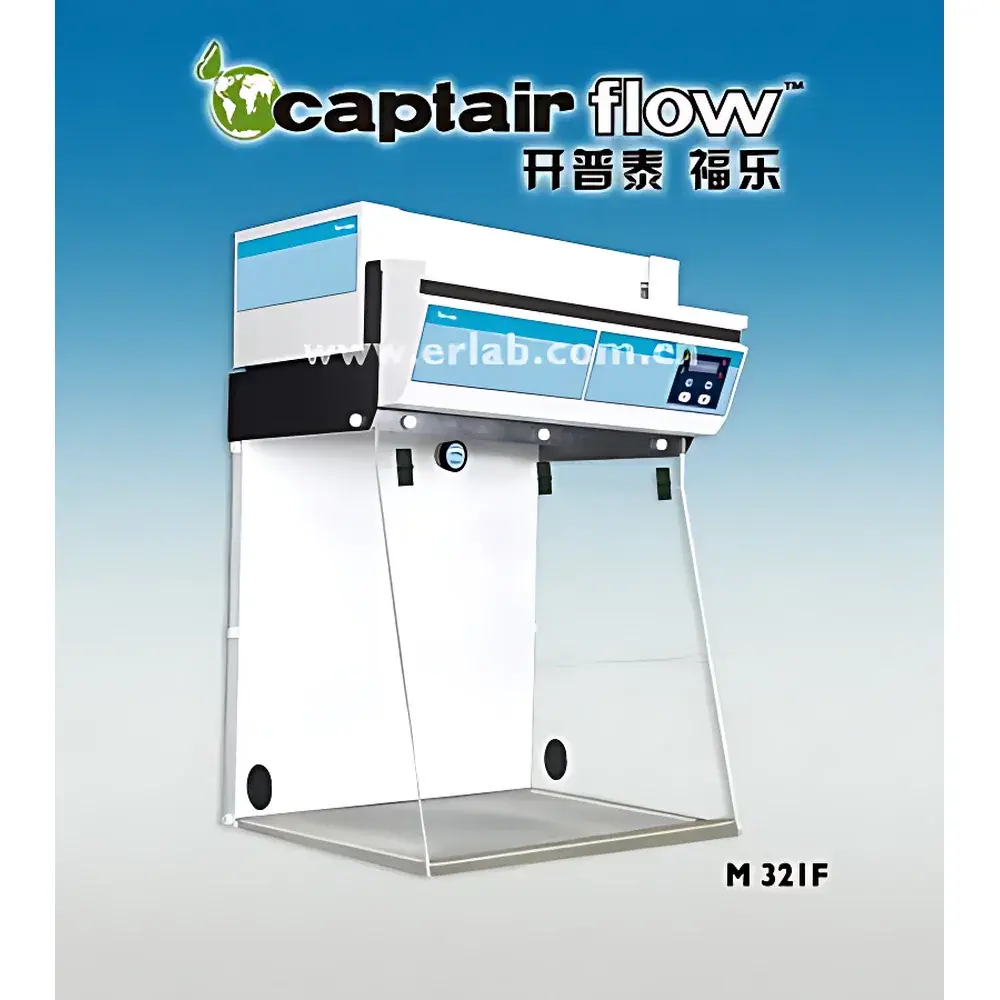
Erlab M321 F Vertical Flow Clean Bench
| Brand | Erlab |
|---|---|
| Origin | Jiangsu, China |
| Model | M321 F |
| Instrument Type | Vertical Flow Clean Bench |
| Cleanliness Class | ISO Class 5 (US Federal Standard 209E Class 100) |
| Noise Level | 52 dB(A) |
| User Configuration | Single-User, Front-Access |
| Airflow Pattern | Vertical Downflow |
| Pre-filter Pressure Monitoring | Yes |
| Alarm System | Fan Failure Audible/Visual Alert |
| Airflow Velocity | > 0.3 m/s |
| Air Volume | 230 m³/h |
| Power Supply | 100–240 V, 50–60 Hz |
| Total Power Consumption | 58 W |
| Current Draw | 0.58 A |
| Filter Type | H14 HEPA (EN 1822-1, MPPS ≥ 0.3 µm, Efficiency ≥ 99.995%) |
| Filter Service Life | Up to 4 years (dependent on ambient air quality) |
| Standard Work Surface | Stainless Steel (304, 2 mm thick, brushed finish, radiused front edge) |
| Optional Surfaces | Solid Phenolic (25 mm, chemical-resistant, non-conductive, integrated spill containment groove) or Fixed-Height Workbench with Leveling Feet |
| Optional Add-on | GF4BE+ Activated Carbon Filter Module for Chemical Vapor Adsorption |
Overview
The Erlab M321 F Vertical Flow Clean Bench is an ISO Class 5-certified laminar flow workstation engineered for precision containment and sample protection in non-sterile but particle-sensitive laboratory operations. It operates on the principle of unidirectional vertical downflow: ambient air is drawn through a pre-filter, conditioned by a low-vibration EC centrifugal fan (IP44 rated), and then passed through an H14 high-efficiency particulate air (HEPA) filter meeting EN 1822-1 requirements at the Most Penetrating Particle Size (MPPS) of ≥0.3 µm (≥99.995% filtration efficiency). The resulting ISO Class 5 airflow—equivalent to US Federal Standard 209E Class 100—ensures ≤100 particles ≥0.3 µm per cubic foot within the work area. Unlike biological safety cabinets, the M321 F provides personnel and environmental protection only indirectly; its primary function is product protection against airborne particulate contamination during aseptic handling, weighing, assembly, or inspection tasks.
Key Features
- Vertically oriented laminar airflow with uniform velocity >0.3 m/s across the entire working plane, validated per ISO 14644-3 Annex B.
- H14 HEPA filter certified to EN 1822-1 with documented MPPS test reports; service life up to 4 years under typical laboratory ambient conditions (ISO Class 8 environment).
- Integrated real-time fan monitoring system with audible and visual alarm triggered upon fan failure or significant speed deviation.
- Digital differential pressure gauge continuously monitors pressure drop across both pre-filter and HEPA filter, enabling predictive maintenance scheduling.
- Brushed 304 stainless steel work surface (2 mm thickness) with ergonomic radiused front edge, corrosion-resistant, non-porous, and compatible with standard laboratory disinfectants.
- Low-noise operation at 52 dB(A) measured at 1 m distance—optimized for shared lab environments requiring acoustic compatibility.
- Universal power input (100–240 V, 50–60 Hz) and energy-efficient EC motor (58 W total consumption) supporting global deployment without voltage conversion hardware.
Sample Compatibility & Compliance
The M321 F is designed for applications where sample integrity depends on particulate control—not biohazard containment. It complies with ISO 14644-1:2015 (Class 5), EN ISO 14644-3:2019 (laminar flow verification protocols), and EU GMP Annex 1 (2022) requirements for Grade A environments when used as a local critical zone within a Grade B background. It meets the particle concentration thresholds defined in USP for low-risk compounding and supports GLP-compliant documentation workflows when paired with optional audit-trail-capable software modules. While not intended for volatile organic compound (VOC) or acid vapor handling without modification, the optional GF4BE+ activated carbon filter module enables safe integration into labs performing combined particulate + chemical hazard workflows—validated per ASTM D5212 for adsorption capacity and breakthrough time.
Software & Data Management
The M321 F features embedded microcontroller-based operation with no external PC dependency. All operational parameters—including fan speed, cumulative runtime, filter pressure differential, and alarm event logs—are stored locally in non-volatile memory with timestamping. Optional Ethernet or RS-485 interface kits enable integration into centralized lab infrastructure management systems (LIMS/LabVantage) for remote status monitoring, preventive maintenance alerts, and electronic logbook generation compliant with FDA 21 CFR Part 11 requirements (when deployed with validated user access controls and electronic signature modules). Calibration and filter replacement records are exportable in CSV format for internal QA audits.
Applications
- Non-pathogenic cell culture setup and media preparation (e.g., hybridoma, insect, or plant cell lines)
- Microbiological plating, colony isolation, and environmental sampling analysis
- Precision weighing of reference standards, pharmaceutical excipients, or nanomaterials
- Assembly and inspection of optical components, MEMS devices, and semiconductor prototypes
- Formulation development in cosmetics and nutraceutical R&D where microbial load is controlled externally
- Electronics manufacturing support: PCB solder paste application, component placement, and post-reflow inspection
- Botanical tissue culture initiation and meristem isolation under controlled particulate conditions
FAQ
Is the M321 F suitable for handling infectious agents or toxins?
No. This unit provides only product protection and does not offer personnel or environmental protection. For biosafety applications, a Class II Biological Safety Cabinet (BSC) compliant with NSF/ANSI 49 is required.
Can the H14 HEPA filter be replaced in-house?
Yes—filter replacement follows a standardized procedure outlined in the operator manual and requires no specialized tools. Erlab recommends qualification via smoke visualization and anemometer mapping after each replacement to confirm laminar flow integrity.
Does the unit meet FDA or EU regulatory expectations for pharmaceutical manufacturing?
It satisfies ISO Class 5 performance criteria referenced in EU GMP Annex 1 and USP . However, formal qualification (IQ/OQ/PQ) must be performed by the end-user’s validation team per site-specific SOPs.
What maintenance intervals are recommended for the pre-filter?
Pre-filter replacement frequency depends on ambient air quality; typically every 3–6 months in ISO Class 8 environments. The differential pressure gauge provides objective indication—replacement is advised when ΔP exceeds 250 Pa.
Is the stainless steel work surface electrostatically dissipative?
No—it is conductive (resistivity <10⁴ Ω/sq) but not ESD-dissipative. For electrostatic-sensitive device (ESD) applications, the optional solid phenolic surface with grounding provisions is recommended.



