
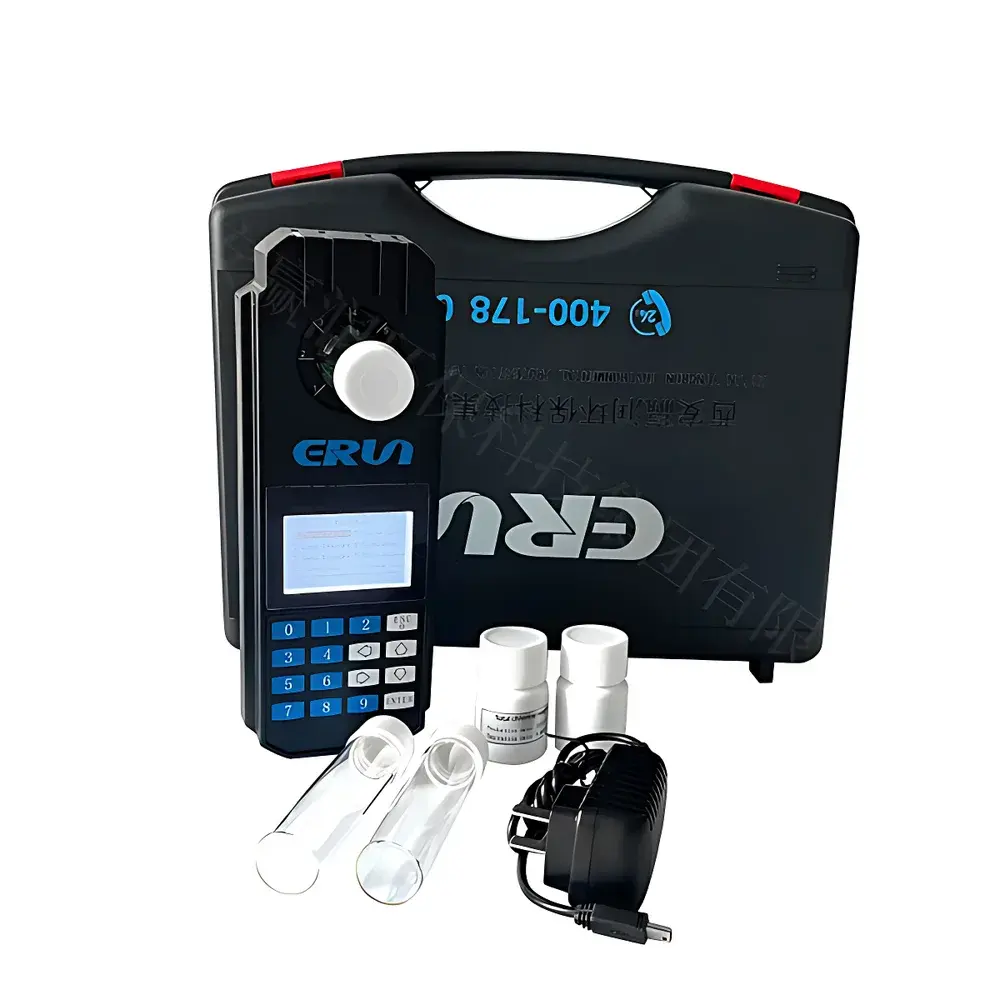
ERUN ERUN-SP5-D4 Portable Cyanide Analyzer
| Brand | ERUN |
|---|---|
| Origin | Shaanxi, China |
| Manufacturer Type | Authorized Distributor |
| Country of Manufacture | China |
| Model | ERUN-SP5-D4 |
| Instrument Type | Portable |
| Detection Method | Spectrophotometric (ISO 6703-1 compliant) |
| Measurement Range | 0.01–0.50 mg/L CN⁻ |
| LOD | 0.005 mg/L |
| Accuracy | ±5% FS |
| Repeatability | ≤3% RSD |
| Optical Stability | ΔA < 0.002 in 20 min |
| Display | Backlit LCD |
| Data Storage | 20 calibration curves + 199 timestamped results (YYYY-MM-DD HH:MM:SS, Absorbance, Transmittance, Concentration) |
| Power Supply | 4 × AA batteries |
| Enclosure | IP65-rated ABS housing |
| Dimensions | 80 × 230 × 55 mm |
| Weight | 500 g |
| Operating Temperature | 5–40 °C |
| Relative Humidity | ≤85% RH (non-condensing) |
| Compliance | GB 5749-2022, GB 3838-2002, ISO 6703-1:2018 |
Overview
The ERUN ERUN-SP5-D4 Portable Cyanide Analyzer is a field-deployable spectrophotometric instrument engineered for rapid, on-site quantification of free and total cyanide (as CN⁻) in surface water, groundwater, wastewater, and drinking water sources. It operates on the internationally standardized pyridine-barbituric acid colorimetric method (aligned with ISO 6703-1:2018 and equivalent to APHA 4500-CN⁻ C), where cyanide reacts under controlled acidic distillation (for total cyanide) or direct alkaline digestion (for free cyanide) to form a purple chromophore measurable at 580 nm. The analyzer integrates a narrow-band interference optical system with cold LED illumination, eliminating thermal drift and ensuring long-term photometric stability—critical for unattended operation in variable ambient conditions. Its compact, handheld architecture (80 × 230 × 55 mm; 500 g) and IP65-rated ABS enclosure enable reliable use in humid, dusty, or intermittently wet environments common during riverbank sampling, industrial effluent monitoring, or emergency response scenarios.
Key Features
- Optimized optical path design with high-stability cold LED source and precision 10-mm fixed-path cuvette holder—minimizes alignment sensitivity and eliminates lamp replacement requirements.
- 16-bit low-power microcontroller with real-time clock (RTC) support for full traceability: each stored result includes concentration, absorbance, transmittance, and ISO 8601 timestamp (year, month, day, hour, minute, second).
- On-device calibration curve management: stores up to 20 user-defined or factory-loaded standard curves, supporting multi-point linear and polynomial regression per method.
- Robust data integrity architecture: automatic power-fail recovery preserves all unsaved measurements and active calibration parameters; no data loss during battery replacement.
- Field-validated detection performance: limit of detection (LOD) of 0.005 mg/L CN⁻ meets regulatory thresholds specified in GB 5749-2022 (drinking water) and GB 3838-2002 (surface water Class I–III), enabling compliance-grade reporting without laboratory confirmation for screening applications.
- Low operational overhead: 4 × AA alkaline batteries provide ≥12,000 measurements per set under typical usage (25°C, 50% display backlight duty cycle); battery level indicator and auto-shutdown reduce waste.
Sample Compatibility & Compliance
The ERUN-SP5-D4 is validated for aqueous matrices including potable water, surface water, municipal wastewater, and industrial process streams containing low-to-moderate levels of interfering ions (e.g., sulfide, nitrite, carbonate). Sample pretreatment follows standardized distillation (for total cyanide per ISO 6703-1 Annex A) or direct addition (for free cyanide). The instrument’s measurement uncertainty profile—±5% full-scale accuracy and ≤3% repeatability (n=6, mid-range standard)—has been verified against NIST-traceable potassium ferricyanide reference materials. All firmware and calibration protocols adhere to GLP-aligned documentation practices. While not certified to FDA 21 CFR Part 11, its audit-ready data logs (immutable timestamps, operator ID fields via optional Bluetooth pairing) support internal QA/QC workflows aligned with ISO/IEC 17025:2017 Clause 7.7 requirements for measurement traceability.
Software & Data Management
Data export is supported via USB-C interface (USB 2.0 CDC class) to Windows/macOS/Linux systems using ERUN’s open-protocol CSV export utility. No proprietary drivers are required. Exported files include column headers compliant with LIMS ingestion standards (e.g., “Sample_ID”, “Measured_Conc_mg_L”, “Absorbance_580nm”, “DateTime_UTC”, “Calibration_Curve_ID”). Firmware updates are delivered as signed binary packages with SHA-256 checksum verification. Internal memory retains all calibration history—including date/time stamps, standard concentrations used, and correlation coefficients—for retrospective review during internal audits.
Applications
- Routine surveillance of cyanide discharge from electroplating, mining, and chemical synthesis facilities.
- Emergency response testing following suspected spills or accidental releases into aquatic ecosystems.
- Drinking water safety verification at distribution points or rural wellheads per GB 5749-2022 Section 8.2.2 (cyanide MCL = 0.05 mg/L).
- Field validation of fixed online cyanide analyzers during commissioning or maintenance intervals.
- Educational laboratories requiring robust, low-maintenance instrumentation for environmental chemistry curricula.
FAQ
Does the ERUN-SP5-D4 require external reagents or consumables beyond the included test kits?
Yes—each analysis requires single-use, pre-measured reagent vials (pyridine-barbituric acid formulation) and disposable glass or quartz cuvettes (10-mm pathlength). ERUN supplies ISO-certified reagent kits with batch-specific calibration certificates.
Can the instrument store multiple calibration curves for different sample matrices?
Yes—up to 20 independent calibration curves may be saved onboard, each labeled with user-defined identifiers (e.g., “Wastewater_Distilled”, “Drinking_Water_Direct”) and associated metadata (date created, slope/intercept, r² value).
Is the device suitable for marine or high-salinity samples?
Not without matrix-matched calibration. High chloride (>10,000 mg/L) may suppress color development; users must validate recovery using spiked seawater standards prior to deployment.
What maintenance is required to ensure long-term optical stability?
No routine optical alignment is needed. Wipe the cuvette compartment lens weekly with lint-free optical tissue. Perform blank verification before each sampling session; replace the LED source only after ≥50,000 hours of cumulative operation (typically >5 years).
Related Products







