
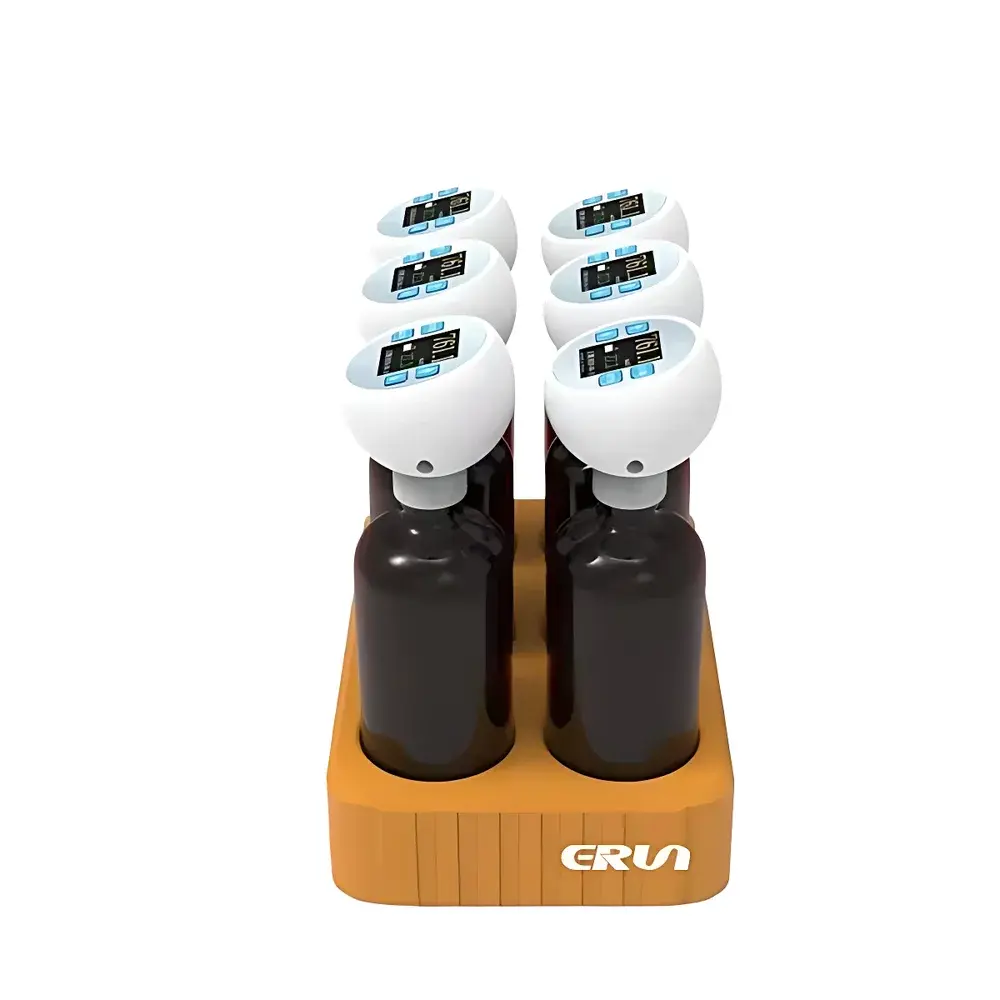
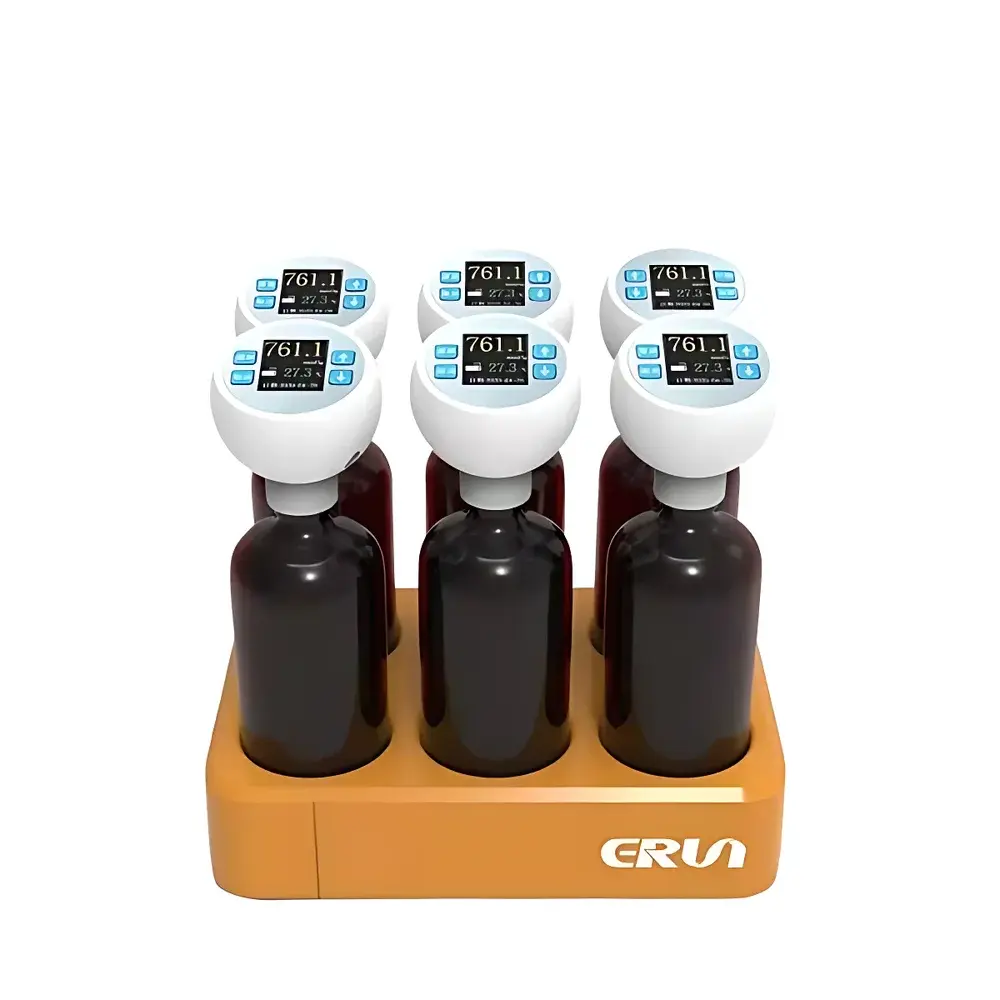
ERUN-SLBOD-B Intelligent BOD₅ Analyzer
| Brand | ERUN |
|---|---|
| Origin | Shaanxi, China |
| Manufacturer Type | Authorized Distributor |
| Country of Origin | China |
| Model | ERUN-SLBOD-B |
| Instrument Type | Laboratory BOD Analyzer |
| Measurement Principle | Mercury-Free Pressure Differential Method |
| Measurement Range | 0–4000 mg/L (direct reading) |
| Detection Limit | 5 mg/L |
| Accuracy | ±8% |
| Repeatability | ≤3% |
| Resolution | 0.01 mg/L |
| Sampling Points per Cycle | Up to 60 |
| Incubation Bottle Volume | 580 mL |
| Temperature Control | 20 ±1 °C |
| Incubation Duration | 1–30 days (user-selectable) |
| Data Storage Capacity | ≥10 years of measurement records |
| Power Supply | AC 220 V ±10%, 50–60 Hz |
| Battery Backup | Integrated Li-ion, >2 years service life |
| Number of Independent Channels | 6 |
| Stirring Mechanism | Programmable magnetic stirring |
| Display | Large backlit LCD |
Overview
The ERUN-SLBOD-B Intelligent BOD₅ Analyzer is a fully automated, mercury-free laboratory instrument engineered for precise and compliant determination of biochemical oxygen demand (BOD₅) in water and wastewater samples according to the Chinese national standard HJ 505–2009. It employs the pressure differential method—based on the stoichiometric consumption of dissolved oxygen during microbial degradation of biodegradable organic matter under controlled aerobic incubation at 20 ±1 °C over a defined period (typically 5 days). Unlike manometric or titrimetric approaches requiring hazardous mercury columns or manual endpoint detection, this system utilizes sealed, gas-tight incubation bottles equipped with high-stability pressure transducers to continuously monitor the partial pressure drop resulting from O₂ depletion. The measured pressure differential is converted in real time to BOD concentration (mg/L) using integrated thermobarometric compensation algorithms, eliminating empirical calibration curves or post-test calculations.
Key Features
- Six independent, parallel measurement channels—each with dedicated pressure sensing, temperature regulation, and magnetic stirring—to enable simultaneous analysis of up to six samples without cross-contamination or inter-channel interference.
- Mercury-free pressure differential technology ensures operator safety, regulatory compliance with RoHS and Minamata Convention requirements, and long-term sensor stability without drift or maintenance-intensive recalibration.
- Programmable incubation duration (1–30 days) supports not only standard BOD₅ (5-day) testing but also extended BODn assessments for recalcitrant or low-biodegradability matrices.
- Integrated 580 mL BOD bottles with optimized headspace-to-liquid ratio and consistent sealing integrity ensure reproducible gas-phase equilibration and minimize boundary-layer artifacts.
- Real-time data acquisition at up to 60 user-defined sampling points per cycle enables high-resolution kinetic profiling of oxygen uptake rates—critical for evaluating biodegradation kinetics and microbial activity thresholds.
- Onboard non-volatile memory retains ≥10 years of timestamped, channel-specific datasets—including pressure, temperature, calculated BOD, and system diagnostics—with automatic file indexing and export via USB interface.
- Self-contained lithium-ion battery backup (>2 years nominal service life) maintains uninterrupted operation during brief power outages, preserving incubation integrity and data continuity.
Sample Compatibility & Compliance
The ERUN-SLBOD-B is validated for use with raw influent, secondary effluent, surface water, groundwater, industrial process streams, and treated municipal wastewater. Sample turbidity, suspended solids (<1000 mg/L), and moderate chloride concentrations (<2000 mg/L) do not interfere with pressure-based detection. The system meets functional equivalency requirements of ISO 5815-1:2019 (Water quality — Determination of biochemical oxygen demand after n days — Part 1: Dilution and seeding method) when operated per HJ 505–2009 protocol. Its audit-ready data structure—including immutable timestamps, user logins, and change history—supports GLP-compliant workflows and aligns with FDA 21 CFR Part 11 principles for electronic records and signatures where local regulatory frameworks permit.
Software & Data Management
Data are stored internally in a structured binary format with embedded metadata (sample ID, operator, start/end time, incubation parameters, ambient pressure/temperature). Export is supported via USB mass storage mode to CSV or Excel-compatible formats. No proprietary software installation is required; exported files are directly importable into LIMS platforms or statistical analysis tools (e.g., R, Python pandas, Minitab). System firmware includes configurable password-protected access levels (operator, supervisor, administrator) and full audit trail logging of all parameter changes, measurement initiations, and data exports—ensuring traceability for internal QA reviews and external accreditation audits (e.g., CNAS, CMA).
Applications
- Regulatory compliance monitoring for discharge permits (e.g., EPA NPDES, local environmental protection bureaus)
- Performance evaluation of biological treatment units (activated sludge, MBR, trickling filters)
- Biodegradability screening of industrial effluents prior to sewer discharge or pretreatment design
- Research on microbial community dynamics and substrate utilization kinetics in aquatic ecosystems
- Method validation and inter-laboratory comparison studies under standardized BOD protocols
- Educational laboratories requiring robust, low-maintenance instrumentation for undergraduate environmental science curricula
FAQ
Does the ERUN-SLBOD-B require sample dilution for concentrations above 4000 mg/L?
Yes—while the direct measurement range extends to 4000 mg/L, samples exceeding this value must be diluted prior to analysis in accordance with HJ 505–2009 Section 7.2 to maintain accuracy within ±8% tolerance.
Can incubation temperature be adjusted outside 20 ±1 °C?
No—the thermal control module is factory-calibrated and locked to 20 ±1 °C to ensure strict adherence to BOD₅ definition and comparability with reference methods.
Is external calibration or daily zeroing required?
No—pressure transducers are factory-zeroed and thermally compensated; routine verification uses certified air-saturated water blanks (recommended weekly per QA/QC plan).
How is stirring controlled during incubation?
Each channel features a microprocessor-driven magnetic stirrer operating at fixed 120 rpm to maintain uniform suspension of seed microorganisms and prevent oxygen stratification—no manual adjustment is needed.
What happens if power is lost during a 5-day run?
The integrated battery sustains core functions (sensing, timing, memory) for >72 hours; upon AC restoration, the system resumes measurement without data loss or cycle interruption.







