
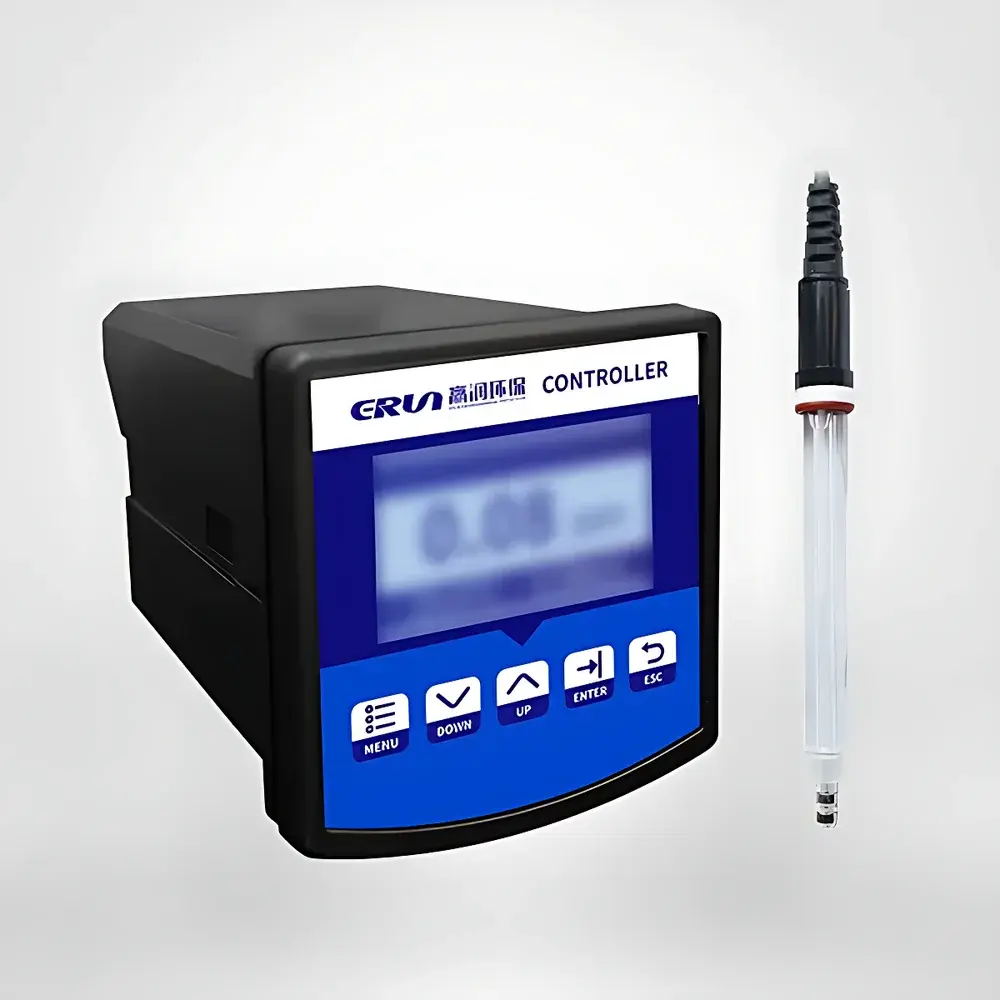
ERUN-SZ1-A-K3 Ozone Online Monitor for Water Applications
| Brand | ERUN |
|---|---|
| Origin | Shaanxi, China |
| Manufacturer Type | Authorized Distributor |
| Country of Origin | China |
| Model | ERUN-SZ1-A-K3 |
| Price | Upon Request |
| Measurement Principle | Constant-Voltage Electrochemical (Membrane-Free) |
| Range | 0–20.00 mg/L |
| Resolution | 0.01 mg/L |
| Accuracy | ±1% FS |
| Temp. Compensation | 0–60 °C |
| Output | 4–20 mA (4-wire, max 750 Ω) |
| Communication | RS-485 (Modbus RTU, partial compatibility) |
| Relay Outputs | 2 × AC220 V / 3 A (High/Low Alarm) |
| Display | Dot-matrix LCD with Chinese UI |
| Enclosure Rating | IP65 |
| Housing Material | ABS |
| Mounting | Panel-mount (92 × 92 mm cutout, 100 × 106 × 168 mm unit) |
| Power Supply | AC220 V or DC24 V/12 V |
| Data Storage | 50 data points + optional historical trend logging (50 groups) |
| Watchdog | Integrated |
| Backup Memory Retention | >10 years |
| Auto Calibration Recognition | Supported |
| Temp. Sensor | Built-in, automatic compensation |
| Software Option | PC-based data acquisition & analysis suite (optional) |
Overview
The ERUN-SZ1-A-K3 Ozone Online Monitor is a microprocessor-controlled electrochemical analyzer engineered for continuous, real-time measurement of dissolved ozone (O₃) concentration in aqueous systems. It employs a membrane-free, constant-voltage amperometric sensor principle—eliminating consumable membranes and electrolyte replenishment while maintaining high sensitivity, rapid response (<30 s T₉₀), and long-term baseline stability. Unlike traditional Clark-type sensors requiring frequent membrane replacement and polarizing voltage adjustments, this design utilizes a solid-state electrode architecture with stable three-electrode configuration (working, counter, reference), enabling robust operation across variable flow conditions and turbid or particulate-laden water matrices. The instrument is calibrated traceably to NIST-traceable ozone standards and conforms to the foundational principles outlined in ISO 15705:2001 (Water quality — Determination of ozone — Amperometric method) and ASTM D5650-21 (Standard Test Method for Determination of Dissolved Ozone in Water). Designed for unattended deployment, it supports 24/7 monitoring in pressurized or gravity-fed pipelines, ensuring compliance with operational thresholds defined in municipal drinking water regulations (e.g., US EPA Guidance Manual for Disinfection By-Products Control) and industrial process control protocols.
Key Features
- Membrane-free constant-voltage electrochemical sensing technology—zero consumables, no reagent dosing, minimal maintenance intervals
- High-resolution display with intuitive Chinese-language menu navigation; simultaneous real-time readouts of ozone concentration (mg/L), temperature (°C), 4–20 mA output status, and alarm thresholds
- Dual independent relay outputs (AC220 V / 3 A) configurable for high/low limit alarms, pump interlock, or chlorine dosing control integration
- RS-485 digital interface compliant with Modbus RTU protocol (partial implementation), supporting multi-drop network configuration and SCADA system integration; optional RS-232 converter available
- Non-volatile memory retaining calibration coefficients, alarm settings, and up to 50 discrete measurement records—with optional historical curve logging (50 user-defined time-series groups)
- Automatic temperature compensation across 0–60 °C using integrated Pt1000 thermistor; eliminates manual correction errors in variable-temperature applications
- Configurable 4–20 mA analog output with user-defined span mapping (e.g., 0–20 mg/L → 4–20 mA); isolated output supports loop-powered configurations
- Embedded watchdog timer ensures firmware-level recovery from transient power anomalies or electromagnetic interference events
- IP65-rated ABS enclosure suitable for indoor control room mounting or semi-outdoor environments near chlorination skids or filter galleries
Sample Compatibility & Compliance
The ERUN-SZ1-A-K3 is validated for use in potable water distribution networks, bottled water production lines, swimming pool recirculation systems, cooling tower make-up water, and ozone-based advanced oxidation process (AOP) reactors. It operates reliably in pH ranges of 4.0–9.5 and conductivity up to 2,000 µS/cm. While not certified to IEC 61508 SIL levels or UL 61010-1 for safety-critical hazardous area deployment, its electrical architecture complies with CE marking requirements under EMC Directive 2014/30/EU and Low Voltage Directive 2014/35/EU. For regulated pharmaceutical or food-grade applications, users must validate installation per GMP Annex 11 (data integrity) and FDA 21 CFR Part 11 (if paired with optional PC software featuring audit trail, electronic signature, and role-based access controls).
Software & Data Management
An optional Windows-compatible data acquisition software package is available for centralized logging, trend visualization, and report generation (PDF/CSV export). When deployed with timestamped data capture, the system supports GLP-aligned record retention—including operator ID, calibration date, sensor zero/span values, and environmental metadata. All configuration changes are logged with timestamps and user identifiers, satisfying basic ALCOA+ data integrity criteria (Attributable, Legible, Contemporaneous, Original, Accurate). Firmware updates are performed via USB-to-serial adapter; version history and checksum verification ensure traceability.
Applications
- Real-time ozone dose verification at point-of-application in municipal water treatment plants
- Process validation during UV/O₃ hybrid disinfection in pharmaceutical water-for-injection (WFI) loops
- Monitoring residual ozone decay kinetics in closed-loop cooling systems to prevent corrosion acceleration
- Quality assurance in PET bottle sterilization tunnels where ozone contact time and concentration directly impact microbial log-reduction
- Research-grade kinetic studies on ozone decomposition pathways in natural organic matter (NOM)-rich surface waters
FAQ
What measurement principle does the ERUN-SZ1-A-K3 employ?
It uses a membrane-free, constant-voltage amperometric sensor based on direct electrochemical reduction of dissolved ozone at a catalyzed working electrode.
Is the sensor compatible with seawater or high-salinity brines?
No—operation above 1,500 µS/cm conductivity or chloride concentrations exceeding 500 mg/L may accelerate electrode passivation; consult technical support for saline-water variants.
Can the 4–20 mA output be scaled to non-linear ranges (e.g., logarithmic)?
No—the analog output is strictly linear within the configured measurement span; non-linear scaling requires external PLC or DCS configuration.
Does the device support automatic zero calibration?
Yes—when connected to an ozone-free water source (e.g., nitrogen-sparged deionized water), the instrument can execute automated zero-point verification upon command.
What is the recommended calibration frequency under continuous operation?
Initial calibration at installation, followed by verification every 7 days in critical applications or every 30 days in stable, low-fouling environments.
Related Products







