
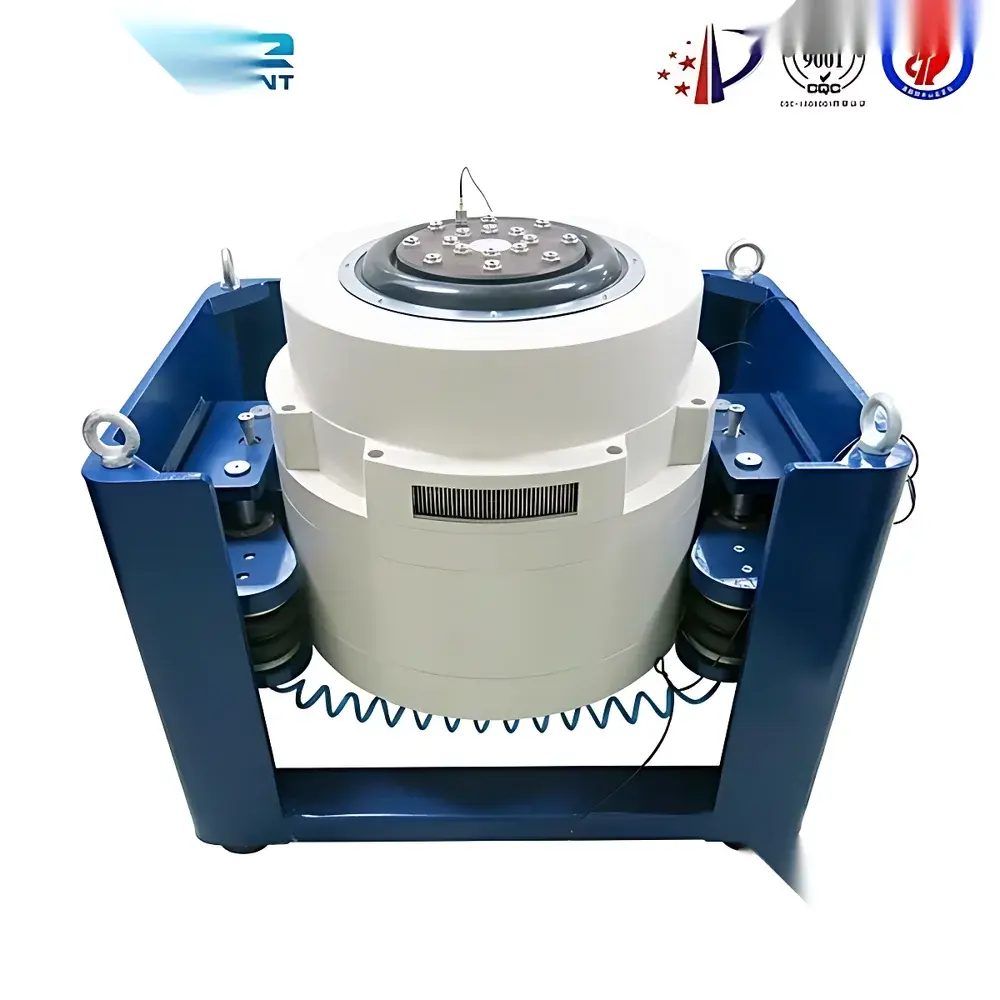
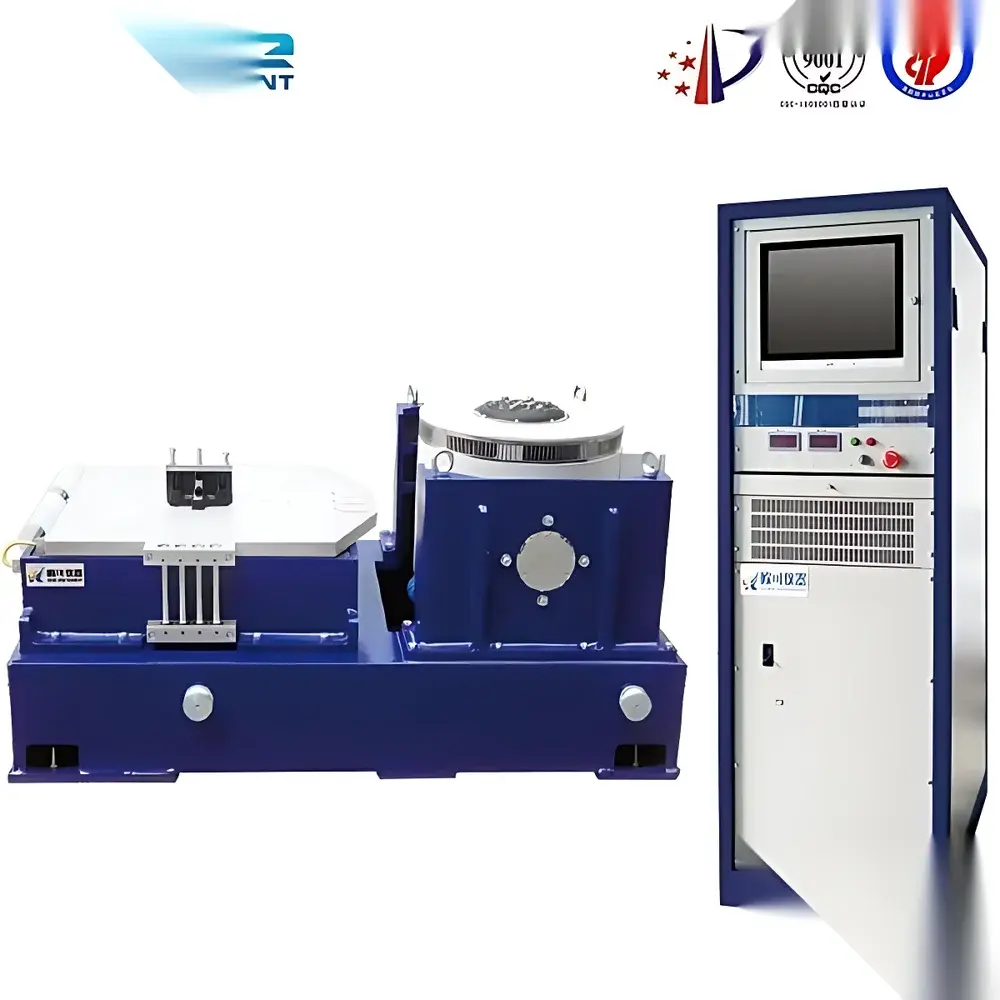
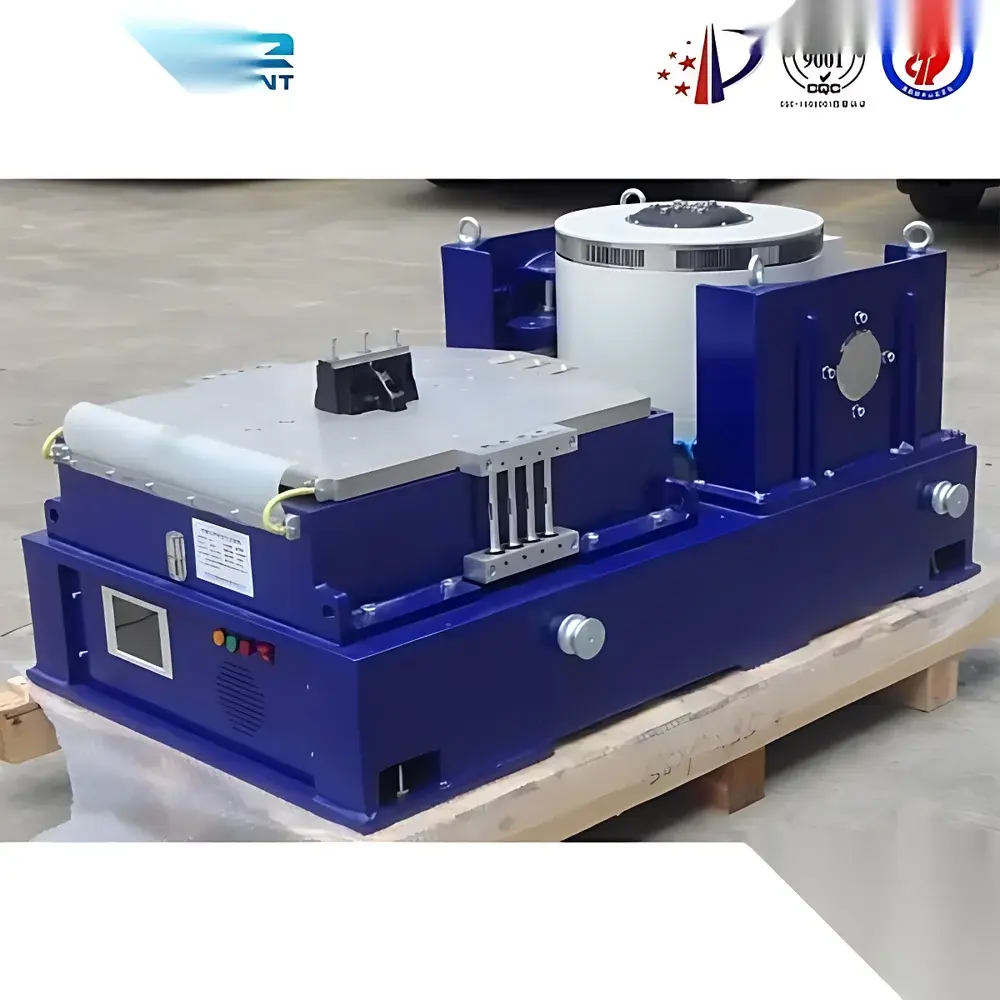
OK-ES-10 Dual-Axis Electromechanical Vibration Shaker System
| Brand | Other Brands |
|---|---|
| Origin | Imported |
| Manufacturer Type | Authorized Distributor |
| Frequency Range | 10–100 Hz (equivalent to 600–6000 rpm) |
| Max. Acceleration | 20 g (peak) |
| Peak-to-Peak Amplitude | 5 mm (standard), up to 25.4 mm at low frequencies |
| Load Capacity | 50 kg (horizontal/vertical) |
| Effective Table Size | 1000 × 1000 mm |
| Timing Range | 0 s – 99 h 59 min |
| Speed Display Resolution | 0.1 rpm |
| Drive Type | DC Motor with Analog Speed Control |
| Power Supply | 380 V, 50 Hz, 1 HP (0.75 kW) |
| Compliance Standards | ASTM D999, ISTA 3A/3B/3E, EN 60068-2-6, ANSI S2.18, UL 60950-1 |
| Net Weight | ~300 kg |
Overview
The OK-ES-10 Dual-Axis Electromechanical Vibration Shaker System is a precision-engineered test platform designed for controlled sinusoidal vibration excitation in both vertical (Z-axis) and horizontal (X/Y-axis) orientations. Unlike hydraulic or servo-hydraulic shakers, this system employs a robust DC-motor-driven eccentric mass mechanism, delivering repeatable, low-noise mechanical oscillation suitable for laboratory-grade environmental stress screening (ESS), early-life failure detection, and structural durability validation. Its operational envelope spans 10–100 Hz (600–6000 rpm), with programmable acceleration up to 20 gpeak and peak-to-peak displacement configurable from 1 mm to 25.4 mm—governed by the fundamental relationship a = 0.002 × f² × D, where a is acceleration (g), f is frequency (Hz), and D is displacement (mm). This physics-based constraint ensures mechanical integrity across the full operating range while maintaining compliance with international transport and reliability testing protocols.
Key Features
- Dual-axis capability: Independent or synchronized vertical/horizontal vibration modes for multi-directional stress simulation
- High-resolution analog speed control: 0.1 rpm display resolution enables precise frequency stepping during sweep tests (e.g., logarithmic or linear sweep per ASTM D999)
- Reinforced aluminum alloy table (1000 × 1000 mm) with T-slots for secure fixture mounting and load distribution
- Thermally stable DC motor drive (0.75 kW) with integrated overload protection and thermal cutoff
- Microprocessor-based timer with non-volatile memory: Supports timed operation from 0 seconds to 99 hours 59 minutes; retains settings after power cycle
- Front-panel LED display with dedicated indicators for run/status/fault conditions
- Structural frame engineered for minimal resonance coupling below 8 Hz, ensuring measurement fidelity during low-frequency fatigue cycles
Sample Compatibility & Compliance
The OK-ES-10 accommodates packaged goods, electronic assemblies, automotive components, and consumer appliances weighing up to 50 kg on its rigid work surface. Its mechanical architecture meets the mechanical input requirements of major international standards, including:
– ASTM D999: Standard Test Methods for Shock and Vibration Testing of Shipping Containers
– ISTA 3 Series (3A, 3B, 3E): Performance-based simulation of parcel delivery and unitized palletized shipment environments
– EN 60068-2-6: Environmental testing — Part 2-6: Tests — Test Fc: Vibration (sinusoidal)
– ANSI S2.18: Mechanical Vibration — Measurement of Vibration Parameters
– UL 60950-1: Safety standard for information technology equipment, including vibration-induced mechanical hazard assessment.
All units undergo factory calibration verification against traceable reference accelerometers and laser vibrometers prior to shipment. Documentation includes calibration certificate, mechanical safety report, and electrical compliance summary aligned with CE marking directives (2014/30/EU EMC Directive and 2014/35/EU LVD).
Software & Data Management
While the OK-ES-10 operates as a standalone analog-controlled shaker, it features a standardized 0–10 V analog input interface compatible with third-party signal generators and data acquisition systems (e.g., National Instruments DAQmx, Dewesoft X, or Brüel & Kjær Pulse). Users may integrate real-time acceleration monitoring via IEPE sensors connected to external analyzers for closed-loop amplitude verification. The system supports manual sweep execution per defined profiles and provides analog tachometer output for synchronization with oscilloscopes or FFT analyzers. For regulated environments requiring auditability, optional RS-232 or USB-to-serial adapters enable basic command logging (start/stop/time remaining) into CSV files—sufficient for GLP-aligned test record retention under internal QA procedures. Full 21 CFR Part 11 compliance requires integration with validated LIMS or ELN platforms, which is supported via custom API development upon request.
Applications
- Environmental stress screening (ESS) of PCBAs and embedded controllers prior to burn-in
- Transport simulation for e-commerce packaging per ISTA 3A (parcel carriers) and ISTA 3E (mixed-load pallets)
- Vibration fatigue life estimation of plastic housings, connectors, and solder joints in automotive ECUs
- Structural resonance mapping of enclosures and chassis using stepped-sine sweeps
- Verification of fastener retention integrity under repeated inertial loading
- Pre-qualification testing for MIL-STD-810H Method 514.8 (vibration) and Method 516.7 (shock)
FAQ
What is the maximum payload capacity for horizontal vs. vertical vibration modes?
The rated load capacity is 50 kg for both orientations. Exceeding this limit may compromise amplitude linearity and accelerate bearing wear.
Can the OK-ES-10 perform random vibration profiles?
No. It is a fixed-frequency or swept-sine electromechanical shaker. Random vibration requires electrodynamic shakers with digital controller integration (e.g., LDS V875 or TIRA TV 50120).
Is the 25.4 mm amplitude achievable across the entire frequency range?
No. Per the acceleration-displacement constraint (a ≤ 20 g), 25.4 mm is only feasible below ~10 Hz. At 100 Hz, maximum allowable P-P displacement is 1 mm.
Does the system include vibration isolation feet or require external isolation?
The unit ships with adjustable leveling feet but no active or passive isolators. Installation on a reinforced concrete floor (≥300 mm thickness) is mandatory to prevent energy coupling into building structures.
What maintenance intervals are recommended?
Lubrication of eccentric shaft bearings every 500 operational hours; inspection of belt tension and motor brush wear every 1,000 hours; annual verification of speed calibration using a handheld tachometer traceable to NIST standards.



