
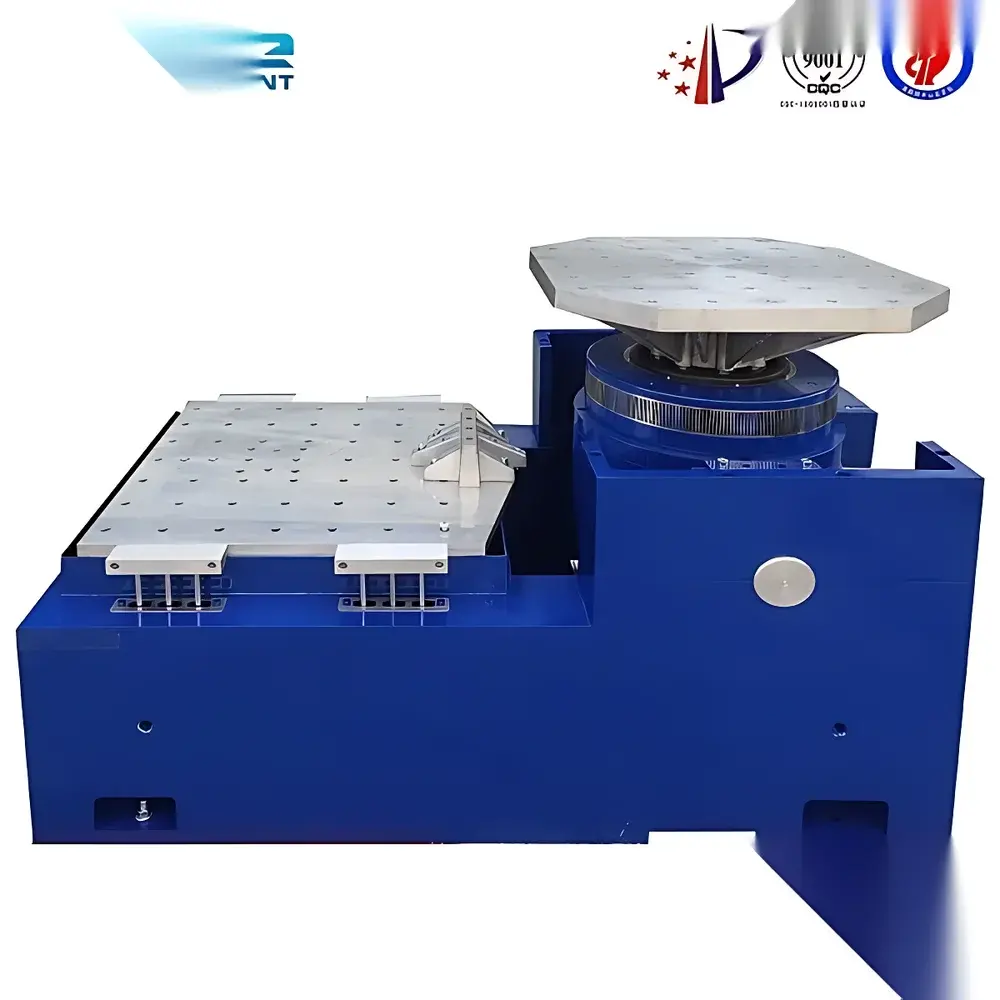
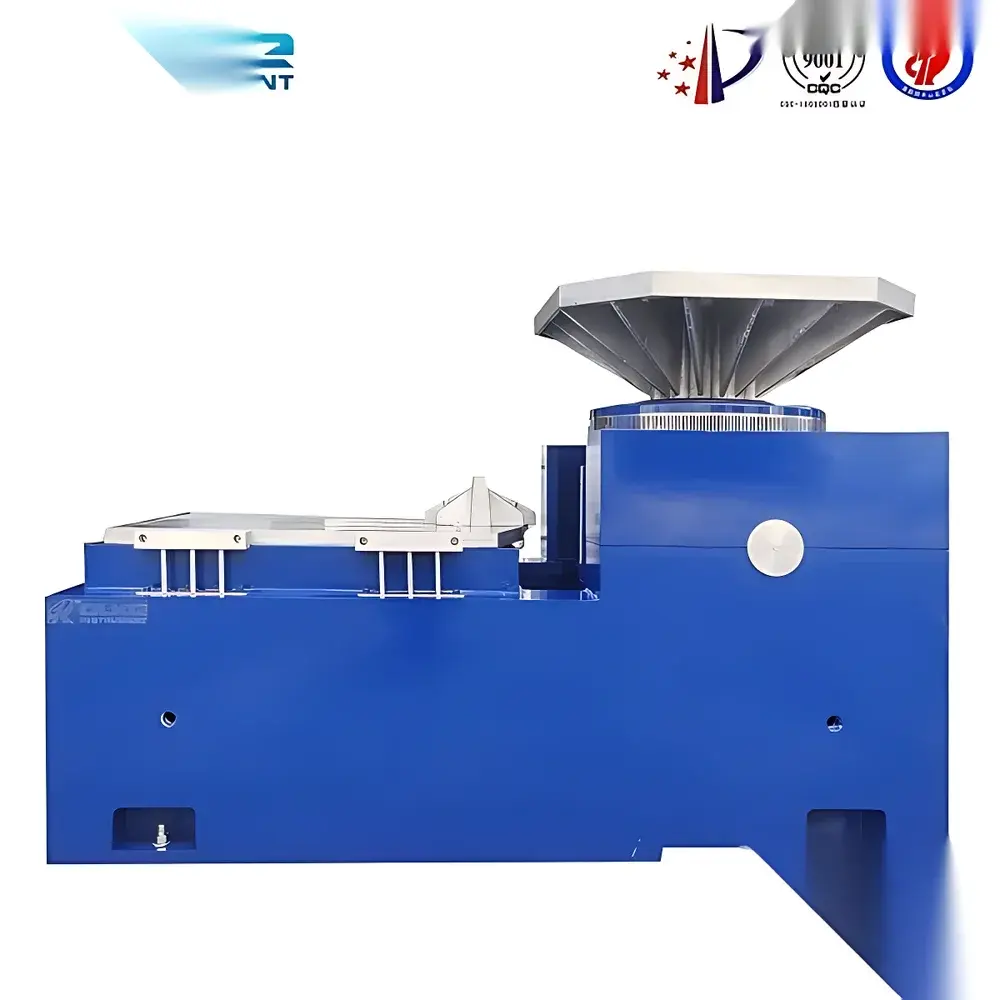
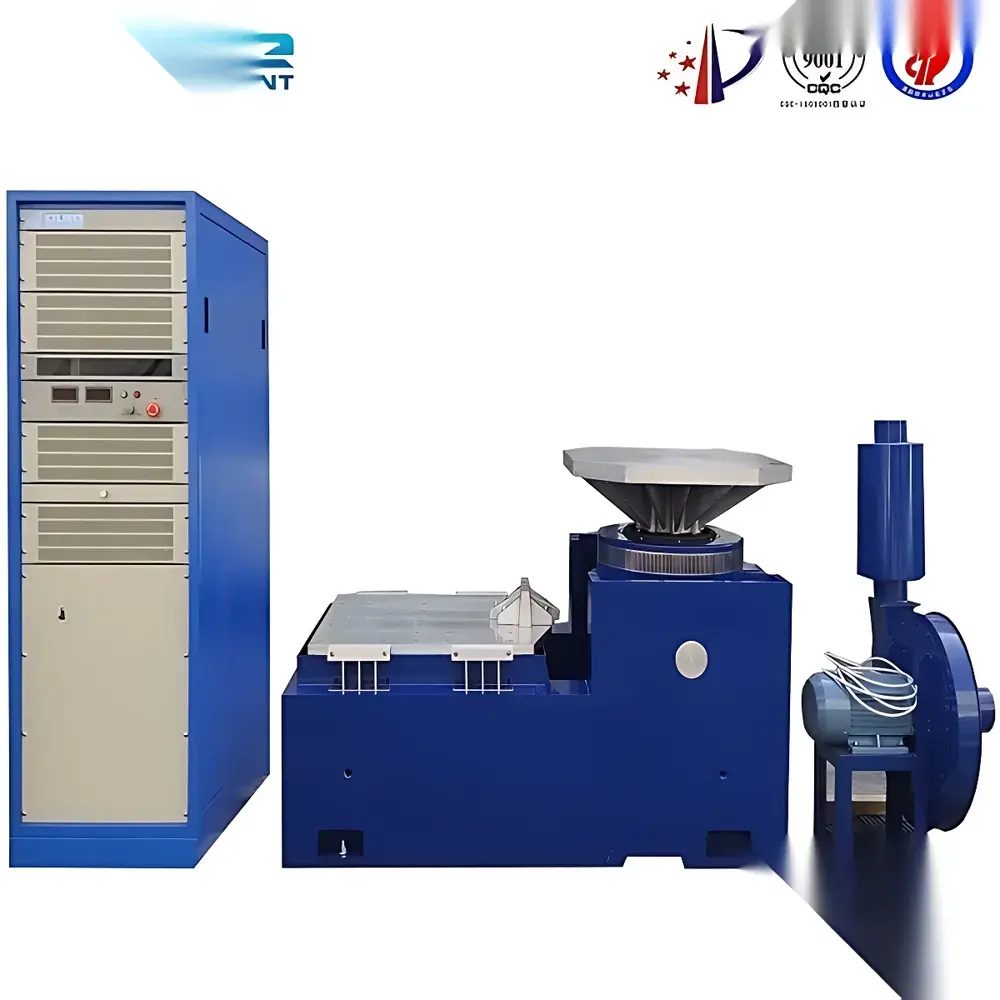
OK-ES-10 Electric Vibration Testing System Controller
| Brand | Other Brands |
|---|---|
| Origin | Imported |
| Manufacturer Type | General Distributor |
| Speed Range | 60–300 rpm (adjustable) |
| Speed Resolution | ±1 rpm |
| Vibration Mode | Reciprocating |
| Peak-to-Peak Amplitude | 25.4 mm |
| Load Capacity | 70 kg |
| Effective Table Area | 1200 mm × 1100 mm |
| Timer Range | 0 s to 99 h |
| Motor Power | 1 HP (DC motor with soft-start) |
| Drive Mechanism | Synchronous low-noise timing belt |
| Base Construction | Heavy-duty channel steel frame with vibration-damping rubber mounts |
| Table Surface | Stainless steel |
| Fixturing | Aluminum clamping assembly with manual handwheel adjustment |
| Power Supply | 220 V, 50 Hz |
| Net Weight | 230 kg |
| Compliance | ASTM D999, ISO 2247, EN 71-1 |
Overview
The OK-ES-10 Electric Vibration Testing System Controller is an electromechanical shaker platform engineered for controlled simulation of transport-induced vibration environments. It operates on a reciprocating motion principle—mechanically driven by a DC motor coupled to a precision timing belt transmission—to replicate the low-frequency, high-displacement vibrational profiles typical of road, rail, and maritime freight logistics. Unlike servo-hydraulic or electrodynamic shakers designed for high-frequency spectral analysis, this system delivers deterministic, repeatable sinusoidal displacement excitation at fixed frequencies within the 1–5 Hz range (corresponding to 60–300 rpm), making it purpose-built for package integrity evaluation and structural durability screening under standardized distribution conditions. Its mechanical architecture prioritizes stability, load-bearing integrity, and operational repeatability over broadband frequency agility—aligning with the requirements of ASTM D999 (Standard Test Methods for Shock and Vibration Testing of Shipping Containers), ISO 2247 (Packaging — Complete, filled transport packages — Vibration testing), and EN 71-1 (Safety of toys — Part 1: Mechanical and physical properties).
Key Features
- Heavy-duty channel steel base integrated with calibrated elastomeric damping mounts ensures minimal energy transmission to supporting structures and maintains consistent dynamic response across repeated test cycles.
- Stainless steel working surface (1200 mm × 1100 mm) provides corrosion resistance, dimensional stability, and ease of cleaning—critical for multi-product validation in QC laboratories and packaging R&D facilities.
- Modular aluminum fixture system with ergonomic handwheel actuation enables rapid, tool-free product securing without introducing mounting-induced stress concentrations or resonance coupling artifacts.
- DC motor with soft-start circuitry and synchronous timing belt drive delivers smooth acceleration/deceleration profiles, reducing mechanical shock transients during test initiation and termination—key for preserving test specimen integrity.
- Digital speed controller with ±1 rpm resolution supports precise replication of standardized vibration schedules defined in transport simulation protocols, including variable-speed ramping sequences required by certain ASTM and ISTA procedures.
- Programmable timer (0 seconds to 99 hours) allows unattended execution of extended durability tests, supporting long-duration exposure assessments per ISO 2247 Clause 7.3 and ASTM D999 Section 8.2.
Sample Compatibility & Compliance
The OK-ES-10 accommodates packaged consumer goods up to 70 kg—including finished electronics enclosures, toy cartons, ceramic ware shipments, automotive interior modules, and furniture subassemblies—without requiring custom adapters or auxiliary support fixtures. Its 25.4 mm peak-to-peak amplitude and fixed reciprocating stroke are calibrated to match the vertical displacement envelope observed in Class I–III commercial vehicle suspension systems under loaded conditions. The system meets essential regulatory and industry-standard conformance criteria: full compliance with ASTM D999 Type A (vertical vibration), ISO 2247 Method A (fixed-frequency sinusoidal), and EN 71-1 Clause 8.11 (vibration resistance of toy packaging). While not certified for GLP/GMP audit trails out-of-the-box, its mechanical repeatability and traceable speed calibration support integration into validated quality management systems when paired with external data logging hardware.
Software & Data Management
The OK-ES-10 operates via an embedded digital control panel with LED-based speed and timer readouts; no proprietary PC software is included. However, analog output signals (0–10 V DC) for real-time speed feedback and relay-triggered start/stop status are provided for integration with third-party SCADA platforms, PLC-controlled test cells, or automated data acquisition systems compliant with ISO/IEC 17025 documentation requirements. Users may log operational parameters—including elapsed time, setpoint rpm, and cycle count—using external timestamped recording devices. For regulated environments requiring electronic records integrity, the system can be interfaced with 21 CFR Part 11-compliant software solutions via optional RS-485 or Modbus RTU modules (sold separately), enabling audit-ready test logs with user authentication and change history tracking.
Applications
- Package design validation for e-commerce fulfillment centers subject to last-mile delivery vibration profiles.
- Pre-shipment qualification testing of medical device packaging per ISO 11607-2 Annex C guidance.
- Structural fatigue assessment of consumer appliance housings during accelerated life-cycle simulation.
- Verification of corrugated box compression strength retention after simulated transit exposure.
- Supplier qualification audits where OEMs mandate minimum vibration endurance thresholds prior to component release.
- Academic research in packaging engineering departments evaluating damping material efficacy under controlled displacement excitation.
FAQ
Is the OK-ES-10 suitable for high-frequency random vibration testing?
No. This system is mechanically limited to fixed-frequency reciprocating motion between 1–5 Hz (60–300 rpm); it does not support broadband random or swept-sine profiles characteristic of electrodynamic shakers.
Can the vibration amplitude be adjusted beyond 25.4 mm?
No. The stroke length is mechanically fixed at 25.4 mm (1 inch) peak-to-peak; amplitude modulation is not supported.
Does the unit include calibration certification?
The system ships with factory-set speed calibration verified against NIST-traceable tachometric standards; formal ISO/IEC 17025 calibration documentation is available upon request at additional cost.
What safety interlocks are integrated?
A hardware-enabled emergency stop circuit interrupts motor power immediately upon activation; no optical or proximity-based safety curtains are included as standard equipment.
Is 220 V, 50 Hz operation compatible with North American 120 V, 60 Hz infrastructure?
No. Voltage and frequency conversion requires an externally sourced industrial-grade transformer/inverter system rated for continuous 1 HP motor load.



