
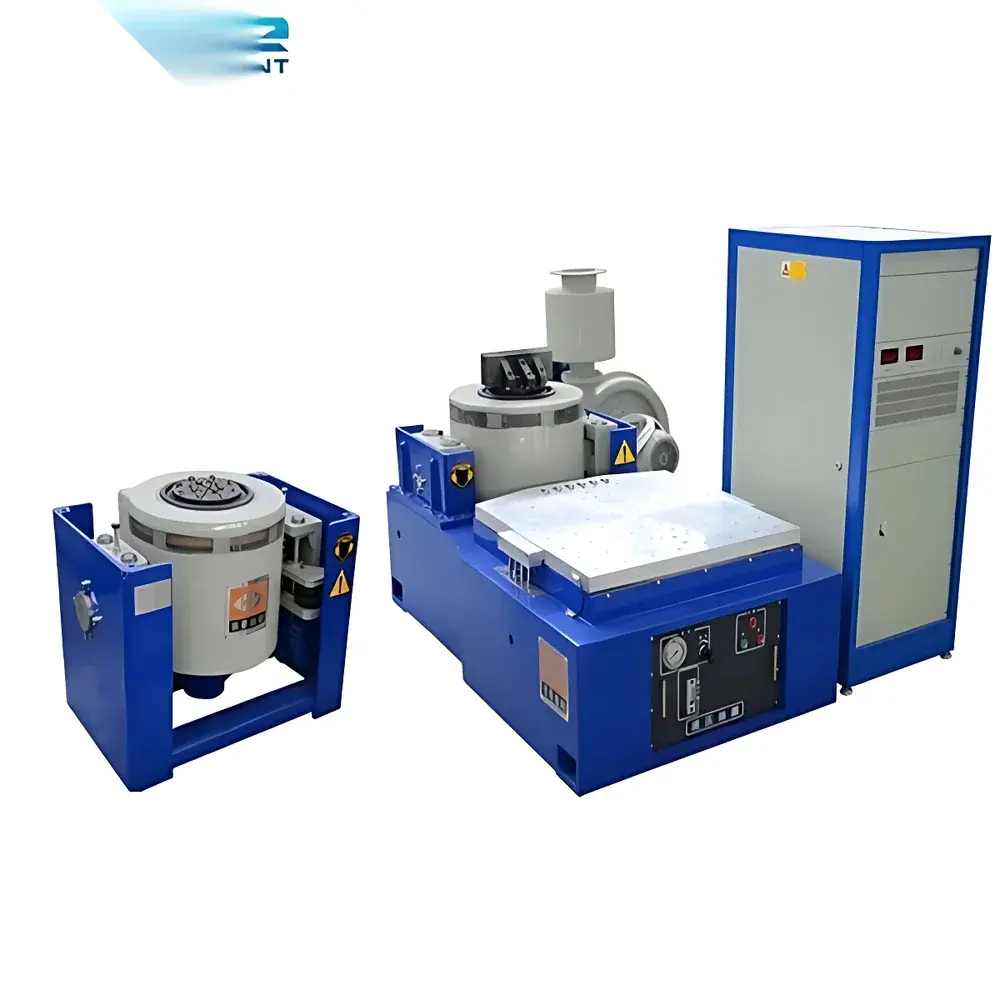
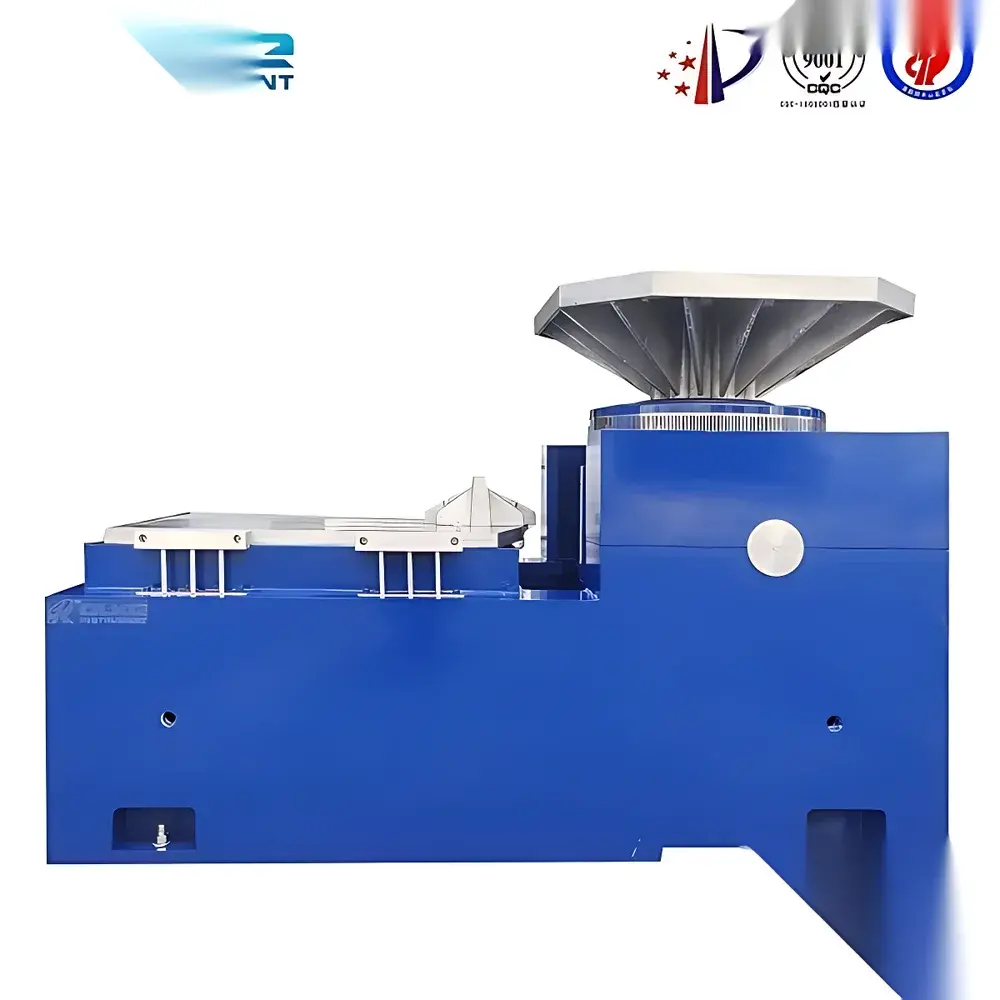
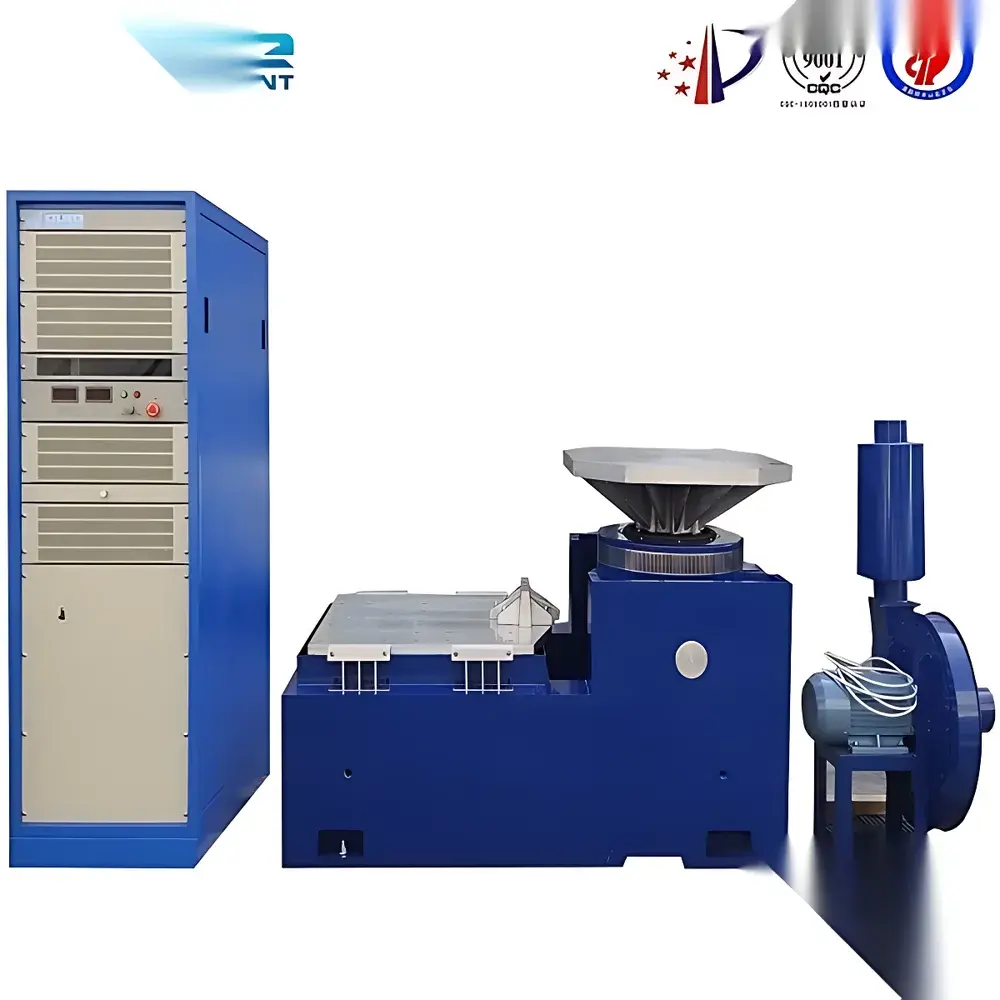
OK-ES-10 Heavy-Duty Rotary Vibration and Shock Test System
| Brand | Other Brands |
|---|---|
| Origin | Imported |
| Manufacturer Type | Authorized Distributor |
| Vibration Frequency Range | 10–100 Hz (equivalent to 600–6,000 rpm) |
| Max Acceleration | 20 g (peak) |
| Peak-to-Peak Amplitude | 5 mm (adjustable down to 1 mm per frequency constraints) |
| Load Capacity | 50 kg (standard), up to 100 kg (custom configuration) |
| Effective Table Surface | 1000 × 1000 mm |
| Time Setting Range | 0 s – 99 h 59 min |
| Speed Display Resolution | 0.1 rpm |
| Drive Method | DC Motor with Precision Speed Control |
| Power Supply | 380 V, 50 Hz, 1 HP (0.75 kW) |
| Machine Dimensions (W×D×H) | 1100 × 1300 × 650 mm |
| Net Weight | ~300 kg |
| Compliance Standards | ASTM D4169, ISTA 3A/3E/3H, EN 15308, ANSI X3.37, UL 60950, MIL-STD-810H (Vibration & Shock Sections) |
Overview
The OK-ES-10 Heavy-Duty Rotary Vibration and Shock Test System is an electromechanical shaker platform engineered for repeatable, high-fidelity simulation of transport-induced mechanical stress on packaged goods—particularly luggage, carry-on cases, travel bags, and logistics containers. Unlike resonant or servo-hydraulic systems, this unit employs a robust rotary eccentric-mass drive architecture with dual magnetic circuits, self-supporting moving-coil assembly, pneumatic suspension supports, linear bearing–guided roller motion, and elastomeric pivot isolation. It delivers controlled sinusoidal vibration, broadband random excitation, and classical shock pulses—including half-sine, trapezoidal, and rear-peak sawtooth waveforms—enabling full compliance with international packaging durability protocols. The system operates within a frequency range of 10–100 Hz (600–6,000 rpm equivalent), with peak acceleration capped at 20 g and peak-to-peak displacement limited to 5 mm—dynamically constrained per the physical relationship a = 0.002 × f² × D, where a is acceleration (g), f is frequency (Hz), and D is displacement (mm). This ensures test integrity across variable spectral content without exceeding structural limits of test specimens or fixture interfaces.
Key Features
- Triple-axis capable mechanical design supporting X-, Y-, and Z-directional vibration testing via configurable mounting orientation
- DC motor-driven eccentric mass system with closed-loop speed regulation and real-time RPM feedback (±0.1 rpm resolution)
- Pneumatic suspension and elastomeric ear-axis isolation minimize base-frame transmission and improve test repeatability
- Linear-bearing–guided roller mechanism ensures low-friction, non-binding motion over extended duty cycles
- Programmable timer with 0-second to 99-hour 59-minute range, supporting multi-stage test profiles and dwell intervals
- Modular integration interface for optional environmental chamber coupling—enabling combined vibration + temperature/humidity conditioning per MIL-STD-810H Method 514.8 and IEC 60068-2-64
- Standard 1000 × 1000 mm stainless steel test table with T-slot pattern for universal fixture attachment
Sample Compatibility & Compliance
The OK-ES-10 accommodates rigid and semi-rigid consumer packages up to 100 kg (with reinforced support), including wheeled luggage, hard-shell suitcases, duffel bags, courier pouches, and industrial shipping containers. Its dynamic envelope satisfies test severity requirements defined in ASTM D4169 (Performance Testing of Shipping Containers), ISTA Series 3 (e.g., 3A for parcel carriers, 3E for mixed-load pallets, 3H for unitized loads), EN 15308 (Packaging — Requirements for Transport Packaging), and ANSI X3.37 (Vibration Testing of Packaged Products). All control logic and data logging meet GLP-aligned traceability requirements; audit trails, user access logs, and parameter lockout functions can be enabled to support FDA 21 CFR Part 11–compliant validation when integrated with certified software modules.
Software & Data Management
While the base unit operates via front-panel digital controls, optional PC-based control software provides waveform synthesis, spectral shaping (PSD generation), shock response spectrum (SRS) calculation, and real-time FFT analysis. Data export conforms to CSV and MATLAB-compatible .mat formats. All test configurations—including amplitude/frequency sweeps, dwell times, and pulse definitions—are stored with timestamped metadata. Firmware supports firmware revision tracking, calibration certificate import, and automated report generation compliant with ISO/IEC 17025 documentation standards. Remote monitoring via Ethernet or RS-485 enables integration into centralized lab management platforms.
Applications
- Validation of suitcase wheel durability, handle retention, zipper integrity, and shell impact resistance under simulated air cargo handling
- Verification of packaging system performance against drop, bounce, and road-transport vibration spectra
- Pre-shipment qualification testing for e-commerce fulfillment centers per Amazon’s APASS or Walmart’s SGS requirements
- Design verification of internal compartment bracing, foam inserts, and suspension systems in premium luggage
- Accelerated life testing of closure mechanisms (zippers, buckles, magnetic latches) under cyclic mechanical fatigue
- Supporting root-cause analysis during field failure investigations through controlled reproduction of transport-induced damage modes
FAQ
What is the maximum payload capacity under standard configuration?
The system is rated for 50 kg under default settings; however, structural reinforcement kits and recalibrated suspension tuning allow operation up to 100 kg—subject to amplitude reduction per the 20 g ceiling constraint.
Can this system perform random vibration testing?
Yes—it supports broadband random excitation with user-defined power spectral density (PSD) profiles, compliant with MIL-STD-810H Method 514.8 and ISO 10326-1.
Is climate chamber integration available as a factory option?
Yes—custom-engineered thermal-humidity enclosures with ±0.5 °C / ±2% RH stability are available with synchronized vibration triggering and environmental data logging.
Does the system include calibration certification?
Each unit ships with NIST-traceable accelerometer calibration data and a factory-verified amplitude/frequency linearity report valid for 12 months.
What safety interlocks are implemented?
Hardware-enforced emergency stop circuitry, door-position sensing, over-acceleration cutoff, and motor thermal overload protection conform to IEC 60204-1 and EN 61800-5-2 functional safety standards.



