
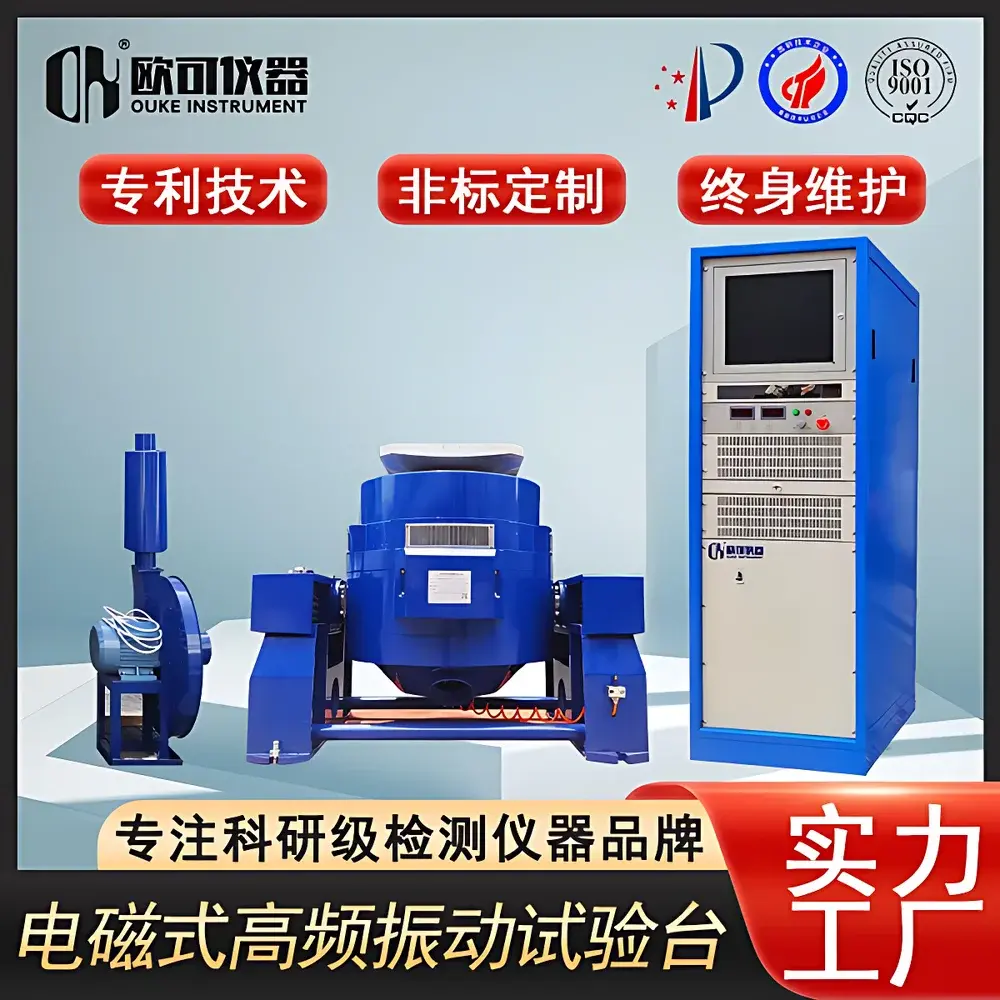
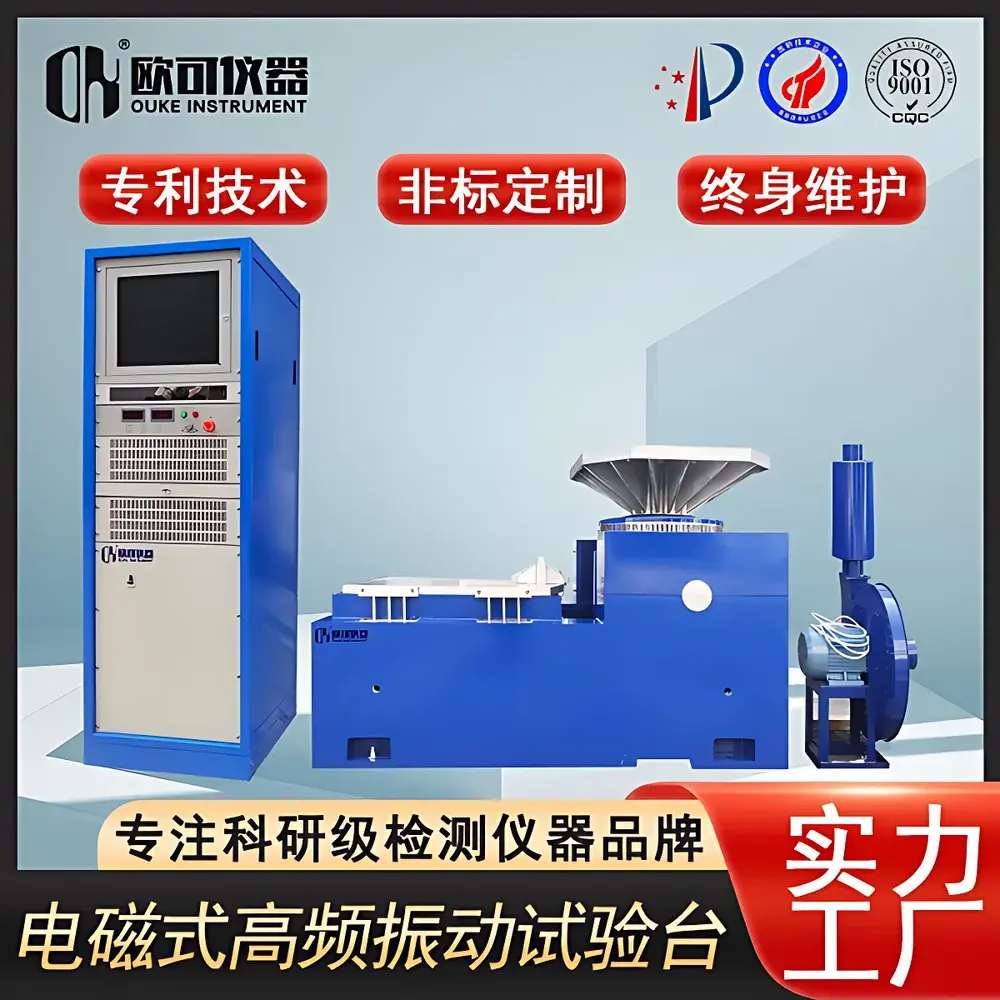
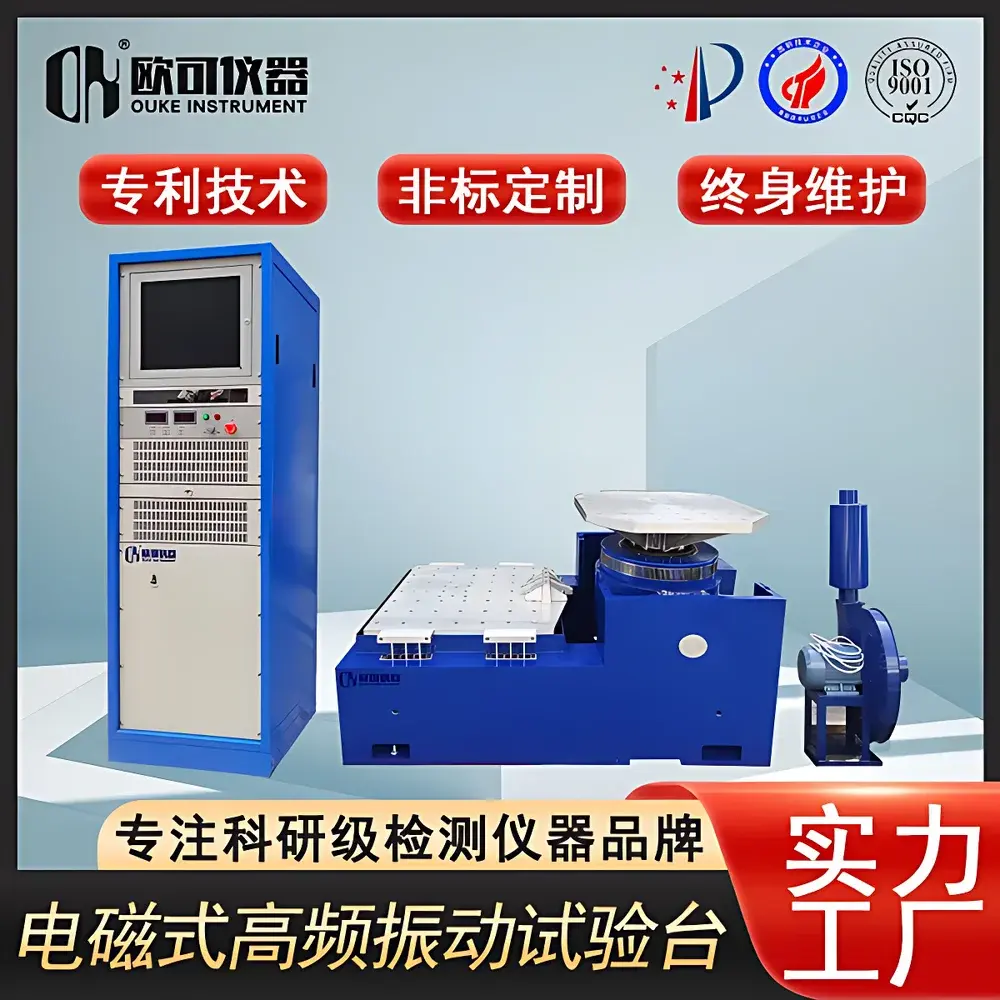
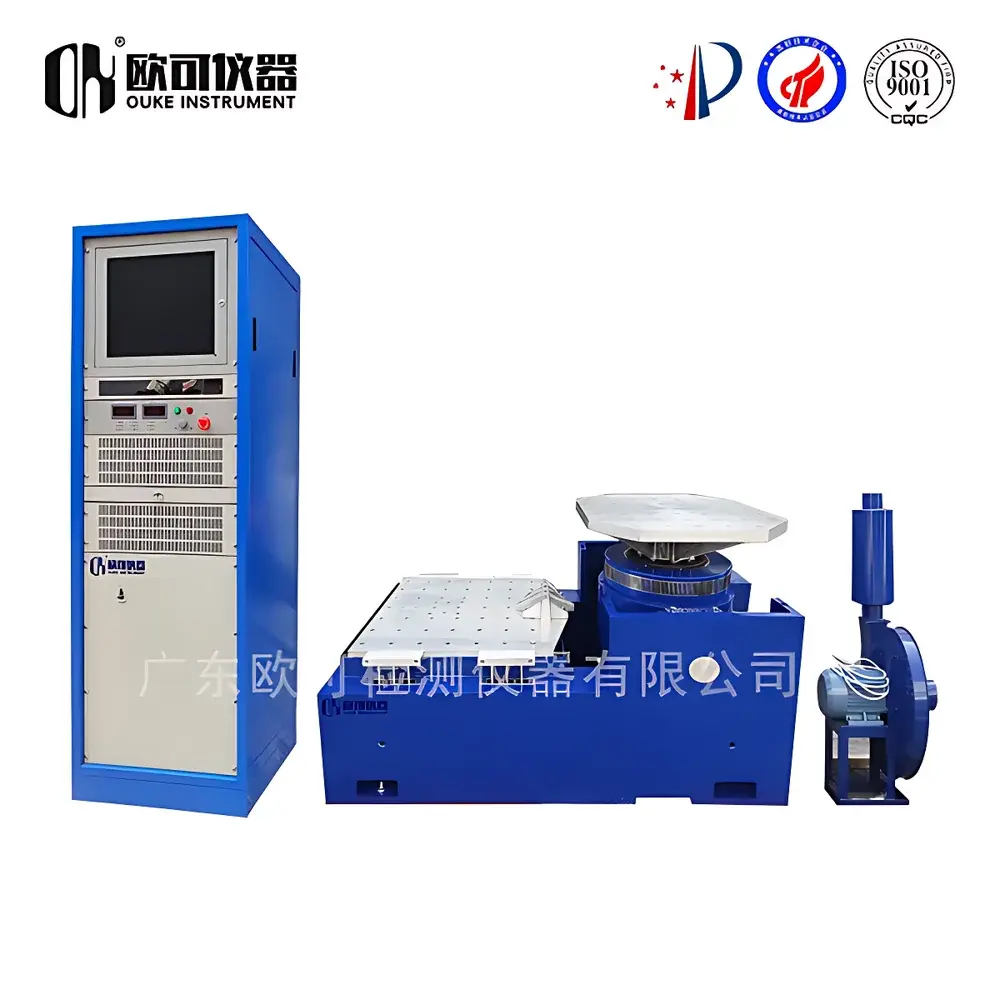
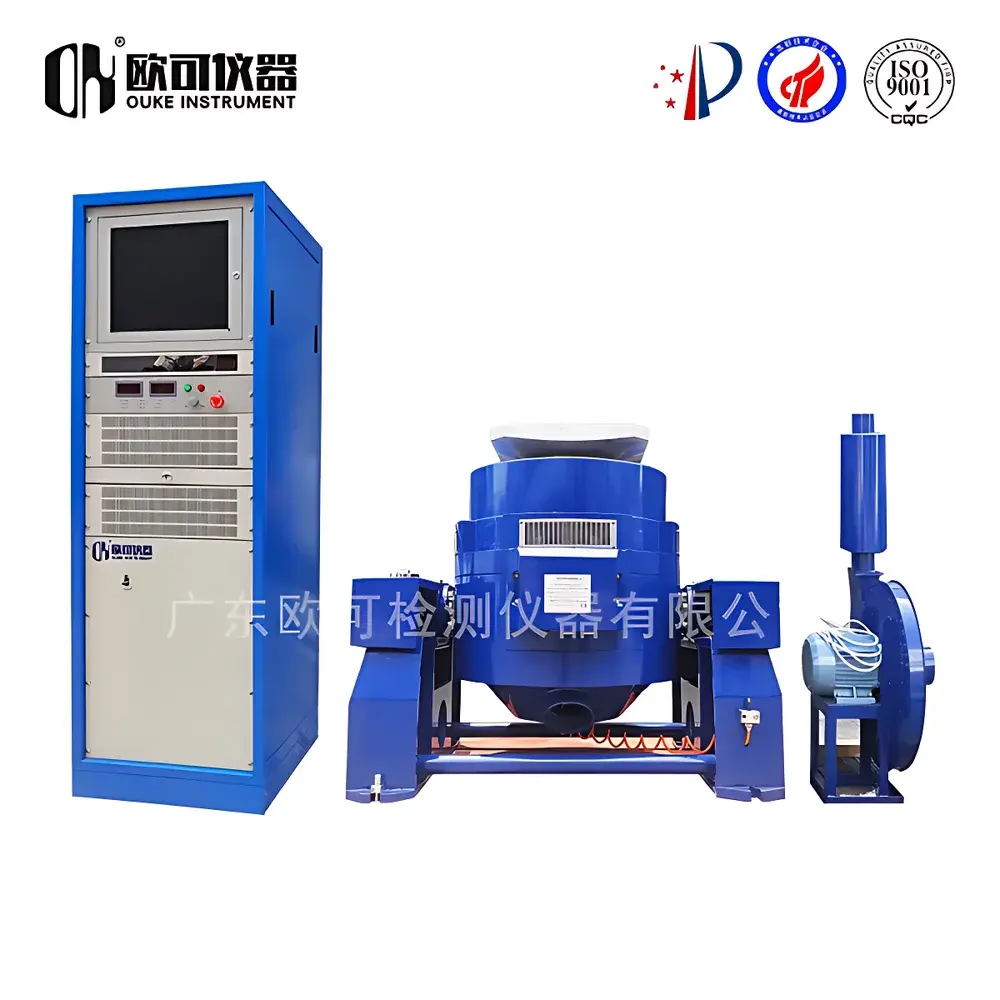
OK-ES-3.3335 Desktop Electromagnetic Vibration Shaker
| Brand | OK Instruments |
|---|---|
| Origin | Guangdong, China |
| Manufacturer Type | OEM/ODM Producer |
| Instrument Type | Electromagnetic Vibration Shaker |
| Rated Thrust | 1.98 kN |
| Frequency Range | 5–5000 Hz |
| Max. Test Load | 70 kg |
| Table Dimensions | 400 × 400 × 30 mm |
| Max. Acceleration | 10 g |
Overview
The OK-ES-3.3335 Desktop Electromagnetic Vibration Shaker is a compact, high-fidelity electrodynamic shaker engineered for precision vibration testing of lightweight components and subassemblies in R&D, quality assurance, and academic environments. It operates on the principle of Lorentz-force actuation—where a current-carrying voice coil interacts with a permanent magnetic field to generate controlled inertial excitation. This design eliminates the need for external field excitation, ensuring low power consumption, rapid thermal stability, and immediate operational readiness. Unlike large-scale industrial shakers requiring reinforced foundations and dedicated HVAC infrastructure, the OK-ES-3.3335 is designed for benchtop deployment: its integrated base accommodates internal power amplification, forced-air cooling, and mechanical isolation, enabling stable operation on standard laboratory workbenches without structural modification. Its 1.98 kN rated thrust and 5–5000 Hz frequency bandwidth support full-spectrum modal analysis, sine dwell, random vibration (per ISO 10816, MIL-STD-810H Method 514.8), and classical shock profiles (half-sine, trapezoidal, sawtooth per IEC 60068-2-27). The system meets fundamental requirements for early-stage reliability screening, environmental stress screening (ESS), and qualification-level testing of electronics up to 70 kg—including PCBs, MEMS sensors, automotive ECUs, consumer wearables, and aerospace avionics modules.
Key Features
- Permanent-magnet electromagnetic actuation with NdFeB magnet assembly—no external excitation supply required, delivering consistent field strength and minimal thermal drift.
- Integrated servo-controlled amplifier and intelligent thermal management—enabling continuous operation at rated acceleration without duty-cycle limitation.
- Benchtop-ready mechanical architecture: 400 × 400 × 30 mm aluminum alloy table with standardized M6 threaded mounting holes (16-hole pattern, 50 mm pitch) for rapid fixture attachment.
- Closed-loop acceleration feedback via integrated IEPE-compatible accelerometer input—supporting real-time amplitude regulation and waveform fidelity verification per IEEE 1057 compliance.
- Low-noise mechanical design (<72 dB(A) at 1 m distance) optimized for shared lab environments; no hydraulic or pneumatic subsystems.
- Compliance-ready control interface: USB 2.0 and Ethernet (TCP/IP) connectivity supporting remote operation, script-based test sequencing, and audit-trail logging.
Sample Compatibility & Compliance
The OK-ES-3.3335 supports test specimens ranging from microelectronic packages (e.g., QFN, BGA ICs) to assembled modules (e.g., ADAS camera housings, IoT gateway enclosures). Its 70 kg maximum payload includes fixture mass—emphasizing the necessity of lightweight aluminum or magnesium alloy fixtures to preserve dynamic headroom. The system is compatible with industry-standard vibration test standards including ISO 16750-3 (road vehicle electronics), AEC-Q200 (passive components), JEDEC JESD22-B103 (shock), and IPC-9701 (solder joint reliability). While not certified for full regulatory submission (e.g., FAA DO-160 Section 8), it provides traceable, repeatable data suitable for internal qualification, design validation, and GLP-aligned lab workflows. Calibration certificates (traceable to NIM, China) are provided with each unit; optional annual recalibration services include sensitivity verification across the full 5–5000 Hz band.
Software & Data Management
The shaker is operated via OK-VibControl™ v3.2—a Windows-based application supporting real-time spectrum monitoring, multi-axis synchronization (when paired with auxiliary channels), and automated report generation in PDF/CSV formats. The software implements FFT-based closed-loop control with <±0.5 dB amplitude tolerance and <±2° phase error across the operating bandwidth. All test configurations—including profile definitions, limit checks, abort conditions, and post-test diagnostics—are stored in encrypted XML files with embedded metadata (operator ID, timestamp, firmware version). Audit trail functionality satisfies FDA 21 CFR Part 11 requirements for electronic records: user authentication, immutable log entries, and electronic signature capability. Raw time-history data is saved in IEEE 754-compliant binary format (IEEE Float32) with 24-bit ADC resolution and 100 kHz sampling rate—ensuring compatibility with third-party analysis tools (MATLAB, Python SciPy, DIAdem).
Applications
- Resonance search and modal parameter extraction for printed circuit assemblies and MEMS packaging structures.
- Environmental Stress Screening (ESS) of solder joints and wire bonds using calibrated random vibration spectra (e.g., GR-63-CORE, Telcordia).
- Transport simulation per ISTA 3A and ASTM D4169—reproducing road, rail, and air cargo vibration environments for small electronics packaging.
- Shock qualification of medical device connectors and implantable sensor housings per ISO 14971 risk management protocols.
- Academic vibration mechanics instruction: experimental validation of single-degree-of-freedom (SDOF) systems, damping ratio estimation, and transmissibility curve derivation.
- Production line end-of-line (EOL) screening: rapid pass/fail verification of batched components using preloaded test templates.
FAQ
What is the maximum allowable fixture mass when testing a 50 kg device?
For optimal dynamic performance, fixture mass should not exceed 20% of total moving mass. With a 70 kg payload rating, we recommend keeping combined specimen + fixture mass ≤60 kg—leaving ≥10 kg margin for inertial compensation and safety factor.
Does the system support triaxial vibration testing?
The OK-ES-3.3335 is a single-axis vertical shaker. Triaxial capability requires orthogonal stacking with two additional units and synchronized controller hardware—available as the OK-TriAx-3335 configuration option.
Is third-party calibration documentation included?
Yes. Each unit ships with a factory calibration certificate (NIM-traceable), covering thrust output, acceleration linearity, and frequency response from 5 Hz to 5000 Hz. Optional ISO/IEC 17025-accredited calibration is available upon request.
Can the shaker be integrated into an environmental chamber?
The base unit is rated for ambient operation only (5–40 °C, <80% RH non-condensing). For temperature-humidity-vibration (THV) testing, OK Instruments offers the OK-ES-3.3335-TC variant with extended cabling, sealed connectors, and chamber-mounting brackets—compatible with standard 200 L walk-in chambers.
What maintenance intervals are recommended?
Routine inspection every 500 operational hours includes visual check of suspension integrity, coil alignment verification, and thermal pad condition. Annual preventive maintenance includes amplifier capacitor aging assessment and accelerometer sensitivity revalidation. No scheduled lubrication is required.



