
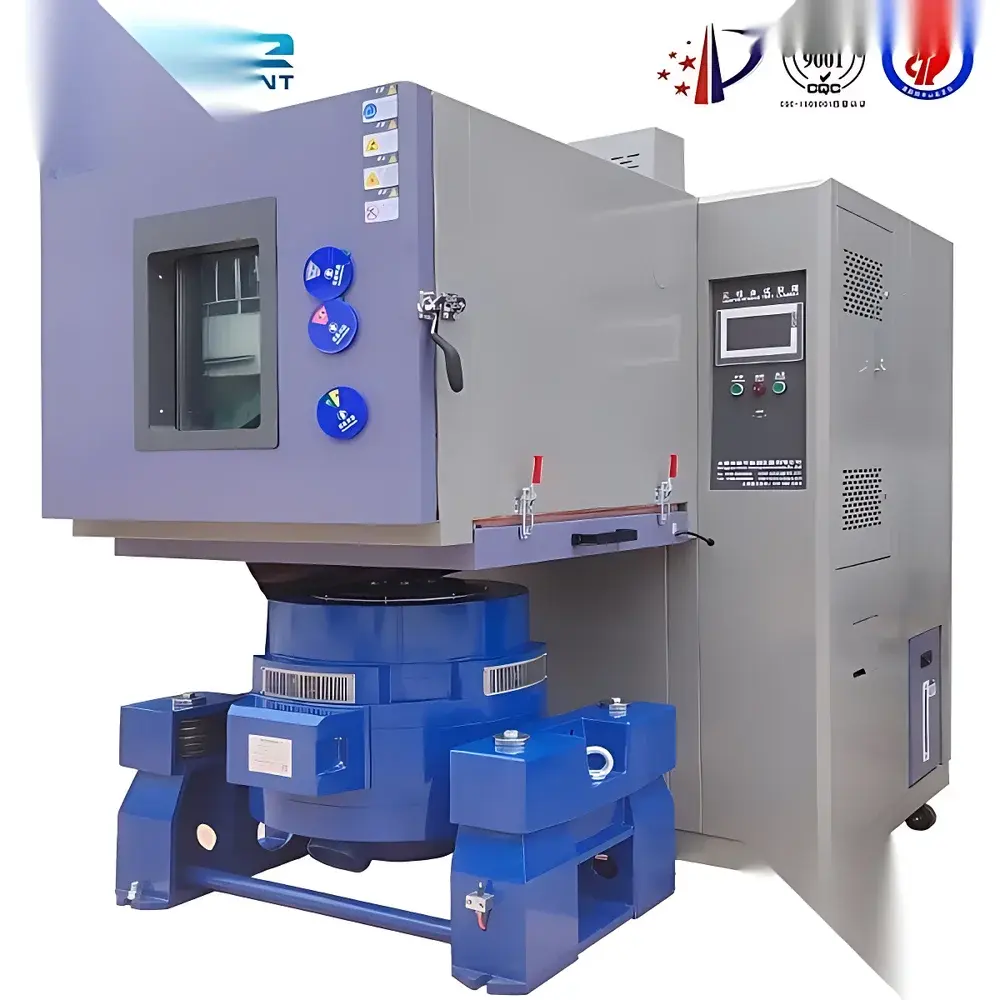
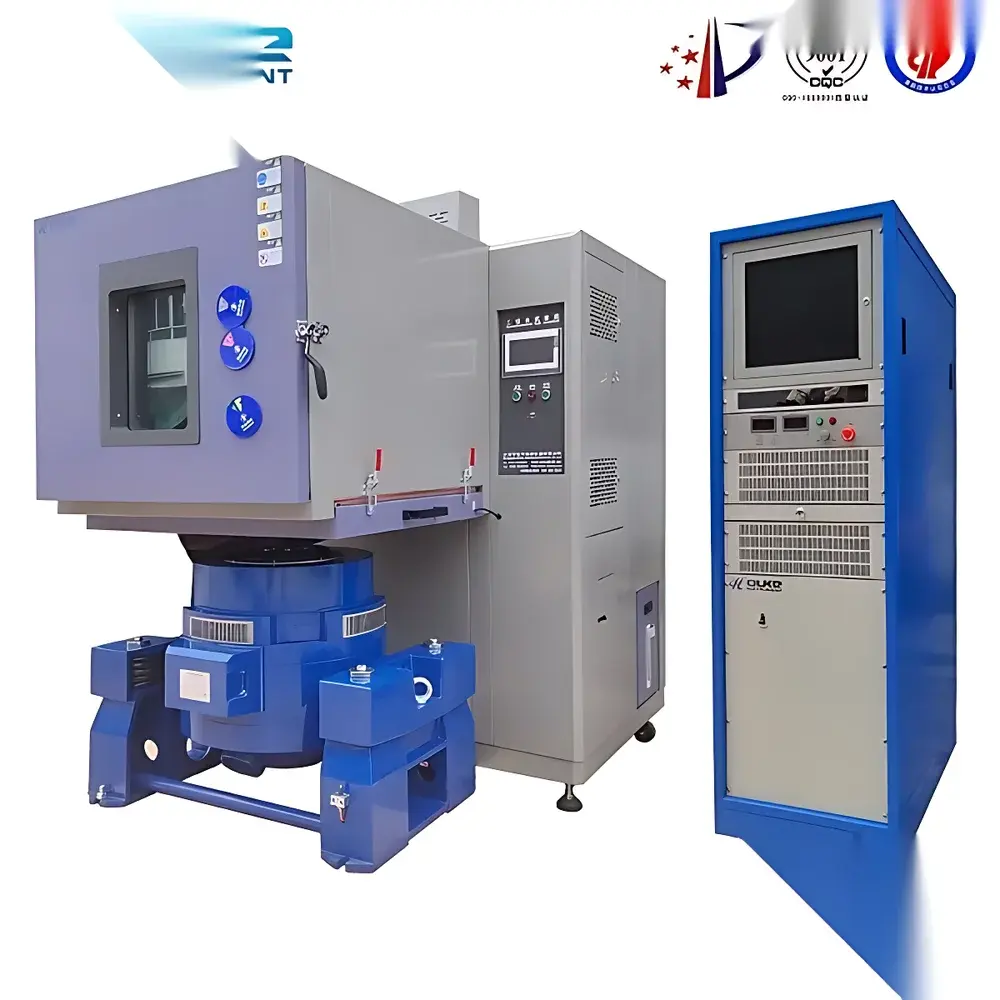
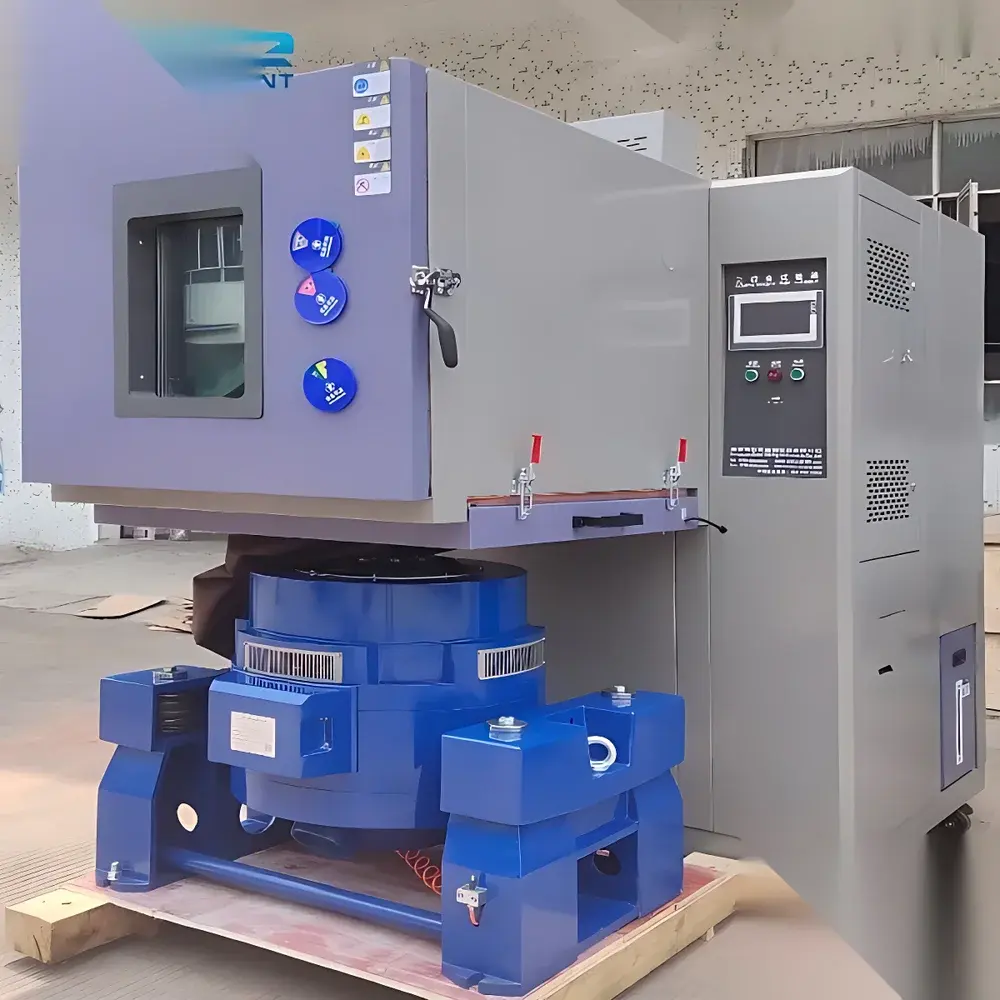
OK-ES Combined Temperature-Humidity-Vibration Test Chamber (Triaxial Environmental Stress Screening System)
| Brand | OK Instruments |
|---|---|
| Origin | Imported |
| Manufacturer Type | Authorized Distributor |
| Price | USD 21,500 (FOB) |
| Max. Load Capacity | 100 kg |
| Max. Dynamic Force | 2200 kgf |
| Frequency Range | 1–600 Hz (display resolution: 0.01 Hz) |
| Power Rating | 3.3 kW |
| Peak-to-Peak Amplitude Range | 0–5.2 mm |
| Max. Acceleration | 22 g |
| Acceleration Formula | a = 0.002 × f² × D (f in Hz, D in mm p-p) |
| Vibration Waveform | Sine (half-wave/full-wave) |
| Sweep Modes | Linear/logarithmic, programmable, bidirectional, repeatable |
| Control Interface | RS-485 (PC control & data logging optional) |
| Voltage Supply | 220 V AC, 15 A |
| Compliance | Designed to support ASTM D4728, ISO 16750-3, MIL-STD-810H Method 514.8, IEC 60068-2-6 & -2-64 |
Overview
The OK-ES Combined Temperature-Humidity-Vibration Test Chamber is an engineered triaxial environmental stress screening (ESS) system designed for simultaneous application of thermal, hygrothermal, and mechanical vibratory stresses on electronic assemblies, automotive components, aerospace subassemblies, and industrial enclosures. It integrates a high-fidelity electrodynamic shaker with a precision climate chamber to replicate real-world operational and transport-induced failure mechanisms—including resonant fatigue, solder joint cracking, interconnect loosening, condensation-induced corrosion, and thermomechanical delamination. Unlike sequential testing approaches, the OK-ES enables true concurrent exposure, ensuring accelerated detection of synergistic failure modes that cannot be identified under isolated stress conditions. Its architecture conforms to the physical principles of coupled thermo-mechanical dynamics, where temperature gradients modulate material stiffness and damping, while vibration excitation amplifies microstructural strain accumulation—critical for reliability qualification per JEDEC JESD22-B103, IPC-9701A, and AEC-Q200.
Key Features
- Triaxial vibration capability: Independent or synchronized excitation along X (horizontal), Y (lateral), and Z (vertical) axes—including programmable sequence modes (e.g., Z→X→Y cycling) and six-degree-of-freedom (6DOF) composite motion profiles.
- High-dynamic-range shaker: 2200 kgf peak force, 22 g maximum acceleration, and 5.2 mm p-p amplitude (frequency-dependent per ISO 5344 compliance), calibrated traceably to NIST standards.
- Climate chamber integration: Precise temperature range –70°C to +180°C and humidity range 10–98% RH, with rapid ramp rates (≥10°C/min, ≥5% RH/min) and uniformity ≤±1.5°C / ±3% RH across test volume.
- Full-spectrum programmability: Supports sine sweep (linear/logarithmic), resonance dwell, random vibration (PSD up to 0.04 g²/Hz), and mixed-mode profiles—all configurable via front-panel interface or optional PC software.
- Real-time parameter monitoring: On-screen display of instantaneous frequency (0.01 Hz resolution), acceleration (g), displacement (mm p-p), and phase angle; optional external transducer inputs for closed-loop control and validation.
- Robust mechanical isolation: Dual-stage air suspension and reinforced steel frame minimize floor-borne interference and ensure measurement integrity during long-duration HALT/HASS protocols.
Sample Compatibility & Compliance
The OK-ES accommodates test specimens up to 100 kg and 750 mm × 750 mm × 650 mm (W × D × H), supporting standard fixtures, fixtureless mounting plates, and custom load-bearing adapters. It meets structural and safety requirements for Class II equipment per IEC 61000-6-2/6-4 and carries CE marking. The system supports full audit trails for GLP/GMP environments when configured with optional 21 CFR Part 11-compliant software—enabling electronic signatures, user-level access control, and immutable data archiving. Test protocols align with ASTM D4728 (vibration durability of packaged products), ISO 16750-3 (road vehicle environmental conditions), and MIL-STD-810H Method 514.8 (vibration testing of airborne equipment). Calibration certificates are provided per ISO/IEC 17025-accredited laboratory procedures.
Software & Data Management
While the base unit operates via intuitive touch-enabled controller with built-in profile storage (≥1000 programs), optional PC integration (via RS-485 or Ethernet gateway) unlocks advanced functionality: real-time waveform visualization, multi-channel synchronized data acquisition (temperature, humidity, acceleration, displacement), automated report generation (PDF/CSV), and export-compatible metadata tagging (ISO/IEC 17025 traceability fields). The software supports hierarchical test sequencing, alarm-triggered emergency shutdown, and post-test FFT analysis for resonance identification. All stored data includes timestamp, operator ID, environmental setpoints, and shaker output parameters—ensuring full reproducibility and regulatory readiness.
Applications
- Reliability screening of PCBAs prior to field deployment (HASS/HALT).
- Validation of automotive ECU housings under combined thermal cycling and road-spectrum vibration.
- Qualification of medical device enclosures for IEC 60601-1 mechanical integrity.
- Package integrity assessment for e-commerce logistics (ASTM D4169 simulation).
- Resonance mapping of avionics chassis to avoid operational frequency bands.
- Material fatigue analysis of polymer-based connectors under humidified cyclic loading.
- Early-life failure detection in consumer electronics battery modules.
FAQ
Does the OK-ES support random vibration testing?
Yes—when equipped with optional random vibration control module, it delivers power spectral density (PSD) profiles compliant with MIL-STD-810H Method 514.8 and ISO 10816-2.
Can temperature and humidity be controlled independently during vibration?
Absolutely—the climate subsystem maintains setpoint stability within ±1.5°C and ±3% RH tolerance even at maximum shaker output, verified via internal PT100 and capacitive RH sensors.
Is calibration documentation included?
Each unit ships with factory calibration certificate covering vibration amplitude/acceleration linearity, temperature/humidity uniformity, and frequency response verification—valid for 12 months.
What safety protections are integrated?
Over-temperature, over-humidity, over-acceleration, phase loss, and emergency stop interlocks are hardwired; all safety circuits comply with EN 60204-1.
Can the system be upgraded for HALT testing?
Yes—optional liquid nitrogen injection, extended low-temperature capability (–100°C), and enhanced shaker cooling enable full HALT protocol execution per ASTM F1879.



