
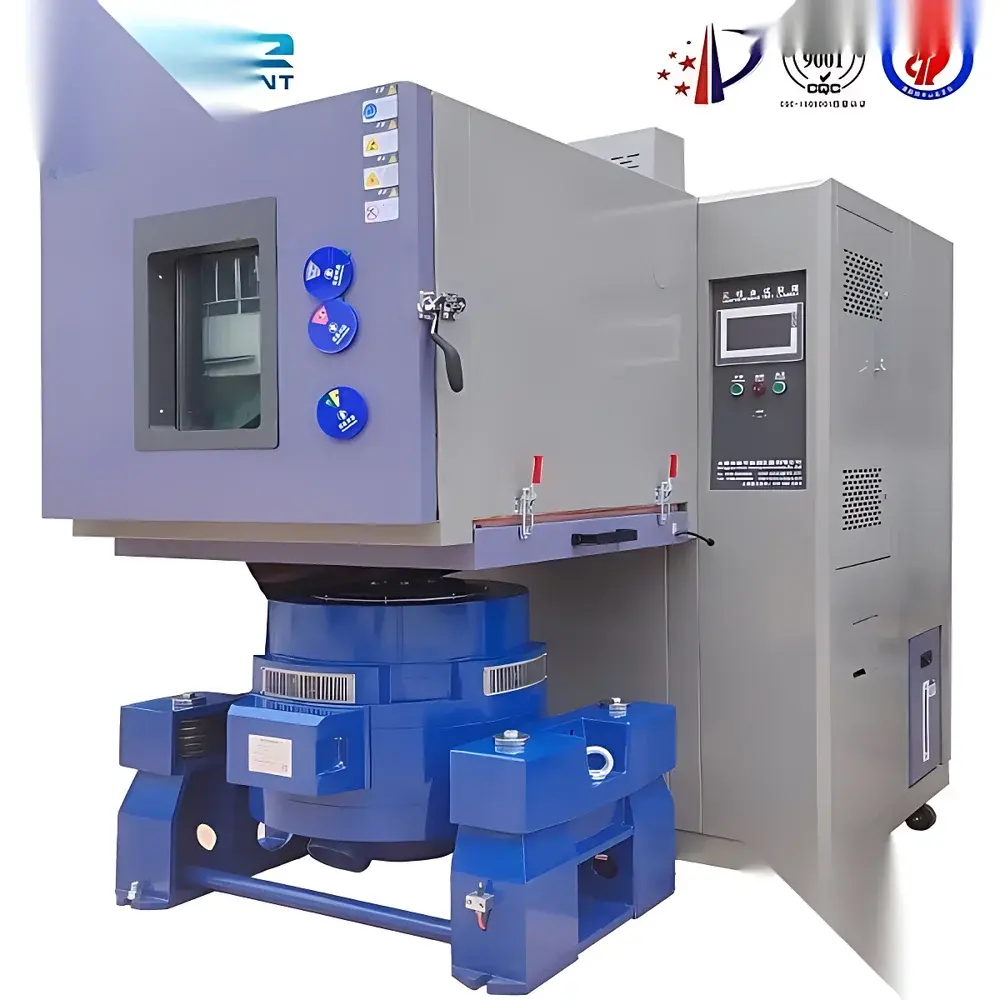
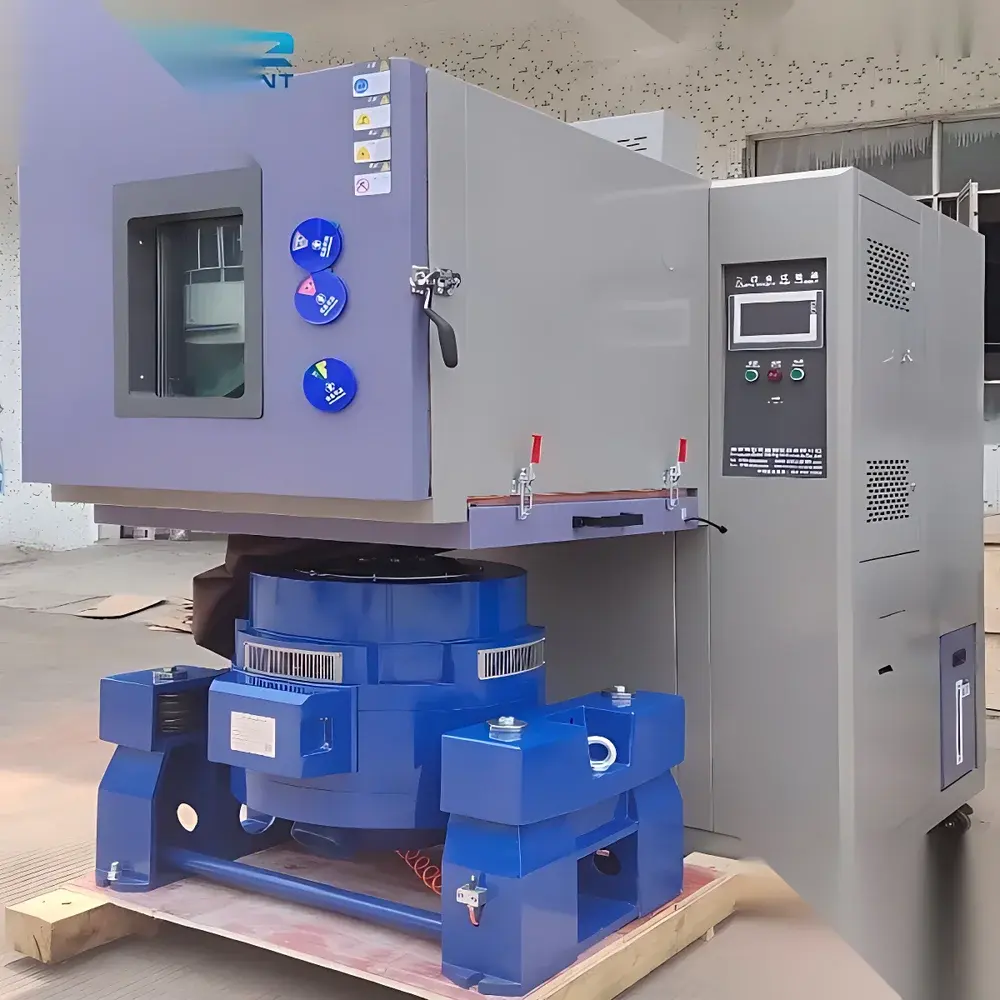
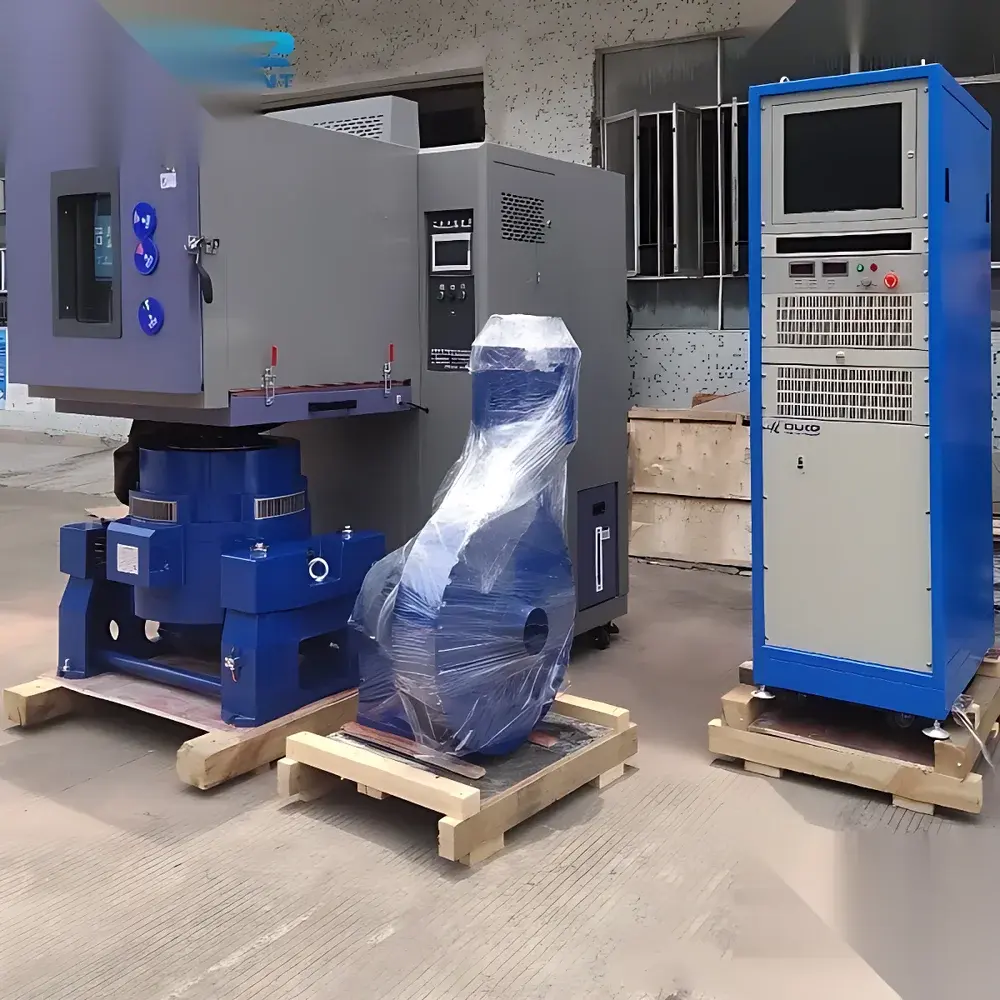
OK-ES Series Combined Temperature-Humidity-Vibration Environmental Test Chamber
| Brand | OK Instruments |
|---|---|
| Origin | Imported |
| Manufacturer Type | Authorized Distributor |
| Price | USD 21,000 (FOB) |
| Frequency Range | 0.5–600 Hz (±0.1%) |
| Max. Load Capacity | 80 kg (100 kg peak) |
| Vibration Amplitude | 0–4 mm p-p |
| Max. Acceleration | 0–15 g (0–150 m/s²) |
| Sinusoidal Force Output | 1500 kgf |
| Temperature Range | −10°C to +80°C |
| Humidity Range | 10–95% RH |
| Vibration Axes | 6-DOF simultaneous (X/Y/Z translational + pitch/yaw/roll) |
| Control Modes | Sine, Random, Swept Sine, Resonance Search, Programmable Profile, Multi-Axis Coupled, Road Simulation |
| Data Logging | Real-time waveform, frequency spectrum, acceleration/time history |
| Cooling Method | Natural convection |
| Noise Level | ≤50 dB(A) at 1 m |
| EMI Emission | ≤100 mGauss at 1 m |
| Power Supply | 200–240 VAC ±20%, 50/60 Hz, 20 A |
Overview
The OK-ES Series Combined Temperature-Humidity-Vibration Environmental Test Chamber is an integrated reliability validation platform engineered for rigorous physical stress testing of electro-mechanical components, consumer goods, automotive modules, and industrial packaging under synchronized environmental and dynamic mechanical loads. It combines precision climate control (temperature and humidity) with high-fidelity electrodynamic vibration excitation across six degrees of freedom (6-DOF), enabling realistic simulation of field service conditions—including thermal cycling during road-induced multi-axis shocks, humidity-driven corrosion under vibratory stress, or accelerated fatigue in temperature-variable operational envelopes. The system operates on classical modal excitation principles (sinusoidal, swept-sine, random power spectral density) and supports ISO 16750-3, MIL-STD-810H Method 514.7, IEC 60068-2-64, and ASTM D4728 for combined environment qualification. Its rigid monolithic base structure, low-center-of-gravity design (50 × 55 × 50 cm cabinet height), and optimized inertial mass distribution ensure minimal parasitic resonance—critical for high-fidelity transfer function measurement and repeatable test execution across laboratories.
Key Features
- Simultaneous triple-stress application: programmable temperature (−10°C to +80°C), humidity (10–95% RH), and multi-axis vibration within a single chamber—eliminating sequential test artifacts and inter-system calibration drift.
- 6-DOF electrodynamic shaker system with independent X/Y/Z linear actuation and rotational pitch/yaw/roll coupling—capable of replicating complex real-world excitations including pothole impacts, engine-induced torsional harmonics, and aircraft cabin turbulence profiles.
- High-resolution closed-loop control architecture supporting sine, random (PSD up to 1500 kgf force output), swept-sine, resonance dwell, and user-defined road-simulation waveforms (SAE J2452, ISO 8608 compliant).
- Modular test sequencing engine allowing infinite nested profiles: e.g., “hold at 60°C/85% RH → initiate 20–200 Hz swept sine at 5 g → transition to random PSD at −20°C → execute 3-axis coupled shock pulse” — all automatically sequenced without operator intervention.
- Real-time waveform visualization and FFT analysis via embedded 16-bit DAQ; optional LD-T1 laser displacement sensor (20 mm range, ±0.5 µm resolution) enables non-contact transmissibility and modal shape verification.
- Compliance-ready audit trail: full GLP/GMP-aligned data logging with timestamped parameter changes, operator ID, calibration status, and digital signature support per FDA 21 CFR Part 11 requirements.
Sample Compatibility & Compliance
The OK-ES chamber accommodates specimens up to 80 kg (100 kg short-term) on a 500 × 500 mm stainless steel shaker table featuring 24 × M10 threaded mounting points. Its 6 mm vertical stroke clearance and 4 mm p-p amplitude range support both lightweight PCB assemblies and heavy-duty automotive ECUs. The system meets structural integrity requirements for UL 60950-1, CE EN 61000-6-3 (EMC), and RoHS 2011/65/EU. All climate and vibration control firmware undergoes annual third-party verification against NIST-traceable standards. Test reports generated include full metadata: environmental setpoints, vibration spectra (acceleration PSD in g²/Hz), thermal ramp rates, humidity dwell stability (±2% RH), and system health diagnostics (coil temperature, amplifier efficiency, refrigerant pressure).
Software & Data Management
Control and analysis are performed via OK-TestSuite v4.2—a Windows-based application with dual-mode operation: local standalone mode for routine QA screening and networked client-server deployment for enterprise-wide test campaign management. The software supports ASTM E178 statistical outlier detection, automatic resonance search with Q-factor calculation, and export of raw time-history data in IEEE 1159-compliant CSV/UDF formats. Integrated report generation complies with ISO/IEC 17025 documentation requirements, embedding digital signatures, calibration certificates, and uncertainty budgets. Remote monitoring via TLS-encrypted HTTP API allows integration with LIMS platforms (e.g., LabVantage, Thermo Fisher SampleManager) and automated pass/fail logic triggering downstream QA workflows.
Applications
- Automotive: ECU vibration-fatigue validation under thermal-humidity cycling per GMW3172 and Ford CETP 00.00-L-467.
- Consumer electronics: Drop-test preconditioning of smartphones and wearables using combined cold/humid storage followed by 6-DOF shock replication.
- Packaging engineering: ISTA 3A/3E-compliant transport simulation with humidity-induced material softening and vibration-induced delamination assessment.
- Aerospace: Avionics box qualification per RTCA DO-160 Section 20 (combined temperature/vibration) and Section 21 (humidity effects).
- Medical devices: ISO 14971 risk mitigation testing of implantable electronics subjected to physiological temperature gradients and body-motion-induced accelerations.
FAQ
Does the OK-ES chamber support real-time closed-loop vibration control during temperature transitions?
Yes—its dual-stage thermal-vibration synchronization protocol maintains ±0.5 g amplitude accuracy and ±0.5 Hz frequency fidelity even during 5°C/min ramp rates.
Can test profiles be exported to comply with FDA 21 CFR Part 11 electronic records requirements?
Yes—the system logs all parameter changes with immutable timestamps, user authentication tokens, and cryptographic hash verification; audit trails are exportable as PDF/A-2b or XML signed packages.
Is third-party calibration certification included with delivery?
Each unit ships with NIST-traceable calibration certificates for temperature (±0.3°C), humidity (±2% RH), and acceleration (±1.5% full scale) valid for 12 months.
What is the maximum allowable specimen height when operating in 6-DOF mode?
The usable vertical envelope is 6 mm p-p stroke; total specimen height must not exceed 120 mm above the mounting surface to avoid interference with internal ductwork and sensor arrays.
How does the system handle resonant frequency shifts caused by thermal expansion of test articles?
The OK-TestSuite includes adaptive resonance tracking: it performs in situ impedance sweeps every 10 minutes during long-duration tests and dynamically adjusts drive signals to maintain target PSD levels across shifting modal peaks.



