
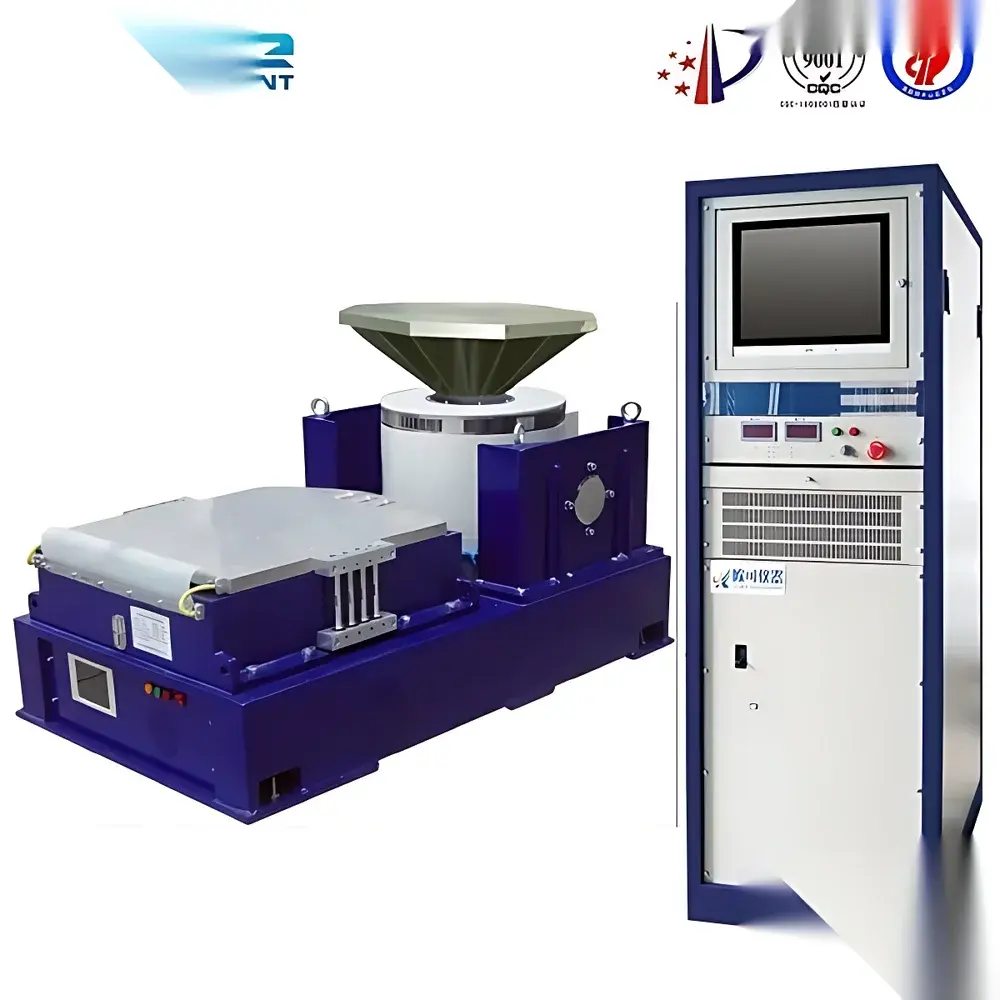
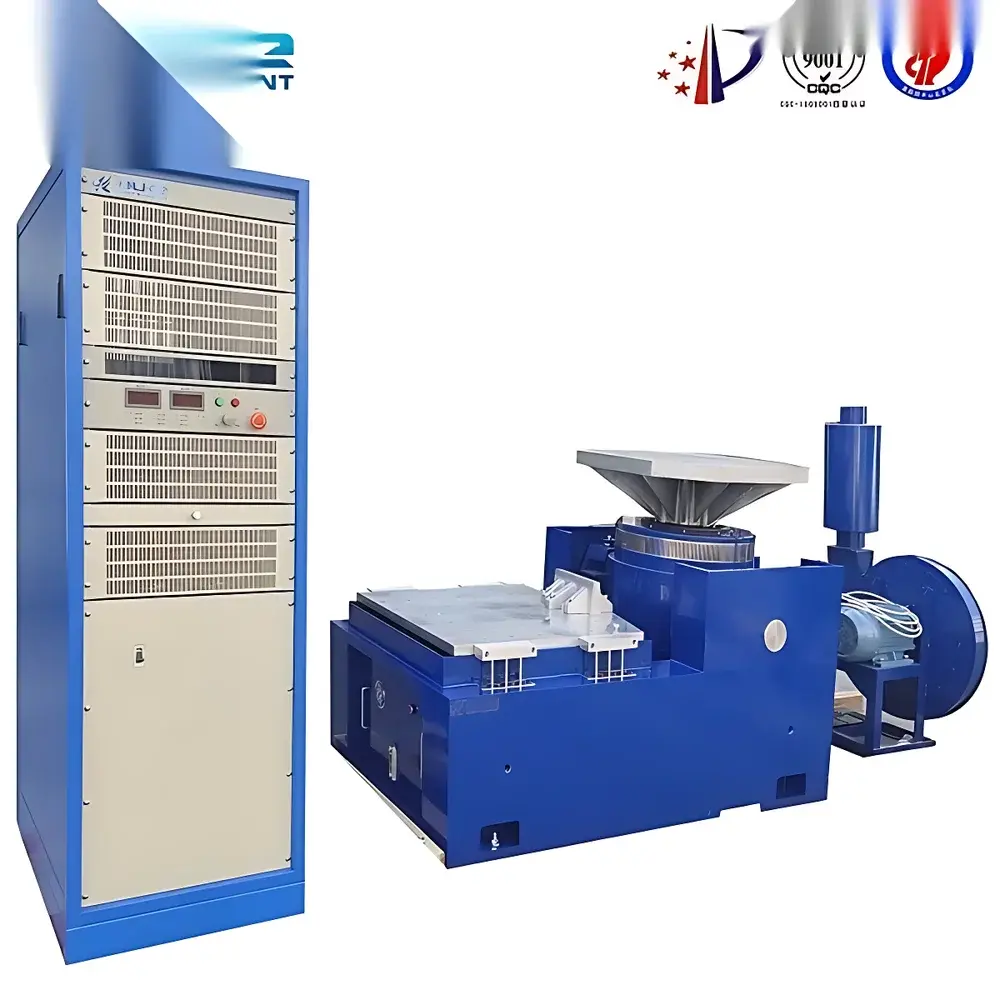
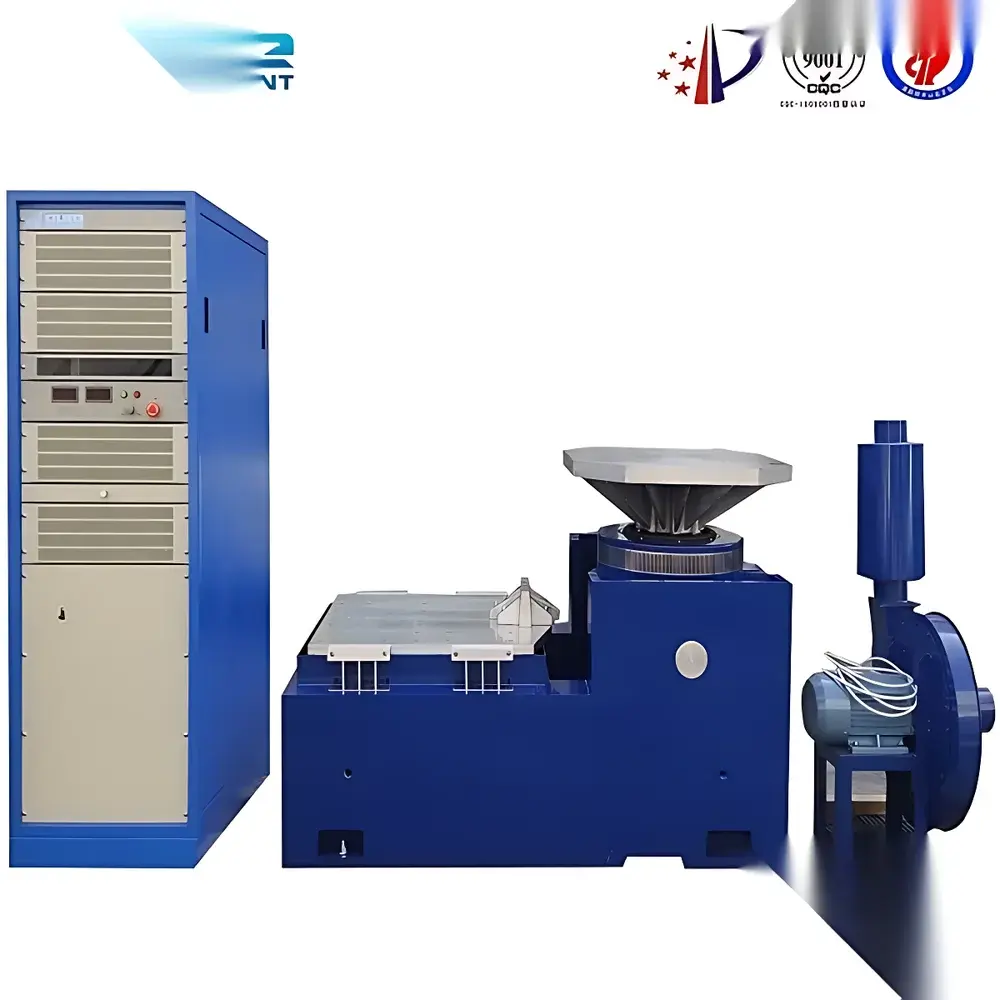
ES Vibration Test System for Automotive Components
| Brand | Other Brands |
|---|---|
| Origin | Imported |
| Manufacturer Type | Authorized Distributor |
| Price | USD 21,500 (FOB) |
| Frequency Range | 100–300 RPM (1.67–5 Hz) |
| Amplitude | 25.4 mm (1 inch) peak-to-peak |
| Max Load Capacity | 100 kg (customizable) |
| Timer Range | 0–9999 h/min/sec |
| Motor Power | 1 HP (746 W) |
| Max Current | 4 A |
| Table Dimensions | 100 cm × 120 cm (customizable) |
| Drive System | Synchronous toothed belt transmission |
| Mounting Interface | Linear rail-based fixture system |
| Base Construction | Heavy-duty C-channel frame with vibration-damping rubber mounts |
| Compliance | ASTM D999, ASTM D3580, ISTA 3A/3E/3H, EN 15308, ANSI/UL 60730, ISO 13374-2 |
Overview
The ES Vibration Test System for Automotive Components is an electromechanical shaker platform engineered for controlled sinusoidal vibration testing of mechanical assemblies, subassemblies, and finished parts under laboratory or pre-production validation conditions. It operates on a fixed-frequency, constant-amplitude sinusoidal excitation principle—utilizing a balanced eccentric-mass drive mechanism coupled with precision synchronous belt transmission—to generate repeatable, low-distortion harmonic motion across the 1.67–5 Hz (100–300 RPM) range. This frequency band is specifically selected to replicate low-frequency road-induced excitations encountered during vehicle operation—including engine idle shake, driveline resonance, and suspension-induced chassis oscillations. Unlike broadband random or shock testing systems, this unit delivers deterministic, sweep-capable sinusoidal profiles ideal for fatigue screening, solder joint integrity verification (e.g., detection of cold joints or micro-cracks), structural resonance mapping, and packaging durability assessment under simulated transport conditions.
Key Features
- Real-time LCD interface displaying instantaneous frequency, elapsed test time, and active sweep segment—enabling immediate operator verification without external instrumentation
- Programmable multi-segment sweep capability supporting up to 30 discrete frequency-amplitude-time steps per test sequence, facilitating complex duty-cycle emulation (e.g., start-stop engine vibration profiles)
- Low-noise synchronous toothed belt drive system minimizing mechanical harmonics and acoustic emission (<65 dB(A) at 1 m), critical for shared lab environments and long-duration endurance tests
- Linear rail-mounted sample mounting platform ensuring rapid, repeatable, and mechanically stable fixture positioning—reducing setup variability and improving test-to-test reproducibility
- Structurally isolated base assembly comprising heavy-gauge C-channel steel framing integrated with high-durometer elastomeric damping pads, suppressing floor-transmitted interference and enhancing motion fidelity
- Industrial-grade 1 HP induction motor with thermal overload protection and current-limited soft-start circuitry, rated for continuous operation up to 9999 hours per test cycle
Sample Compatibility & Compliance
The system accommodates rigid and semi-rigid automotive components weighing up to 100 kg—including brake calipers, HVAC housings, wiring harness assemblies, instrument cluster modules, and powertrain control units—when mounted using standard M6/M8 threaded inserts or custom fixture plates. Its mechanical design and operational envelope align with internationally recognized transport simulation and mechanical stress standards, including ASTM D999 (vibration testing of shipping containers), ASTM D3580 (vibration testing of packaged-products), ISTA 3A (general simulation for parcel delivery), ISTA 3E (unitized loads on pallets), EN 15308 (vibration testing of packaged goods), and ANSI/UL 60730 (safety requirements for automatic electrical controls). While not certified for full GLP/GMP audit trails, its timer and frequency logging support traceable test records required under ISO/IEC 17025-accredited quality systems.
Software & Data Management
This analog-controlled vibration shaker does not include embedded PC software or digital data acquisition. All parameter configuration and monitoring occur via front-panel keypad and LCD display. However, the system features a TTL-level analog output (0–5 V) proportional to instantaneous motor speed, enabling integration with third-party DAQ systems (e.g., National Instruments USB-6009, Keysight 34972A) for synchronized waveform capture, spectral analysis, and automated pass/fail reporting. Users may export timestamped frequency and duration logs manually via USB-stick-supported printout (via optional thermal printer module) or integrate into existing MES/QMS platforms using Modbus RTU over RS-485 (requires optional communication interface kit).
Applications
- Early-life failure screening of electronic control units (ECUs) and sensor modules to identify latent defects such as cracked solder joints, delaminated PCB traces, or loose connectors
- Structural integrity validation of plastic housing assemblies subjected to cyclic bending moments and torsional loading
- Verification of adhesive bond strength in bonded trim components under sustained low-frequency oscillation
- Transport packaging qualification per ISTA and ASTM protocols—assessing cushioning performance, box compression resistance, and internal product shifting
- Pre-validation of mounting bracket designs prior to full-scale road testing, reducing prototype iteration cycles
- Cross-industry adaptation for consumer electronics, medical device enclosures, and industrial control panels requiring deterministic low-frequency fatigue exposure
FAQ
Is this system compliant with FDA 21 CFR Part 11 for regulated pharmaceutical or medical device testing?
No—this is a Class I mechanical shaker intended for engineering validation, not regulated clinical or GxP-compliant testing. It lacks electronic audit trail, user authentication, and data integrity safeguards required under Part 11.
Can the table size or load capacity be modified beyond standard specifications?
Yes—custom table dimensions (up to 150 cm × 180 cm) and load ratings (up to 250 kg) are available upon request; lead time increases by 6–8 weeks and requires structural recalibration documentation.
Does the system support random vibration or shock pulse profiles?
No—it is designed exclusively for sinusoidal sweep and fixed-frequency operation. Random or transient shock testing requires a servo-hydraulic or electrodynamic shaker with closed-loop controller and power amplifier.
What maintenance intervals are recommended for long-term reliability?
Belt tension verification every 500 operating hours; motor bearing lubrication every 2,000 hours; visual inspection of rail guides and damping mounts quarterly—per manufacturer’s preventive maintenance schedule included with shipment.



