
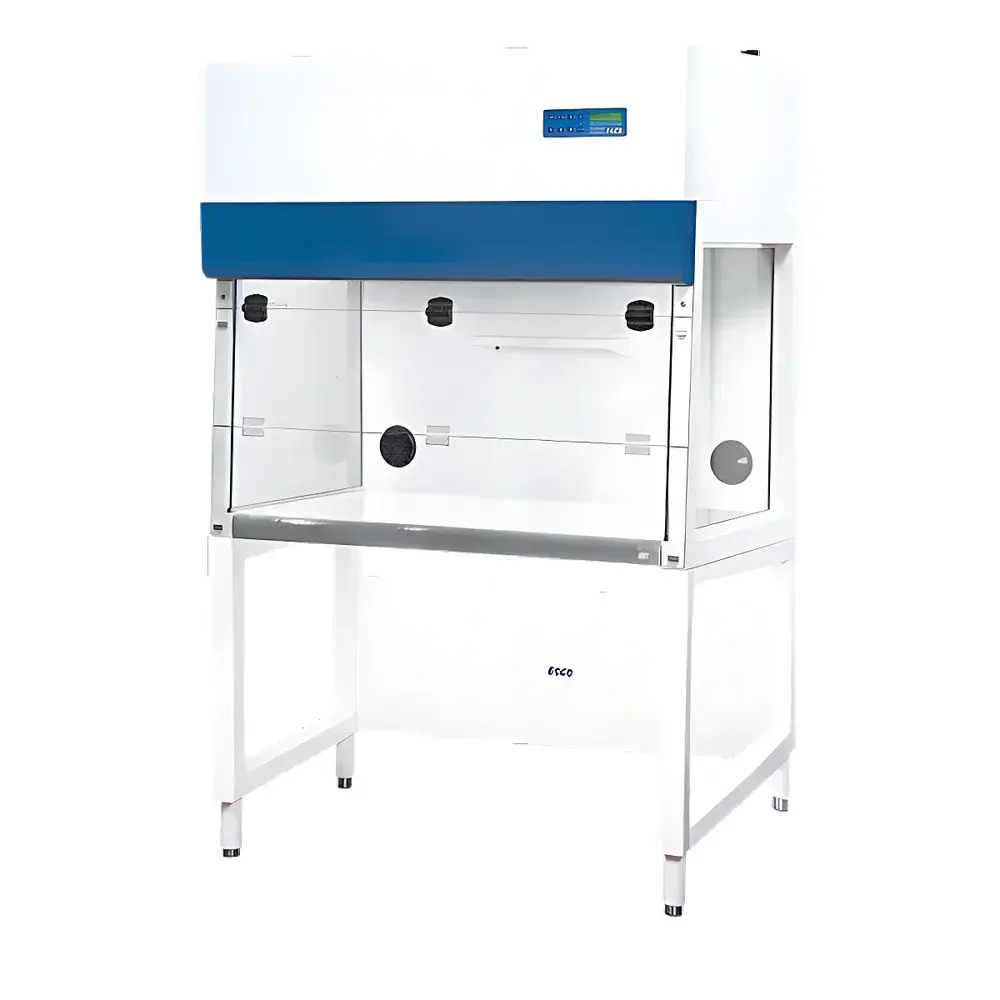
Esco Airstream PCR-Specific Vertical Laminar Flow Hood
| Brand | Esco |
|---|---|
| Origin | Singapore |
| Manufacturer Type | Authorized Distributor |
| Origin Category | Imported |
| Model | PCR-3A1, PCR-4A1 |
| Price | Upon Request |
| External Dimensions (L×W×H) | PCR-3A1: 1035 × 617 × 950 mm |
| PCR-4A1 | 1340 × 617 × 950 mm |
| Internal Dimensions (L×W×H) | PCR-3A1: 935 × 538 × 550 mm |
| PCR-4A1 | 1240 × 538 × 550 mm |
| Airflow Velocity | 0.30 m/s (60 fpm) |
| Power Supply | 230 VAC, 50 Hz |
| Pre-filter & HEPA Filter Efficiency | >99.99% at 0.3 µm |
| HEPA Service Life | ≥3 years (under typical lab conditions) |
| Control System | Esco Sentinel Microprocessor Controller |
| UV Timer & Alarm Functions | Yes |
| UV Lamp & Pre-filter Replacement Alerts | Yes |
Overview
The Esco Airstream PCR-Specific Vertical Laminar Flow Hood is an engineered containment solution designed exclusively for polymerase chain reaction (PCR) workflows where nucleic acid contamination control is non-negotiable. Unlike general-purpose laminar flow cabinets, this system implements a unidirectional vertical airflow architecture—certified to ISO 14644-1 Class 5 (equivalent to Federal Standard 209E Class 100)—to maintain a particle-free working environment over the entire work surface. The airflow originates from a ceiling-mounted HEPA filter bank, passes vertically downward at a uniform velocity of 0.30 m/s, and exits through a perforated stainless steel base plate into a dedicated recirculation or exhaust ducting path. This configuration eliminates turbulent eddies and stagnant zones, thereby minimizing the risk of amplicon carryover between samples—a critical requirement in molecular diagnostics, forensic genomics, and qRT-PCR validation studies compliant with CLIA, CAP, and ISO/IEC 17025 frameworks.
Key Features
- True vertical laminar airflow with full-width HEPA filtration (≥99.99% efficiency at 0.3 µm), ensuring consistent ISO Class 5 cleanliness across the entire work area—no dead zones or lateral recirculation.
- Integrated Esco Sentinel microprocessor controller with password-protected parameter access, enabling secure configuration of UV irradiation cycles, alarm thresholds, and operational logging.
- Dual-stage filtration: high-capacity polyurethane pre-filter (capturing coarse particulates and organic volatiles) followed by a certified HEPA filter—designed for ≥3 years of service life under standard 8-hour/day laboratory usage.
- Real-time airflow monitoring with audible and visual alerts triggered when velocity deviates beyond ±10% of setpoint—critical for maintaining validated operating conditions per ISO 14644-3 and USP environmental monitoring guidelines.
- Automated maintenance alerts for UV lamp intensity decay and pre-filter saturation—reducing unplanned downtime and supporting preventive maintenance schedules aligned with GLP/GMP documentation requirements.
- Ergonomic cabinet design with adjustable-height foot stands (710 mm or 860 mm options), optional casters, and a recessed footrest shelf to reduce operator fatigue during extended PCR setup sessions.
Sample Compatibility & Compliance
The Airstream PCR hood accommodates standard PCR consumables—including 96-well plates, tube racks, pipette tip boxes, and thermal cyclers—without compromising laminar integrity. Its internal chamber dimensions (935 × 538 × 550 mm for PCR-3A1; 1240 × 538 × 550 mm for PCR-4A1) support both benchtop and modular workflow integration. The unit complies with IEC 61010-1 (Safety Requirements for Electrical Equipment for Measurement, Control, and Laboratory Use) and meets EN 12464-1 lighting standards for task illumination (≥500 lux at work surface). While not a biological safety cabinet (BSC), it is explicitly intended for use in segregated PCR labs following the three-room principle (reagent prep → sample prep → amplification/analysis), as recommended by the Association for Molecular Pathology (AMP) and WHO Laboratory Biosafety Manual.
Software & Data Management
The Esco Sentinel controller does not require external software but logs operational events—including UV cycle start/end timestamps, filter runtime hours, airflow deviation incidents, and alarm acknowledgments—in non-volatile memory. Audit trail functionality supports FDA 21 CFR Part 11 compliance when paired with Esco’s optional LabLink™ data export module (USB or RS-232 interface), enabling traceable record retention for quality assurance audits. All user-modifiable parameters are protected by configurable administrator passwords, preventing unauthorized changes to calibration settings or safety interlocks.
Applications
- Pre-amplification reagent and master mix preparation in clinical molecular laboratories.
- Template DNA/RNA handling prior to reverse transcription or library construction in NGS core facilities.
- Assembly of CRISPR-Cas9 editing components under contamination-controlled conditions.
- Quality control testing of oligonucleotide primers and probes prior to assay development.
- Supporting ISO/IEC 17025-accredited testing laboratories requiring documented environmental controls for method validation.
FAQ
Is this unit suitable for handling hazardous biological agents?
No. The Airstream PCR hood provides personnel and product protection only—not environmental protection. It is not a biosafety cabinet and must not be used for work involving viable pathogens, toxins, or recombinant DNA requiring BSL-2 or higher containment.
Can the UV lamp be operated while the sash is open?
No. Interlocked safety circuitry automatically deactivates UV emission when the front access panel is opened, complying with IEC 62471 photobiological safety requirements.
What certifications does the HEPA filter carry?
Each HEPA filter is individually tested and certified to EN 1822-1:2019 (H14 class) and carries a test report with serial-numbered traceability, including initial efficiency, pressure drop, and leak-test results.
How often should the pre-filter be replaced?
Replacement frequency depends on ambient particulate load; Esco recommends inspection every 3 months and replacement every 6–12 months—or sooner if the differential pressure sensor triggers the visual alert.
Does the system support integration with building management systems (BMS)?
Yes, via optional 4–20 mA analog output or Modbus RTU (RS-485), enabling remote monitoring of airflow status, UV lamp health, and filter lifetime metrics within centralized lab infrastructure platforms.
Related Products



