
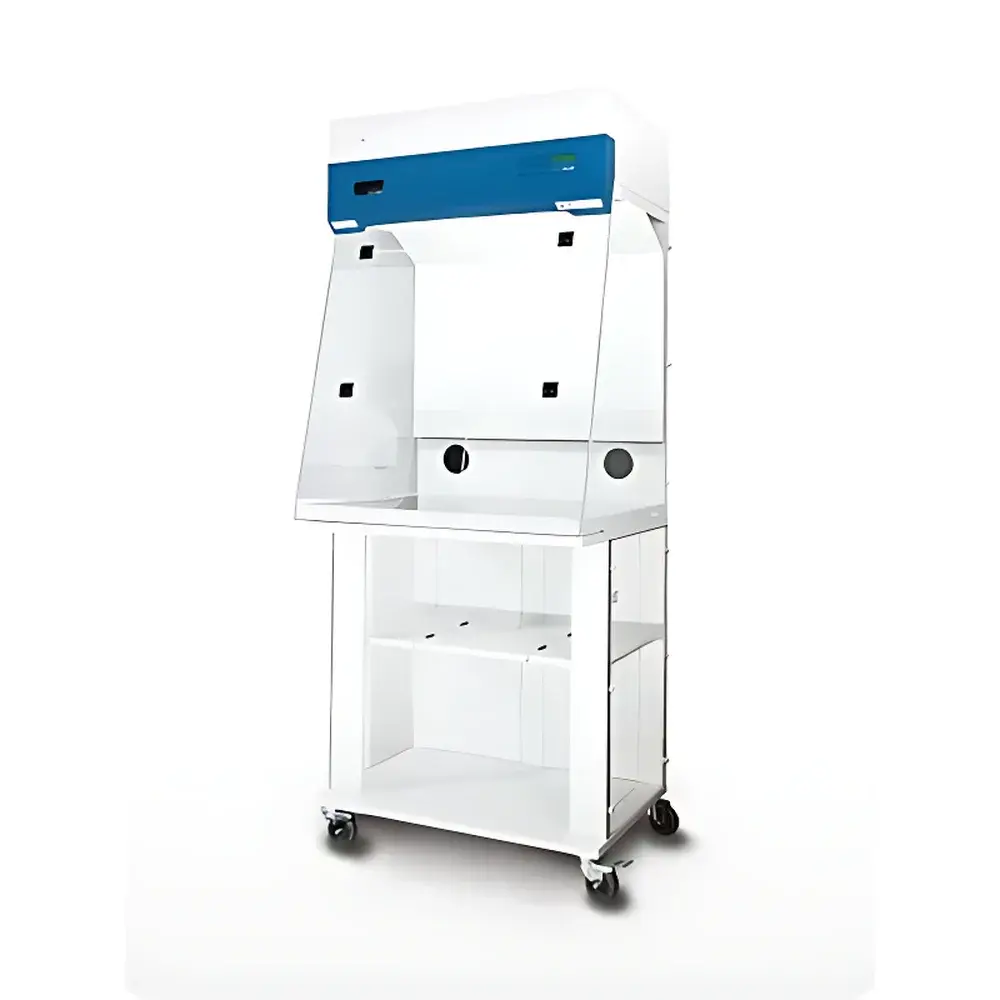
Esco Ascent Opti Ductless Fume Hood
| Brand | Esco |
|---|---|
| Origin | Singapore |
| Manufacturer | Esco Micro Pte Ltd |
| Product Type | Ductless (Recirculating) Fume Hood |
| Model | SPD-A |
| Certifications | ASHRAE 110, BS 7989, BS 7258 |
| Surface Material | 304 Stainless Steel |
| Lighting | 5000K Fluorescent Lamp |
| Noise Level | 55 dBA |
| Inflow Velocity | 0.50 m/s (100 fpm) |
| Power Supply | 220–240 V AC, 50 Hz, 1Ø |
| Filter Options | Nanocarb™ Carbon Filters (7+ chemically specific variants) |
| Control System | Sentinel™ Microprocessor-Based Monitoring & Alarm |
| Optional Accessories | Mobile Base Cart (MBC-3A0 / MBC-4A0), Transparent Rear Panel, ISOCIDE® Antimicrobial Coating |
Overview
The Esco Ascent Opti Ductless Fume Hood is an engineered solution for laboratories requiring localized chemical vapor containment without structural ductwork or external exhaust infrastructure. Unlike conventional ducted hoods, the Ascent Opti operates on a closed-loop recirculation principle: ambient air is drawn across the work surface, passed through a dual-stage filtration system—typically pre-filters followed by application-specific Nanocarb™ activated carbon filters—and returned to the laboratory environment at safe, non-hazardous concentrations. This design eliminates reliance on building HVAC systems, reduces energy consumption associated with conditioned air replacement, and enables rapid deployment in modular labs, teaching facilities, and renovation-constrained spaces. The unit complies fully with internationally recognized performance standards including ASHRAE Standard 110 (Method of Testing Performance of Laboratory Fume Hoods), British Standards BS 7989 (Specification for ductless fume cupboards) and BS 7258 (Code of practice for safe use), ensuring validated containment efficiency, operator protection, and reproducible airflow behavior under dynamic load conditions.
Key Features
- Elliptical arm openings engineered for ergonomic access while maintaining high face velocity uniformity and containment integrity across the full sash operating range.
- Sentinel™ microprocessor-based control system providing real-time monitoring of airflow velocity, filter saturation status, and motor performance—with audible and visual alarms for deviations beyond preset thresholds (e.g., <0.45 m/s inflow, filter service interval exceeded).
- 304 stainless steel work surface and interior chamber construction ensures corrosion resistance, non-shedding performance, and compatibility with routine decontamination protocols—including alcohol wipes, diluted acids, and hydrogen peroxide solutions.
- Integrated 5000K color-corrected fluorescent lighting delivers uniform illumination (≥450 lux at work surface) without UV emission or thermal loading that could affect temperature-sensitive reagents.
- Removable, sloped stainless steel work surface with integrated drain pan facilitates spill containment and simplifies cleaning—particularly critical in QC/QA environments where cross-contamination must be minimized.
- ISOCIDE® antimicrobial coating applied to all exposed interior surfaces achieves ≥99.9% reduction of common bacterial strains (e.g., Staphylococcus aureus, Escherichia coli) within 24 hours under ISO 22196 test conditions.
- Two dedicated rear-mounted power outlets (IEC 60320 C13) support direct connection of analytical instruments, centrifuges, or pH meters without external extension cords—reducing trip hazards and electrical clutter.
- Low-noise operation at ≤55 dBA (measured at 1 m, front center) supports concentration-intensive tasks in shared lab spaces and teaching laboratories.
Sample Compatibility & Compliance
The Ascent Opti accommodates a broad spectrum of non-radioactive, low-to-moderate volatility chemical applications—including organic solvents (acetone, ethanol, hexane), weak acids (acetic, citric), aldehydes (formaldehyde), ammonia, halogenated compounds, and mercury-containing reagents—when paired with the appropriate Nanocarb™ filter configuration. Each filter type is identified via a standardized alphanumeric code printed directly on the cartridge housing, enabling traceable filter selection and change logs required under GLP and ISO/IEC 17025 quality systems. Units are supplied with full certification documentation verifying compliance with ASHRAE 110-2016 (face velocity, tracer gas containment, and flow visualization), BS 7989:2001 (filter efficiency testing per EN 1822), and CE marking per EU Machinery Directive 2006/42/EC. Optional transparent rear panels meet pedagogical requirements for classroom demonstration without compromising containment validation.
Software & Data Management
While the Ascent Opti operates as a standalone hardware system without cloud connectivity, its Sentinel™ controller supports audit-ready data logging via optional RS-485 interface (Modbus RTU protocol). Logged parameters include cumulative runtime, total filtered air volume, alarm event timestamps, and real-time inflow velocity—all exportable as CSV files for integration into LIMS or internal QA databases. All alarm events trigger both local LED indicators and sustained audible tones, satisfying FDA 21 CFR Part 11 requirements for operator alerting in regulated environments. Filter replacement history can be manually recorded in the built-in logbook section of the user manual—a practice aligned with ISO 15190:2020 recommendations for laboratory biosafety equipment maintenance tracking.
Applications
- Undergraduate and graduate chemistry teaching laboratories requiring safe, portable vapor handling during titrations, distillations, and synthesis demonstrations.
- Pharmaceutical QC labs performing dissolution testing, standard preparation, or reference standard weighing where volatile excipients (e.g., isopropyl alcohol, dichloromethane) are routinely handled.
- Environmental testing facilities conducting EPA Method 8081/8270 sample extraction with chlorinated solvents, provided appropriate halogen-specific Nanocarb™ filters are installed.
- Research labs with space-constrained or historic building infrastructure where duct installation is cost-prohibitive or architecturally infeasible.
- Industrial hygiene sampling prep areas where low-level aldehyde or ammonia exposure must be mitigated during sorbent tube conditioning.
FAQ
What filter types are available for the Ascent Opti, and how do I select the correct one?
Esco offers seven Nanocarb™ carbon filter configurations optimized for specific chemical families: general organics, acidic gases, mercury vapor, sulfur compounds, halogenated organics, aldehydes, and ammonia. Selection must be based on Safety Data Sheet (SDS) Section 8 exposure limits and compound volatility—consult Esco’s Chemical Compatibility Guide before operation.
Can the Ascent Opti be used for perchloric acid or hydrofluoric acid applications?
No. Perchloric acid, hydrofluoric acid, and other strongly oxidizing or highly corrosive agents require specialized ducted hoods with wash-down capability and inert ducting. The Ascent Opti is not rated for these applications.
Is the mobile base cart compatible with all SPD models?
Yes—the MBC-3A0 cart supports SPD-3A/3B units; the MBC-4A0 is designed for SPD-4A/4B configurations. Both feature locking casters, fold-down storage shelves, and structural reinforcement for safe instrument relocation.
How often must the carbon filters be replaced?
Filter service life depends on chemical type, concentration, and daily usage duration. Esco recommends monitoring Sentinel™ saturation alerts and replacing filters every 6–12 months under typical academic lab use—or sooner if breakthrough odor is detected or alarm thresholds are triggered.
Does the unit require annual third-party certification?
Yes. Per ASHRAE 110 and ISO 15190, ductless fume hoods must undergo annual performance verification—including face velocity mapping, containment testing with SF₆ tracer gas, and filter efficiency validation—by an accredited第三方 service provider.



