
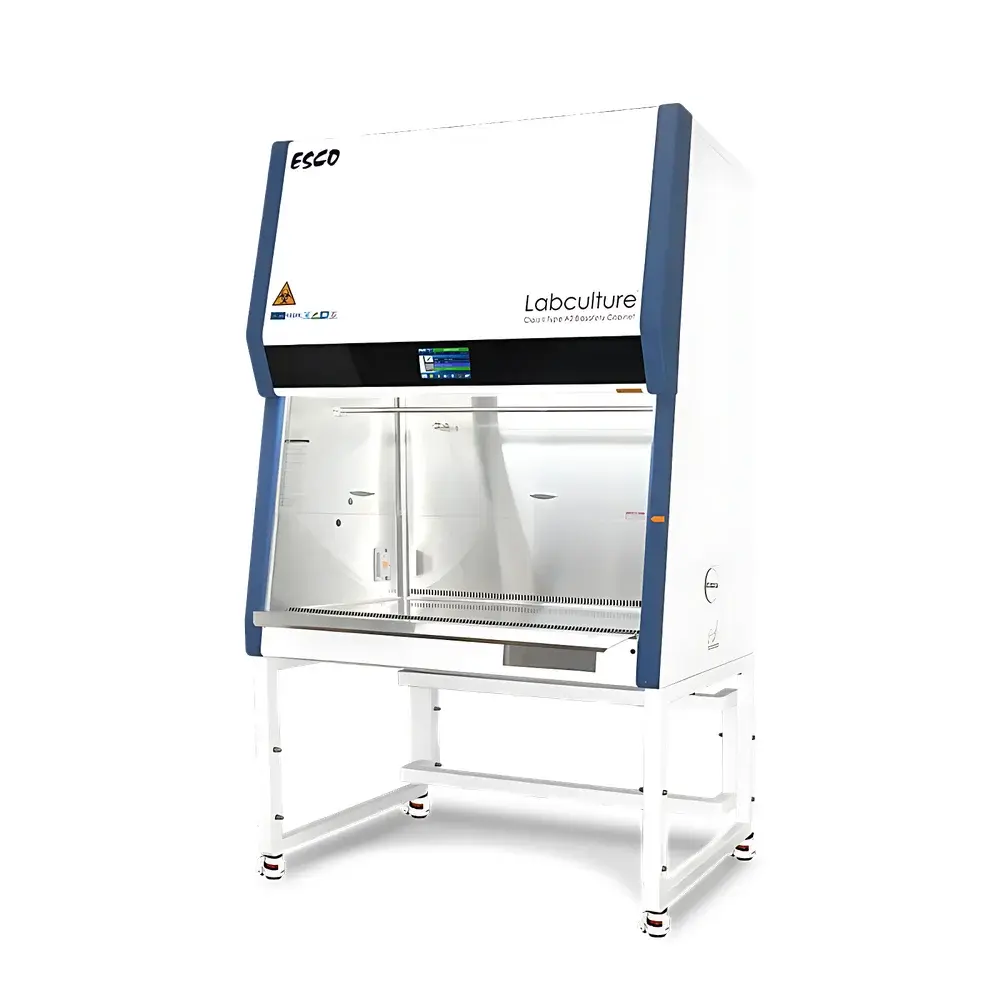
Esco Labculture G4 A2 Class II Biological Safety Cabinet
| Brand | Esco |
|---|---|
| Origin | Singapore |
| Model | LA2-G4 |
| External Dimensions (W×D×H) | 1035 × 815 × 1570 mm |
| Internal Dimensions (W×D×H) | 915 × 625 × 720 mm |
| Inflow Velocity | 0.53 m/s (105 fpm) |
| Downflow Velocity | 0.30 m/s (60 fpm) |
| Power Supply | 220–240 VAC, 50/60 Hz |
| Filtration | ULPA (≥99.999% @ 0.12 µm) |
| Work Area Cleanliness | ISO Class 3 |
| Noise Level | ≤56 dBA |
| Fan Type | DC-ECM (70% energy reduction vs. AC motors) |
| Compliance | NSF/ANSI 49-2022, EN 12469:2000, AS 2252.2–2013 |
Overview
The Esco Labculture G4 A2 Class II Biological Safety Cabinet is an engineered solution for containment of low-to-moderate risk biological agents (BSL-1 to BSL-2), designed to simultaneously protect personnel, the environment, and product integrity. It operates on the principle of laminar airflow generated by a dual-fan system: a dedicated supply fan delivers HEPA- or ULPA-filtered air vertically downward across the work surface at a uniform velocity, while an exhaust fan draws room air inward through the front grille (inflow) and recirculates a portion (typically 70%) after filtration. The remaining 30% is exhausted externally via ductwork. This balanced airflow architecture—combined with negative-pressure containment zones surrounding positive-pressure work areas—ensures reliable barrier integrity and minimizes cross-contamination risk. Certified to NSF/ANSI 49-2022 and EN 12469:2000, the G4 platform meets global regulatory expectations for biosafety infrastructure in academic, clinical, and pharmaceutical laboratories.
Key Features
- Centurion™ Touchscreen Controller: Intuitive 7-inch graphical interface with real-time display of inflow/downflow velocities, filter life status, UV lamp operation, alarm history, and system diagnostics.
- Energy-Efficient DC-ECM Blower System: Reduces power consumption by up to 70% compared to conventional AC motors; maintains stable airflow under variable static pressure conditions and contributes to noise levels as low as 56 dBA.
- ULPA Filtration (≥99.999% @ 0.12 µm): Delivers ISO Class 3 (Class 10) clean air to the work area—critical for sterile cell culture, microbial isolation, and sensitive molecular workflows.
- ISOCIDE® Antimicrobial Coating: Integrated silver-ion-based surface treatment applied to stainless steel interior surfaces inhibits microbial colonization and supports routine decontamination protocols.
- Ergonomic Design Elements: Seamless one-piece stainless steel work surface with integrated drip tray; adjustable-height armrests positioned above the work surface to prevent obstruction of the front intake grille; recessed LED task lighting with dimming capability to reduce eye fatigue during extended procedures.
- BMS Integration Capability: USB port enables direct communication with building management systems (BMS) or laboratory information management systems (LIMS) for audit-ready logging of operational events, runtime hours, and maintenance triggers.
Sample Compatibility & Compliance
The Labculture G4 accommodates standard microbiological and cell culture workflows including pipetting, media preparation, transfection, and aseptic transfer of primary cells or hybridomas. Its ISO Class 3 work environment ensures compatibility with applications requiring particulate-free air—such as CRISPR editing workflows, stem cell expansion, and viral vector production—where ambient particle counts must remain below 1,000 particles/m³ (≥0.1 µm). The cabinet complies with NSF/ANSI 49-2022 Section 6.3 for Class II, Type A2 performance verification, including tracer gas containment testing (SF₆), airflow visualization (smoke studies), and velocity mapping per ISO 14644-3. It also satisfies EN 12469:2000 Annex C requirements for operator protection and product protection validation. For GLP/GMP environments, optional data-logging modules support 21 CFR Part 11-compliant electronic records when paired with validated software platforms.
Software & Data Management
The Centurion controller stores ≥10,000 event logs with timestamps—including door position changes, UV activation cycles, alarm activations, and filter differential pressure thresholds. All logs are exportable via USB in CSV format for integration into quality documentation systems. Optional firmware updates are delivered via secure HTTPS download and require digital signature verification prior to installation. Audit trail functionality includes user login tracking, parameter change history, and system configuration snapshots—enabling full traceability during internal audits or regulatory inspections (e.g., FDA, MHRA, TGA). Remote monitoring is supported through Esco’s proprietary LabConnect™ gateway (sold separately), allowing centralized oversight of multiple cabinets across distributed lab sites.
Applications
- Aseptic processing of mammalian and insect cell lines in biopharmaceutical R&D
- Handling of genetically modified organisms (GMOs) under institutional biosafety committee (IBC) oversight
- Preparation of sterile diagnostic reagents and reference standards
- Microbiological analysis of environmental or clinical samples per CLSI M22-A4 guidelines
- Supporting USP and compliant compounding activities when installed in ISO 7 or better buffer rooms
- Training laboratories requiring robust, low-maintenance containment for undergraduate and graduate instruction
FAQ
Does the Labculture G4 require external ducting?
Yes—Type A2 cabinets must be connected to a dedicated hard-ducted exhaust system or a thimble connection with canopy hood to safely discharge 30% of total airflow containing potentially contaminated air.
What is the recommended service interval for ULPA filters?
Filter replacement frequency depends on usage intensity and ambient particulate load; typical intervals range from 18–36 months. Pressure drop monitoring via the Centurion interface provides predictive alerts based on real-time ΔP values.
Can the cabinet be validated for ISO Class 3 compliance in-house?
While basic airflow checks can be performed internally, formal ISO Class 3 certification requires third-party testing using calibrated aerosol photometers and particle counters per ISO 14644-1:2015 Annex B protocols.
Is the ISOCIDE coating compatible with common disinfectants?
Yes—the silver-ion layer remains effective after repeated exposure to 70% ethanol, 10% bleach, hydrogen peroxide vapor, and quaternary ammonium compounds used in routine decontamination.
How does the DC-ECM fan improve airflow stability during filter loading?
Unlike fixed-speed AC motors, the brushless DC motor dynamically adjusts RPM to maintain setpoint inflow and downflow velocities despite increasing filter resistance—ensuring consistent containment performance throughout filter service life.



