
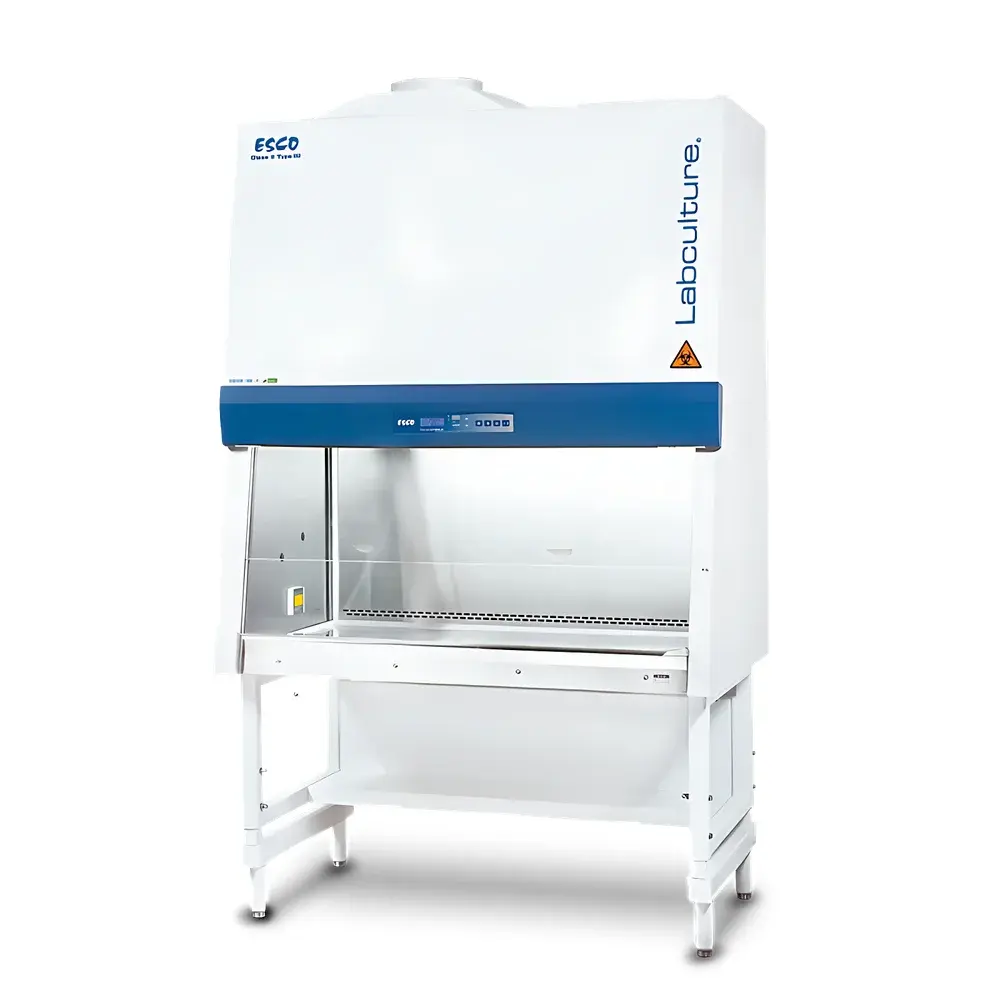
Esco Labculture LB2-B Series Class II, Type B2 Biosafety Cabinet (E-Series, Total Exhaust)
| Brand | Esco |
|---|---|
| Origin | Singapore |
| Model | LB2-B |
| Certification | NSF/ANSI 49, YY0569 |
| Airflow Inflow | 0.53 m/s |
| Downflow Velocity | 0.31 m/s |
| Power Supply | 220 VAC, 50 Hz |
| Construction | Seamless Stainless Steel Work Chamber |
| Filtration | ULPA (≥99.999% @ 0.12 µm) |
| Compliance | Fully compliant with NSF/ANSI 49-2022 for Class II, Type B2 cabinets |
Overview
The Esco Labculture LB2-B Series Class II, Type B2 Biosafety Cabinet (E-Series) is a total-exhaust, ducted biosafety system engineered for maximum personnel, product, and environmental protection in applications involving volatile toxic chemicals, radionuclides, or high-risk biological agents requiring absolute containment. Unlike recirculating Class II, Type A2 cabinets, the LB2-B operates exclusively on 100% exhausted airflow—no air is recirculated into the laboratory environment. This architecture eliminates cross-contamination risks associated with chemical vapors that cannot be adsorbed by standard carbon or HEPA filtration media. The cabinet draws room air through the front sash opening at a certified inflow velocity of 0.53 m/s (105 fpm), directs it downward across the work surface at a uniform 0.31 m/s (60 fpm) via a tilted supply filter array, and exhausts all contaminated air through a dedicated ducted connection to an external blower system. Its design conforms strictly to the performance, construction, and testing requirements of NSF/ANSI 49-2022 and China’s YY0569-2011 standards for Class II, Type B2 cabinets.
Key Features
- ULPA filtration system certified per IEST-RP-CC001.3, delivering ≥99.999% particle removal efficiency for particles ≥0.12 µm—including bacterial spores, viruses, and fine aerosols.
- Monolithic stainless steel work chamber formed from a single sheet—zero seams, welds, or fasteners—to ensure seamless decontamination and resistance to corrosion during routine disinfection or formaldehyde sterilization cycles.
- Sentinel Gold microprocessor control system featuring a large-format graphical display that continuously monitors and reports real-time sash position, inflow/downflow velocities, filter differential pressure, UV lamp status, and alarm history with timestamped event logging.
- Brushless DC motor-driven blower assembly optimized for energy efficiency, low acoustic output (<65 dB(A)), and extended service life—eliminating brush wear and reducing maintenance intervals.
- Ergonomic front sash angle (10° tilt) and contoured control/display panel aligned to ADA accessibility guidelines for sustained operator comfort and visual clarity.
- Frameless tempered glass sash with integrated anti-fog coating and smooth vertical movement mechanism for unobstructed visibility and simplified cleaning.
- ISOCIDE™ antimicrobial coating applied to all painted exterior surfaces, inhibiting microbial colonization per ISO 22196:2011 test methodology.
- Enhanced side-wall baffle geometry and optimized rear plenum design to improve particle capture efficiency and minimize turbulence-induced re-entrainment.
- RS-232 serial interface supporting remote monitoring, parameter export, and integration with facility-wide BMS or LIMS platforms under GLP/GMP audit-ready conditions.
Sample Compatibility & Compliance
The LB2-B accommodates a wide range of sterile manipulations—including cell culture, molecular cloning, pharmaceutical compounding, and diagnostic assay preparation—where concurrent exposure to biohazards and hazardous chemicals necessitates zero recirculation. It supports workflows involving volatile organic compounds (VOCs), cytotoxic drugs, radioactive isotopes, and BSL-2/BSL-3 pathogens when used in conjunction with appropriate facility exhaust infrastructure. All models are independently tested and certified to NSF/ANSI 49-2022 (Class II, Type B2) and YY0569-2011. Optional configurations support 21 CFR Part 11-compliant electronic signatures and audit-trail generation when paired with validated software modules. The cabinet’s structural integrity, airflow containment, and filter integrity are verified annually per manufacturer-recommended certification protocols traceable to ISO 14644-3.
Software & Data Management
Sentinel Gold firmware provides comprehensive operational oversight with dual-mode data handling: local storage (non-volatile memory) retains up to 30 days of continuous airflow, pressure, and alarm logs; RS-232 output enables automated transfer to centralized laboratory databases. Event logs include sash movement timestamps, door interlock status, UV cycle completion, and filter saturation alerts—all structured for compatibility with CSV-based analysis tools. Firmware updates are performed via secure USB interface with version-locking to maintain regulatory compliance. Audit trail functionality meets GLP documentation requirements, recording user ID (if enabled), action type, timestamp, and pre-/post-change parameter values.
Applications
- Preparation of chemotherapeutic agents under USP and compliance frameworks.
- Handling of genetically modified organisms (GMOs) requiring physical containment per NIH Guidelines.
- Radioisotope dispensing (e.g., 125I, 3H) where vapor-phase contamination must be excluded from lab ambient air.
- High-containment virology research involving aerosol-generating procedures with BSL-3 agents under BMBL-5-aligned infrastructure.
- Quality control testing of sterile pharmaceutical products where ISO 5 (Class 100) laminar flow integrity must be maintained without recirculation risk.
- Environmental microbiology labs performing simultaneous pathogen isolation and chemical residue analysis.
FAQ
What distinguishes Type B2 from Type A2 biosafety cabinets?
Type B2 cabinets operate as total-exhaust systems with zero air recirculation, making them mandatory for volatile chemical use. Type A2 cabinets recirculate ~70% of filtered air internally, limiting their suitability to low-toxicity chemical applications.
Is ducting required for LB2-B installation?
Yes—LB2-B cabinets must be hard-ducted to a dedicated external exhaust system with balanced static pressure control. Flexible ducting is not permitted per NSF/ANSI 49.
Can the LB2-B be used for BSL-3 work?
It may serve as primary containment for BSL-3 agents only when integrated into a certified BSL-3 laboratory with appropriate architectural controls (e.g., directional airflow, anteroom, negative pressure cascade).
What maintenance intervals are recommended for ULPA filters?
ULPA filters require annual integrity testing (e.g., DOP/PAO scanning per ISO 14644-3); replacement frequency depends on usage intensity and challenge load—but typically ranges from 3–5 years under normal operation.
Does Sentinel Gold support FDA 21 CFR Part 11 compliance?
Yes—when configured with user authentication, electronic signature capability, and immutable audit trails, the system supports Part 11 compliance in regulated GxP environments.



