
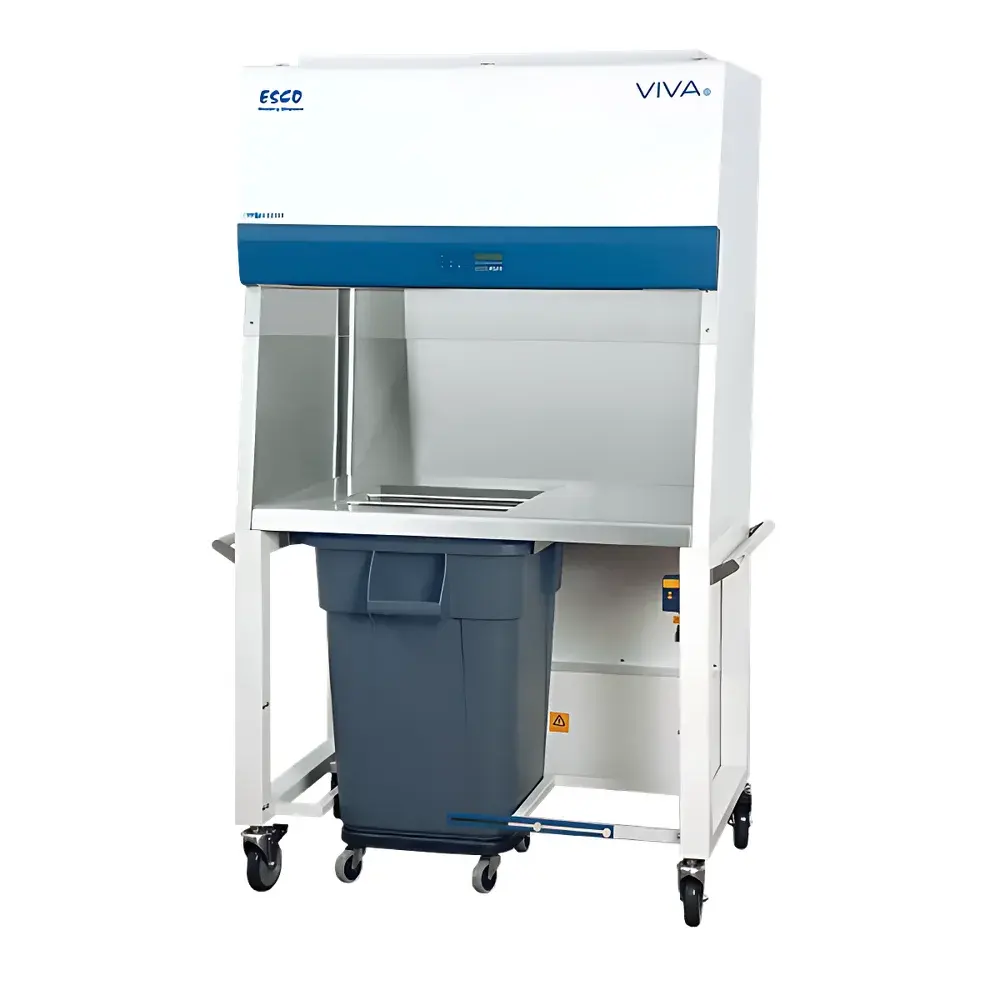
Esco VIVA Animal Bedding Handling Workstation
| Brand | Esco |
|---|---|
| Model | VBD |
| Origin | Singapore |
| Type | ULPA-Filtered Clean Bench for Animal Facility Use |
| Power Supply | 220–240 VAC, 50 Hz |
| Inflow Air Velocity | 0.35 m/s (70 fpm) |
| External Dimensions (H min/max) | 1247 × 760 × 1966 mm / 1247 × 760 × 2271 mm |
| Internal Work Area | 1040 × 680 × 594 mm |
| Filter System | ULPA + Nanocarb Activated Carbon + Pre-filter |
| Surface Finish | Stainless Steel (ISOCEDE® Antimicrobial Coating) |
| Integrated Waste Container | 40-gallon NSF-certified |
| Height Adjustment | Hydraulic Mechanism |
| Control System | Sentinel Microprocessor-based Controller |
| Compliance | NSF/ANSI 49 Class I Equivalent Design Principles, ISO 14644-1 Class 5 (at work surface), GLP-ready configuration |
Overview
The Esco VIVA Animal Bedding Handling Workstation (Model VBD) is a purpose-engineered Class I clean bench designed specifically for safe, ergonomic, and contamination-controlled handling of soiled animal bedding, cage changing, and associated waste management tasks in vivariums, preclinical research facilities, and AAALAC-accredited institutions. Unlike general-purpose laminar flow hoods, the VBD integrates aerodynamic containment, multi-stage filtration, and anthropometric design to mitigate occupational exposure to bioaerosols, endotoxins, allergens, and volatile organic compounds generated during bedding disposal. Its airflow architecture follows the fundamental principle of inward-facing unidirectional inflow—drawing ambient room air across the work surface at a calibrated velocity of 0.35 m/s—then exhausting it through a dual-stage filtration system comprising a ULPA filter (≥99.999% @ 0.12 µm) and a Nanocarb activated carbon module. This ensures both operator respiratory protection and environmental release control in accordance with OSHA guidelines for laboratory animal facility personnel and NIH Office of Laboratory Animal Welfare (OLAW) recommendations.
Key Features
- Hydraulic height-adjustable work surface (1966–2271 mm overall height) enables customization to user anthropometry, reducing repetitive strain injury risk during prolonged cage handling.
- ULPA filtration (EN 1822 H14 equivalent) provides ≥99.999% particle capture efficiency down to 0.12 µm—critical for trapping fine particulate matter from cellulose- or corn-cob-based bedding.
- Nanocarb™ granular activated carbon filter effectively adsorbs ammonia, hydrogen sulfide, and other malodorous VOCs generated by urine-soaked substrates.
- Replaceable pre-filter extends ULPA service life and allows safe in-situ replacement under active airflow—minimizing downtime and maintaining continuous containment integrity.
- Integrated 40-gallon (151 L) NSF/ANSI 372-certified stainless steel waste container is securely mounted within the work area, eliminating secondary transfer steps and cross-contamination vectors.
- ISOCEDE® antimicrobial coating applied to all exposed stainless steel surfaces inhibits microbial colonization (tested per ISO 22196 against Staphylococcus aureus and Escherichia coli)—supporting routine decontamination protocols.
- Sentinel™ microprocessor controller continuously monitors inflow velocity, filter differential pressure, and operational status; logs event history with timestamped records for GLP/GMP traceability.
- Seamless, electropolished 304 stainless steel work surface with radius-rounded edges facilitates rapid wipe-down and prevents debris accumulation in crevices.
- Dedicated sloped spill zone at the front edge directs loose bedding and particulates toward the waste receptacle—enhancing procedural efficiency and containment fidelity.
Sample Compatibility & Compliance
The VBD workstation accommodates standard rodent caging systems (e.g., Allentown, Tecniplast, Lab Products), including static and ventilated cages up to 32 cm wide. Its internal dimensions (1040 × 680 × 594 mm) support simultaneous handling of two large IVC racks or four standard shoebox cages. The unit complies with key regulatory frameworks governing animal research infrastructure: design principles align with NSF/ANSI 49 Class I performance criteria for personnel and environmental protection; airflow validation meets ISO 14644-1 Class 5 (ISO 5) cleanliness requirements at the work surface; electrical safety conforms to IEC 61010-1 and CE marking directives. While not certified as a biosafety cabinet, its engineering controls satisfy institutional biosafety committee (IBC) requirements for low-risk aerosol-generating procedures involving non-pathogenic or BSL-1 animal models.
Software & Data Management
The Sentinel controller operates without external PC dependency but supports optional RS-485 or Ethernet connectivity for integration into centralized facility monitoring platforms (e.g., LabVantage, Siemens Desigo, or custom SCADA). Logged parameters—including real-time inflow velocity, cumulative filter runtime, and alarm events (e.g., low airflow, filter saturation)—are stored locally for ≥12 months with tamper-resistant timestamps. Audit trail functionality satisfies FDA 21 CFR Part 11 requirements when paired with validated user authentication modules and electronic signature workflows. Data export is supported via USB flash drive in CSV format for QA documentation and annual HVAC validation reports.
Applications
- Primary cage changing and soiled bedding disposal in SPF rodent housing units
- Preparation of clean bedding and nesting material under particulate-controlled conditions
- Handling of genetically modified or immunocompromised animal cohorts requiring enhanced environmental stewardship
- Waste segregation and temporary containment prior to autoclaving or incineration
- Supporting compliance with AAALAC International accreditation standards for occupational health and facility hygiene
- Integration into modular vivarium designs where space-constrained, plug-and-play containment is required
FAQ
Is the VBD certified as a biosafety cabinet?
No. It is engineered as a Class I clean bench optimized for animal bedding handling—not biological agent containment. It does not recirculate air and provides personnel/environmental protection only.
Can the ULPA filter be replaced without shutting down the unit?
Yes—the pre-filter can be changed under live airflow; however, ULPA replacement requires brief shutdown and recommissioning per ISO 14644-3 protocols.
What maintenance intervals are recommended?
Pre-filter: every 3–6 months depending on usage intensity; ULPA: typically 5–7 years with proper pre-filtration; Nanocarb: 12–18 months in high-ammonia environments.
Does the workstation meet GLP audit requirements?
Yes—Sentinel’s event logging, password-protected settings, and configurable alarm thresholds support full traceability required for Good Laboratory Practice compliance.
Is installation support available globally?
Esco provides factory-authorized commissioning services, including airflow mapping, filter integrity testing (DOP/PAO), and IQ/OQ documentation packages for regulated facilities.



