
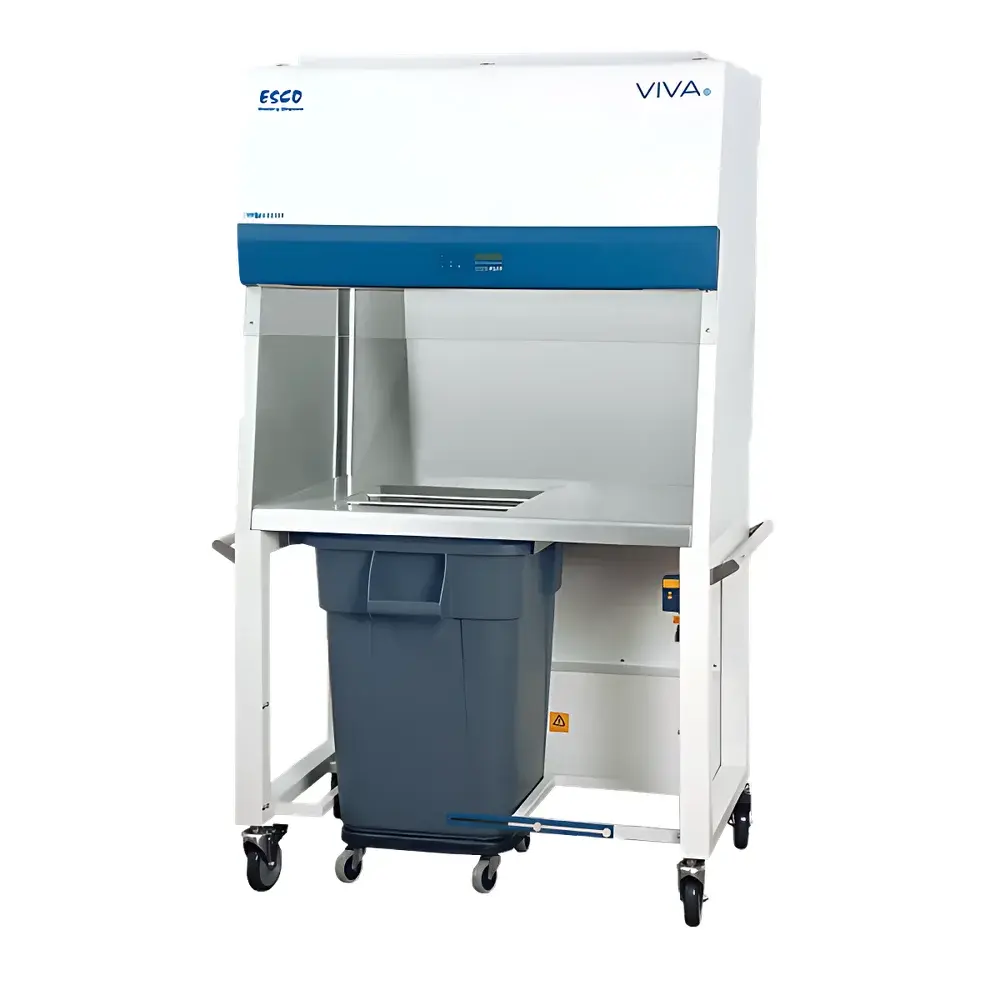
Esco VIVA Animal Bedding Handling Workstation
| Brand | Esco |
|---|---|
| Origin | Singapore |
| Manufacturer Type | Authorized Distributor |
| Origin Category | Imported |
| Model | VBD-4A1 |
| Price | Upon Request |
| External Dimensions (L×W×H) | 1247 × 760 × 1966–2271 mm |
| Internal Dimensions (L×W×H) | 1040 × 680 × 594 mm |
| Inflow Air Velocity | 0.35 m/s |
| Power Supply | 220–240 VAC, 50 Hz |
Overview
The Esco VIVA Animal Bedding Handling Workstation (Model VBD-4A1) is an ergonomically engineered, Class II Type A2 biosafety-certified containment workstation specifically designed for safe, efficient, and compliant handling of soiled animal bedding, cage washing, and related husbandry tasks in preclinical research, academic, and contract research organization (CRO) laboratories. Unlike conventional open benchtop procedures or generic fume hoods, the VBD-4A1 employs a dual-filtered, inward-flowing laminar air system based on ASHRAE 110–tested airflow dynamics to simultaneously protect personnel, product integrity, and the laboratory environment. Its core operational principle relies on controlled directional airflow—drawn through a prefilter, then purified by a ULPA (Ultra-Low Penetration Air) filter (≥99.999% @ 0.12 µm) and a Nanocarb™ activated carbon filter—to remove airborne allergens (e.g., mouse urinary proteins), endotoxins, ammonia, hydrogen sulfide, and other volatile organic compounds (VOCs) generated during bedding disposal and cage sanitation. The workstation is independently verified per ELISA-based allergen challenge testing protocols to confirm ≤0.01 ng/m³ residual airborne allergen exposure under standard operating conditions—meeting stringent occupational health requirements outlined in OSHA Technical Manual Section VI and EU Directive 2000/54/EC.
Key Features
- Ergonomic hydraulic height adjustment system enabling continuous vertical positioning of the work surface between 1966 mm and 2271 mm (min/max overall height), reducing repetitive strain injury (RSI) risk per ISO 11228-1:2018 guidelines.
- Integrated NSF/ANSI 49–certified 40-gallon (151 L) stainless steel waste container mounted directly into the work surface, facilitating immediate, hands-free disposal of soiled bedding and cage debris without cross-contamination.
- Sentinel™ microprocessor-based control system with real-time monitoring of inflow velocity, filter differential pressure, UV lamp status (if equipped), and alarm logging—supporting GLP-compliant audit trails.
- Seamless, electropolished 304 stainless steel work surface with radius-rounded edges (R10) and integrated spill containment slope (3° incline toward waste port) for rapid decontamination and compliance with ISO 14644-1 cleanroom surface standards.
- Nanocarb™ impregnated activated carbon filter (120 mm depth) optimized for adsorption of low-molecular-weight VOCs including ammonia (NH₃), formaldehyde (CH₂O), and trimethylamine (C₃H₉N), validated per ASTM D5228–18 breakthrough testing.
- ULPA filtration (EN 1822–1 H14 grade) with prefilter staging to extend service life; prefilter replacement possible under active airflow without interrupting operations.
- Uniform 500 lux LED illumination (IEC 60598–1 compliant) distributed across the entire work area, eliminating shadow zones during visual inspection of cages or bedding consistency.
- ISOCIDE® antimicrobial coating applied to all exposed stainless steel surfaces, inhibiting growth of Staphylococcus aureus, Pseudomonas aeruginosa, and Aspergillus niger per ISO 22196:2011.
Sample Compatibility & Compliance
The VBD-4A1 accommodates standard rodent caging systems (including IVC racks up to 600 mm depth), bulk bedding bags (up to 20 kg), and automated cage washer discharge chutes. It complies with international biosafety and occupational hygiene standards including NSF/ANSI 49–2022 (Class II, Type A2), EN 12469:2000, AS/NZS 2243.3:2010, and supports adherence to AAALAC International accreditation requirements for allergen mitigation. All electrical components meet IEC 61010–1 safety standards; optional UV germicidal irradiation modules (254 nm) are available for enhanced surface decontamination between shifts.
Software & Data Management
The Sentinel™ controller stores up to 12 months of operational logs—including date/time-stamped filter pressure differentials, inflow velocity deviations (>±10%), and alarm events—with export capability via USB-C interface in CSV format. Audit trail functionality satisfies FDA 21 CFR Part 11 requirements when paired with institutional electronic signature policies. No cloud connectivity is embedded; data remains local unless interfaced with lab-wide LIMS via optional RS-485 or Modbus TCP gateway (sold separately).
Applications
- Primary processing of soiled corn-cob, paper-based, and aspen shaving bedding from murine, lagomorph, and non-human primate colonies.
- Manual or semi-automated cage dumping and pre-rinse prior to tunnel washer loading.
- Allergen-sensitive facility maintenance workflows requiring documented exposure control (e.g., transgenic breeding cores).
- GLP-regulated toxicology study support where bedding-derived particulate interference must be excluded from inhalation exposure chambers.
- Training environments for veterinary technicians and animal care staff on ALARA (As Low As Reasonably Achievable) handling principles.
FAQ
What certifications does the VBD-4A1 hold for biosafety and electrical safety?
It is certified to NSF/ANSI 49–2022 (Class II, Type A2), EN 12469:2000, and IEC 61010–1:2010.
Can the ULPA and carbon filters be replaced while the unit is operating?
The prefilter may be replaced under airflow; ULPA and Nanocarb™ filters require shutdown and verification via aerosol challenge test post-installation.
Is the 40-gallon waste container removable for autoclaving?
Yes—the NSF-certified container is fully detachable and compatible with standard laboratory autoclave cycles (121°C, 15 psi, 30 min).
Does the workstation support integration with building management systems (BMS)?
Optional analog 4–20 mA output signals for inflow velocity and filter delta-P are available for BMS linkage.
What is the expected service life of the Nanocarb™ filter under typical rodent facility usage?
Based on 8-hour daily operation and average ammonia load (≤15 ppm), nominal service life is 12–14 months—monitored via integrated pressure drop sensors.



