
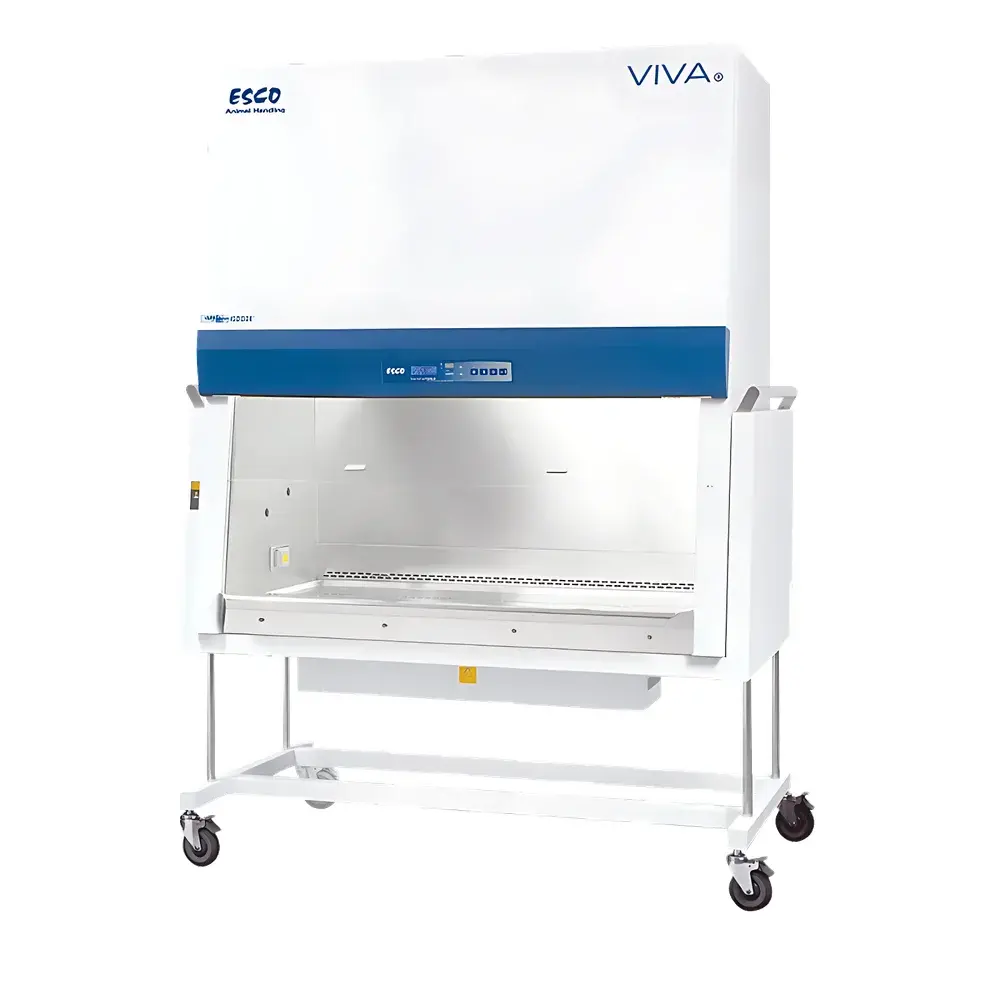
Esco VIVA VA2-A1-E Universal Animal Handling Safety Cabinet
| Brand | Esco |
|---|---|
| Origin | Singapore |
| Model | VA2-A1-E |
| External Dimensions (L×W×H) | 1423 × 815 × 1510 mm |
| Internal Work Area (L×W×H) | 1270 × 623 × 680 mm |
| Inflow Velocity | 0.45 m/s |
| Downflow Velocity | 0.35 m/s |
| Power Supply | 220–240 VAC, 50/60 Hz |
| Filtration | Dual ULPA (≥99.999% @ 0.12 µm MPPS) |
| Pre-filter | Polyester pleated, 85% arrestance |
| Compliance | ISO 14644-1 Class 3 (equivalent to Fed Std 209E Class 1), NSF/ANSI 49 compliant design principles, GLP-aligned operational safeguards |
Overview
The Esco VIVA VA2-A1-E Universal Animal Handling Safety Cabinet is an engineered containment solution designed specifically for laboratories conducting in vivo procedures involving laboratory animals, allergen-sensitive models, or immunocompromised subjects. Unlike conventional biosafety cabinets, the VA2-A1-E integrates dual-path airflow architecture derived from Class II A2 biosafety principles—yet optimized for animal handling workflows. It maintains a unidirectional, vertically downward laminar downflow (0.35 m/s) across the work surface, combined with a controlled inward inflow (0.45 m/s) at the sash opening. This configuration ensures three-tier protection: (1) operator protection from aerosolized allergens, dander, and zoonotic agents; (2) product integrity by delivering ISO Class 3 (≤1 particle ≥0.1 µm per cubic foot) clean air to the work zone—exceeding standard ISO Class 5 environments by two orders of magnitude; and (3) environmental protection via recirculation of 70% of total airflow through dual ULPA filters and exhaust of 30% through a dedicated ducted or thimble-connected pathway. The cabinet’s structural integrity, airflow stability, and filter efficiency are validated per ISO 14644-1, with performance benchmarks aligned with NSF/ANSI 49 Annex D guidance for animal-use enclosures.
Key Features
- Dual ULPA filtration system: One ULPA filter (≥99.999% efficiency at 0.12 µm Most Penetrating Particle Size) for downflow supply; second ULPA filter for exhaust air—ensuring both operator and environmental protection.
- Integrated activated carbon filter module: Installed in the exhaust path to adsorb volatile organic compounds (VOCs), ammonia, and other odorous metabolites generated during animal handling—critical for long-duration procedures and facility air quality compliance.
- ESCO Sentinel™ microprocessor control system: Real-time monitoring of inflow and downflow velocities, sash position, and filter loading status via backlit LCD interface; configurable alarm thresholds with audible and visual alerts for sash mispositioning or airflow deviation >±10%.
- ISOCIDE® antimicrobial powder coating: Applied to all exposed interior and exterior steel surfaces; inhibits microbial colonization (tested per ISO 22196) without leaching or compromising surface integrity under routine decontamination protocols.
- Ergonomic front-sloped work surface: 12° incline reduces operator neck and shoulder strain during prolonged procedures; combined with adjustable height pedestal option (VA2-A1-E variant), supports anthropometric alignment per ISO 11228-1 guidelines.
- Fail-safe airflow interlock: Automatic power cutoff and alarm activation upon detection of sustained inflow/downflow failure (>3 seconds), preventing inadvertent exposure during filter clogging or fan malfunction.
Sample Compatibility & Compliance
The VA2-A1-E accommodates a broad range of animal handling activities—including intranasal dosing, tail vein injection, cage changing, surgical preparation, and behavioral assay setup—without compromising containment integrity. Its ISO Class 3 work area supports sterility-critical tasks such as embryo transfer or germ-free colony maintenance when paired with validated disinfection cycles. The cabinet complies with core regulatory expectations for GLP-compliant animal facilities: airflow uniformity (±15% across work surface per ISO 14644-3), filter integrity testing capability (DOP/PAO scanning), and audit-ready event logging (via optional Sentinel data export). While not certified to NSF/ANSI 49 as a biosafety cabinet due to its specialized animal-use configuration, its engineering adheres to the airflow safety logic, pressure differentials, and structural containment criteria outlined in Annex D of that standard. All materials meet RoHS Directive 2011/65/EU and are compatible with common veterinary disinfectants (e.g., 70% ethanol, 1:10 sodium hypochlorite, hydrogen peroxide vapor).
Software & Data Management
The Esco Sentinel™ control platform records time-stamped operational events—including sash position history, airflow deviations, alarm triggers, and filter usage hours—with internal non-volatile memory (retains ≥30 days of logs). Optional RS-485 or Ethernet connectivity enables integration into centralized lab infrastructure management systems (LIMS or BMS) for remote monitoring and automated report generation. Audit trail functionality satisfies FDA 21 CFR Part 11 requirements when deployed with user authentication and electronic signature modules (available as add-on firmware package). Calibration certificates for airflow sensors are traceable to NIST standards and provided with each unit shipment.
Applications
- Allergen challenge studies requiring strict operator isolation from rodent dander and protein aerosols
- Handling of transgenic or immunodeficient models where cross-contamination must be minimized
- Veterinary clinical pathology sample processing in shared animal facilities
- Preclinical inhalation toxicology exposure chamber setup and calibration
- Production of monoclonal antibodies using murine hybridoma cultures under low-bioburden conditions
- GLP-regulated reproductive toxicity assays involving timed-pregnant dams
FAQ
Is the VA2-A1-E certified to NSF/ANSI 49?
No—it is engineered to Class II A2 airflow principles but classified as a specialized animal handling enclosure. Certification under NSF/ANSI 49 applies only to human-pathogen-focused biosafety cabinets.
Can it be used for chemical fume containment?
Not as a primary fume hood; the activated carbon filter addresses low-concentration VOCs from animal metabolism, not high-volume solvent vapors. For chemical work, a dedicated ducted fume hood is required.
What validation documentation is supplied?
Each unit ships with Factory Acceptance Test (FAT) report, airflow uniformity map, ULPA filter certification (EN 1822-1), and ISOCIDE® coating biocidal efficacy data per ISO 22196.
How often must ULPA filters be replaced?
Typical service life is 5–7 years under continuous operation; replacement interval is determined by real-time pressure differential monitoring and annual integrity testing per ISO 14644-3.
Does the cabinet support external ducting?
Yes—exhaust can be configured for either hard-ducted connection (with canopy adapter) or thimble-mounted recirculation with carbon filter bypass, depending on facility HVAC specifications.
Related Products



