
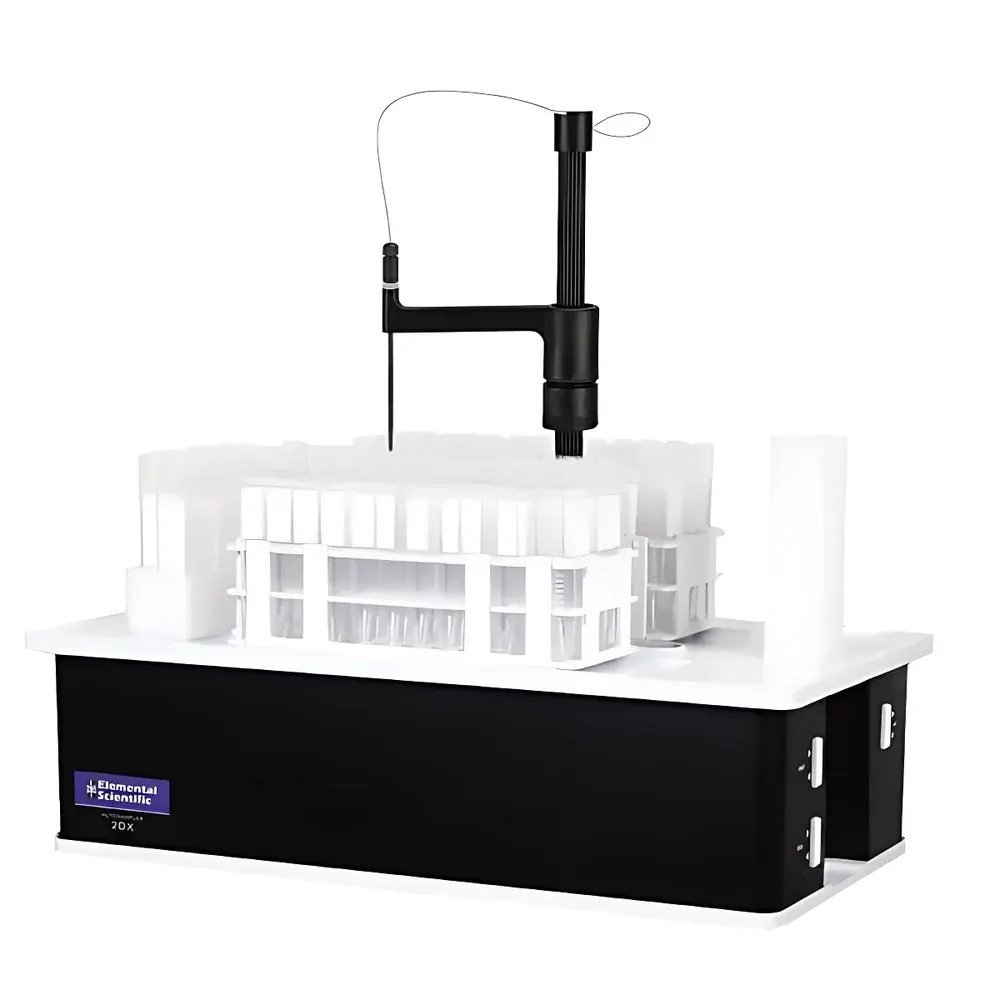
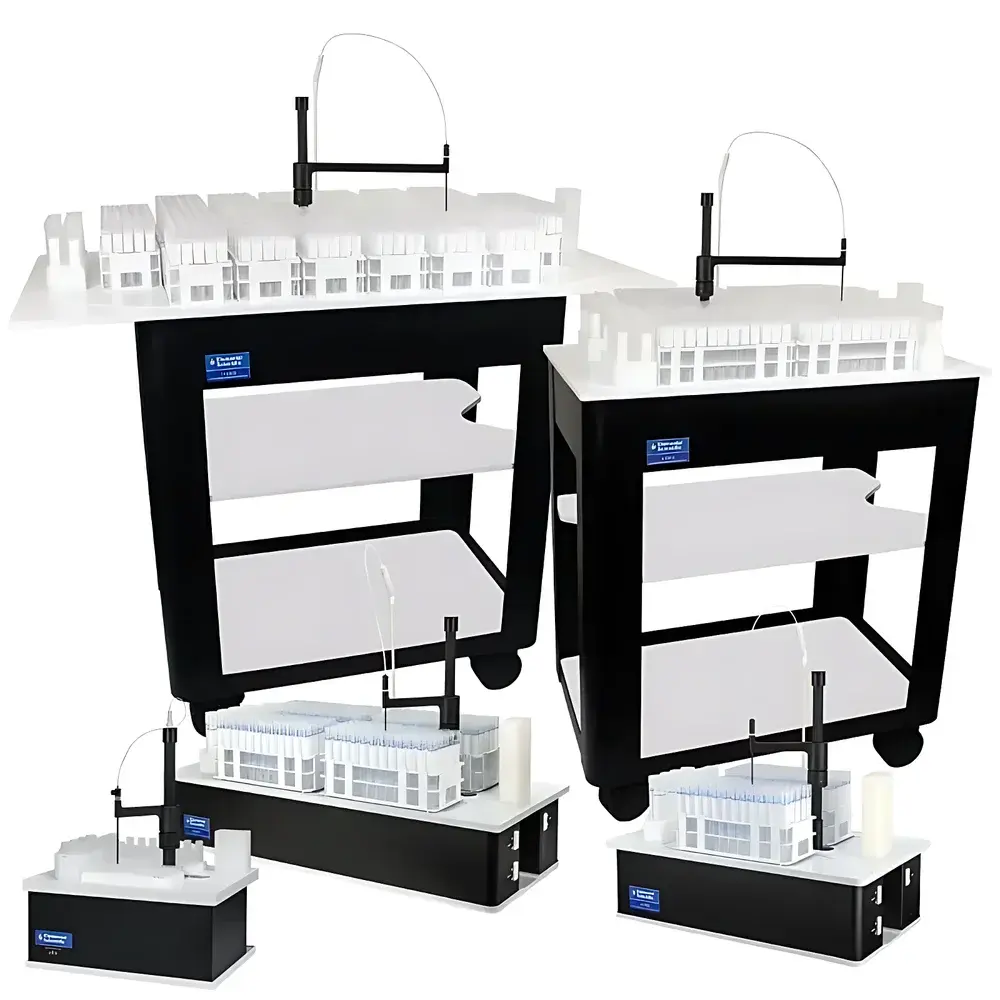
ESI DX Series ICP Automatic Sample Introduction System
| Brand | ESI |
|---|---|
| Origin | Imported |
| Manufacturer Type | Authorized Distributor |
| Model | DX |
| Pricing | Upon Request |
Overview
The ESI DX Series ICP Automatic Sample Introduction System is a high-reliability, chemically inert autosampler engineered specifically for inductively coupled plasma optical emission spectrometry (ICP-OES) and mass spectrometry (ICP-MS) platforms. Built upon over three decades of ESI’s domain expertise in trace elemental analysis and laboratory automation, the DX Series employs a robust, non-metallic fluidic architecture—utilizing fluoropolymer and ceramic components throughout all sample-contact surfaces—to eliminate metal leaching and ensure ultra-trace integrity down to sub-ppt levels. Its core operation relies on precise XYZ robotic motion control combined with dual-rinse station architecture, enabling reproducible sample aspiration, transport, and nebulization initiation under stringent GLP/GMP-compliant workflows. Designed for compatibility with major ICP instrument manufacturers—including Thermo Fisher, Agilent, PerkinElmer, and Shimadzu—the DX Series integrates natively via standardized RS-232, Ethernet, or proprietary OEM communication protocols, ensuring seamless method synchronization and audit-ready command logging.
Key Features
- Chemically inert sample path: All wetted materials—including syringe barrels, needle hubs, wash stations, and calibration arms—are constructed from PFA, FEP, ETFE, or high-purity alumina ceramics, eliminating metallic contamination risks in semiconductor-grade reagents, clinical matrices, and geochemical digests.
- Dual independent rinse stations: Each station supports programmable solvent selection (e.g., 2% HNO₃, ultrapure water, organic solvents), dwell time, and aspiration volume—reducing carryover to <0.005% across high-concentration transitions.
- Redundant positional accuracy: X-Y gantry system with optical encoders and Z-axis rotary arm deliver ±0.1 mm repeatability; auto-calibration arm ensures consistent needle tip positioning relative to sample vial rims and nebulizer interfaces.
- Intelligent obstruction recovery (DXCi variant): Integrated torque-sensing motors detect mechanical resistance during arm movement and execute real-time re-homing without operator intervention—critical for unattended overnight runs.
- Modular scalability: Optional FAST module enables parallel sample loading/unloading during analysis; prepFAST module adds integrated dilution, standard addition, and matrix-matching capabilities compliant with ISO/IEC 17025 method validation requirements.
- Configurable physical integration: Available with anti-spill containment cabinets, HEPA-filtered purge air systems, mobile cart mounting, and optional septum-piercing needle assemblies for air-sensitive or volatile samples (e.g., methylmercury standards, organometallics).
Sample Compatibility & Compliance
The DX Series accommodates standard 12–16 mm diameter borosilicate or polypropylene vials (up to 1000 positions), as well as custom rack formats for 96-well plates or microtubes. It handles aqueous acids (up to 6 M HNO₃, 3 M HCl), organic solvents (methanol, acetone, MIBK), HF-containing digestates (with fluorinated configuration), and viscous biological fluids (serum, urine, tissue homogenates). Regulatory alignment includes full support for FDA 21 CFR Part 11 electronic signature and audit trail requirements when paired with ESI’s certified software suite. Instrument performance verification adheres to ASTM D5685 (for ICP sample introduction systems) and ISO 17294-2:2016 (water quality — detection of metals by ICP-MS), with documented calibration stability exceeding 72 hours under continuous operation.
Software & Data Management
Controlled via ESI’s Windows-based AutoLIMS™ software, the DX Series provides method-driven sequence definition, real-time status monitoring, and automated error logging with timestamped event records. Software modules include method templates for EPA Method 200.8, ISO 15586, and USP /; built-in QC flagging triggers alerts for failed rinses, missed vial detection, or pressure anomalies. All commands, parameter changes, and execution logs are stored in encrypted SQLite databases with configurable retention policies—enabling full traceability for internal audits or regulatory inspections. Optional OPC UA server integration allows bidirectional data exchange with enterprise LIMS platforms (e.g., LabWare, STARLIMS) without middleware dependencies.
Applications
- Semiconductor manufacturing: Ultra-pure chemical certification (SEMI C1/C10 grade) requiring sub-fg/g detection limits and zero background interference.
- Environmental monitoring: Multi-element analysis of wastewater, soil extracts, and airborne particulates per EPA 6020B and 200.8 protocols.
- Clinical toxicology: Quantification of essential/toxic elements (As, Cd, Pb, Se, Zn) in whole blood and serum using isotope-dilution ICP-MS.
- Geochemical research: High-precision isotopic ratio measurements (e.g., Sr, Nd, Hf) where memory effects must be minimized below 10⁻⁶.
- Pharmaceutical QA/QC: Elemental impurity screening of drug substances and excipients aligned with ICH Q3D guidelines.
FAQ
Does the DX Series support direct integration with my existing ICP-MS platform?
Yes—ESI maintains official communication protocol certifications for all major ICP-MS vendors; contact technical support with your instrument model number for confirmed compatibility documentation.
What maintenance intervals are recommended for the XYZ motion system?
The X-Y gantry requires no scheduled lubrication; annual verification of encoder calibration and belt tension is advised per ISO/IEC 17025 preventive maintenance schedules.
Can the DXCi model perform automatic vial cap piercing?
Cap piercing is supported only with the optional septum-piercing needle kit (part #DX-SPN), which integrates with the standard calibration arm and is validated for crimp-top and screw-cap vials.
Is prepFAST functionality available as a field upgrade?
Yes—prepFAST hardware and software licenses can be installed post-purchase; installation must be performed by ESI-certified field service engineers to maintain compliance with ISO 9001 calibration records.
How is carryover quantified during method validation?
Carryover is assessed per ICH Q2(R2) guidelines using a 10× concentrated standard followed by five blank injections; reported values reflect the highest signal observed in blanks as a percentage of the initial standard response.
Related Products




