
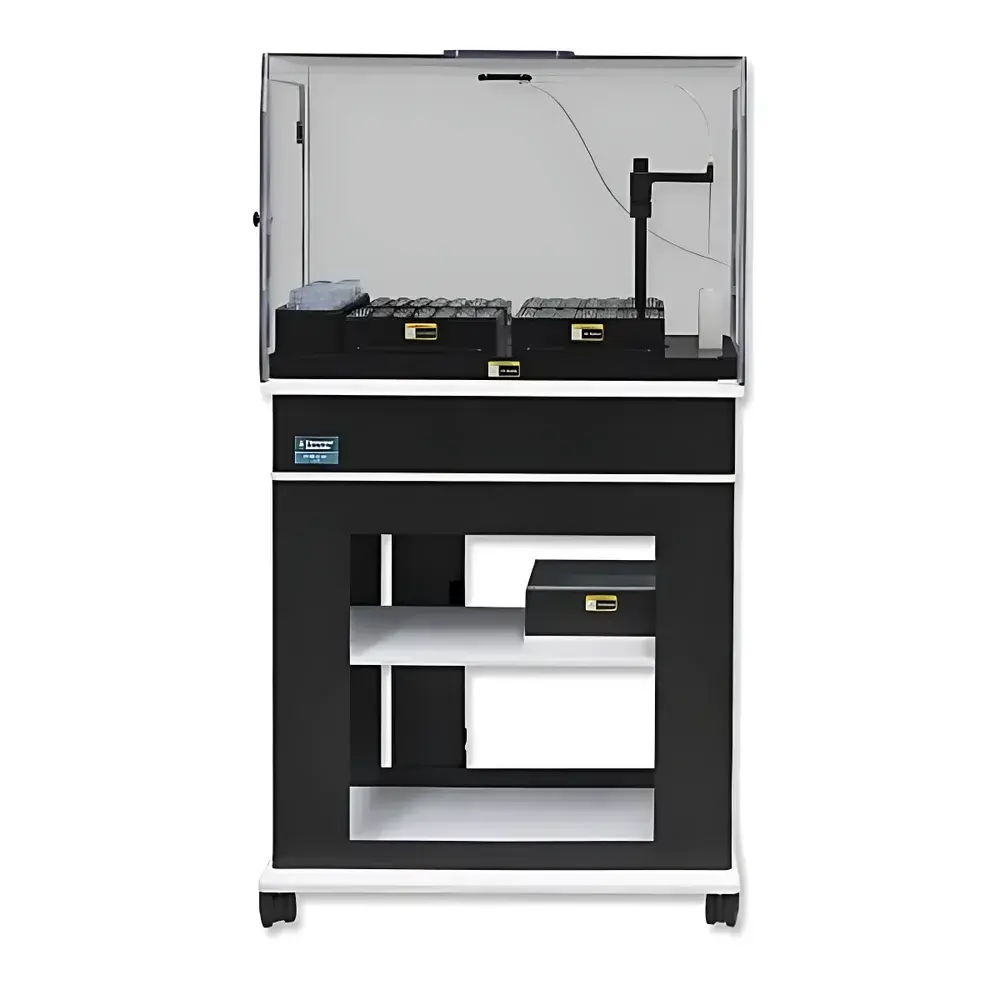
ESI EdibleOil ICP Automated Sample Introduction System
| Brand | ESI |
|---|---|
| Origin | Imported |
| Manufacturer Type | Authorized Distributor |
| Model | EdibleOil ICP |
| Pricing | Available Upon Request |
Overview
The ESI EdibleOil ICP Automated Sample Introduction System is a purpose-built, temperature-controlled autosampler engineered specifically for direct analysis of edible oils by inductively coupled plasma optical emission spectrometry (ICP-OES) and mass spectrometry (ICP-MS). Unlike conventional liquid autosamplers designed for aqueous or dilute acid matrices, this system addresses the fundamental analytical challenges posed by high-viscosity, non-polar, thermally labile lipid-based samples. It eliminates the need for microwave-assisted acid digestion—a time-consuming, contamination-prone, and analyte-loss–sensitive step—by maintaining the entire fluidic path—including sample loop, transfer lines, nebulizer, and spray chamber—at precisely controlled elevated temperatures. This thermal management strategy ensures homogeneous sample phase behavior, stable aerosol generation, and reproducible transport efficiency, enabling robust, matrix-tolerant elemental quantification across diverse oil types (e.g., olive, soybean, palm, canola, fish oil) without dilution or derivatization.
Key Features
- Full-path heating system (up to 120 °C, adjustable) maintains consistent viscosity and prevents wax/crystal precipitation during aspiration and delivery
- Chemically inert fluidic pathway: PFA, FEP, and fused silica components eliminate metal leaching and cross-contamination
- Dual independent wash stations with programmable solvent selection (e.g., hexane, isopropanol, chloroform) for effective removal of residual lipids and organic matrix
- X-Y-Z robotic arm architecture with hardened ceramic guide rails and sealed stepper motors—engineered for long-term reliability in high-throughput labs
- Self-calibrating positioning system using optical encoders and reference fiducials ensures sub-millimeter repeatability in vial targeting
- Smart collision detection: real-time torque monitoring triggers automatic retraction and positional recovery upon mechanical obstruction
- Stainless steel sampling needle with integrated mesh filter and auto-retracting tip protection mechanism minimizes clogging and physical damage
- Integrated dust shield and optional laminar-flow enclosure support ISO/IEC 17025-compliant cleanroom operation
Sample Compatibility & Compliance
The system accommodates both liquid and semi-solid edible oils at ambient temperature, including cold-pressed, refined, hydrogenated, and emulsified formulations. Its design conforms to ASTM D4897–22 (Standard Test Method for Elemental Analysis of Used Lubricating Oils by ICP Spectrometry) and aligns with USP / requirements for elemental impurities in pharmaceutical excipients derived from natural oils. All wetted materials comply with FDA 21 CFR §177.2600 (indirect food additives: plastics) and EU Regulation (EC) No 1935/2004. The firmware supports audit-trail logging per FDA 21 CFR Part 11 and GLP/GMP data integrity requirements when integrated with compliant LIMS or instrument control software.
Software & Data Management
Controlled via ESI’s proprietary AutoLIS™ software (v5.2+), the system provides method-driven workflow automation, including temperature ramp profiles, multi-solvent wash sequences, and dynamic viscosity compensation algorithms. It communicates natively with Thermo Fisher iCAP, Agilent 5110/5900, PerkinElmer Avio, and Shimadzu ICPE-9800 platforms via standardized RS-232, Ethernet TCP/IP, or OEM-specific protocol drivers. Raw positional logs, thermal history, wash cycle counts, and error diagnostics are exportable as CSV or XML for traceability. Optional integration with LabWare LIMS or Thermo Fisher SampleManager enables full chain-of-custody tracking and electronic signature enforcement.
Applications
- Quantitative determination of toxic elements (Pb, Cd, As, Hg) in edible oils per EU Commission Regulation (EU) No 2023/915
- Trace metal profiling (Fe, Cu, Ni, Cr) for authenticity verification and geographic origin assessment
- Monitoring catalyst residues (e.g., Ni, Co) from hydrogenation processes
- Stability studies evaluating metal-mediated oxidation (e.g., Cu-induced rancidity)
- Quality control of frying oils in food manufacturing and catering supply chains
- Regulatory compliance testing for infant formula lipid ingredients under Codex Alimentarius STAN 72-1981
FAQ
Does this autosampler require sample dilution prior to ICP analysis?
No—direct introduction of undiluted edible oil is supported through active viscosity control and optimized nebulization.
Can it be retrofitted to existing ICP instruments?
Yes; hardware and communication protocols are validated for integration with major OEM platforms without modification to the spectrometer.
What maintenance intervals are recommended?
Daily solvent flush, weekly nebulizer inspection, and biannual calibration of thermal sensors and positional encoders per ESI Maintenance Manual Rev. 4.1.
Is method validation documentation provided?
Yes—includes IQ/OQ/PQ protocols, system suitability test procedures, and ASTM-aligned performance verification reports.
How is carryover addressed for high-fat samples?
Dual solvent wash stations, heated rinse loops, and post-injection air purge ensure carryover remains below 0.05% for all regulated elements.
Related Products







