
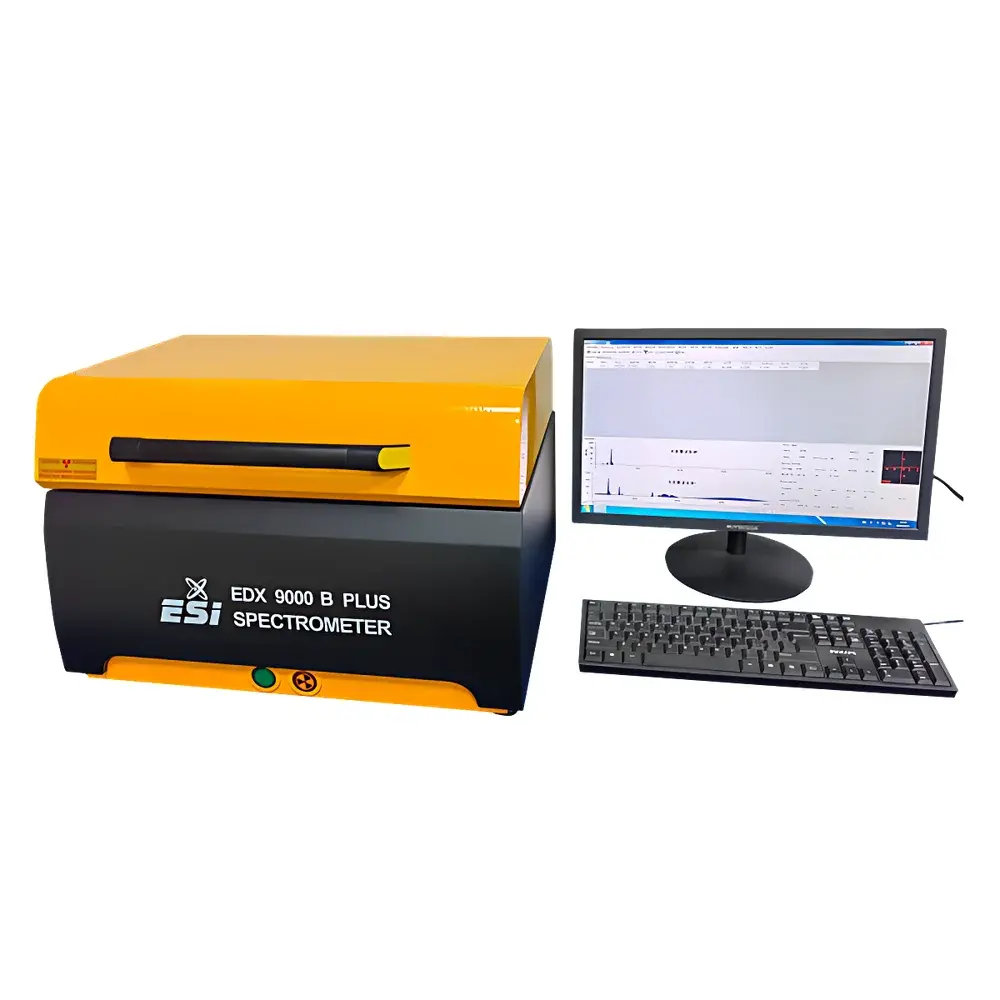
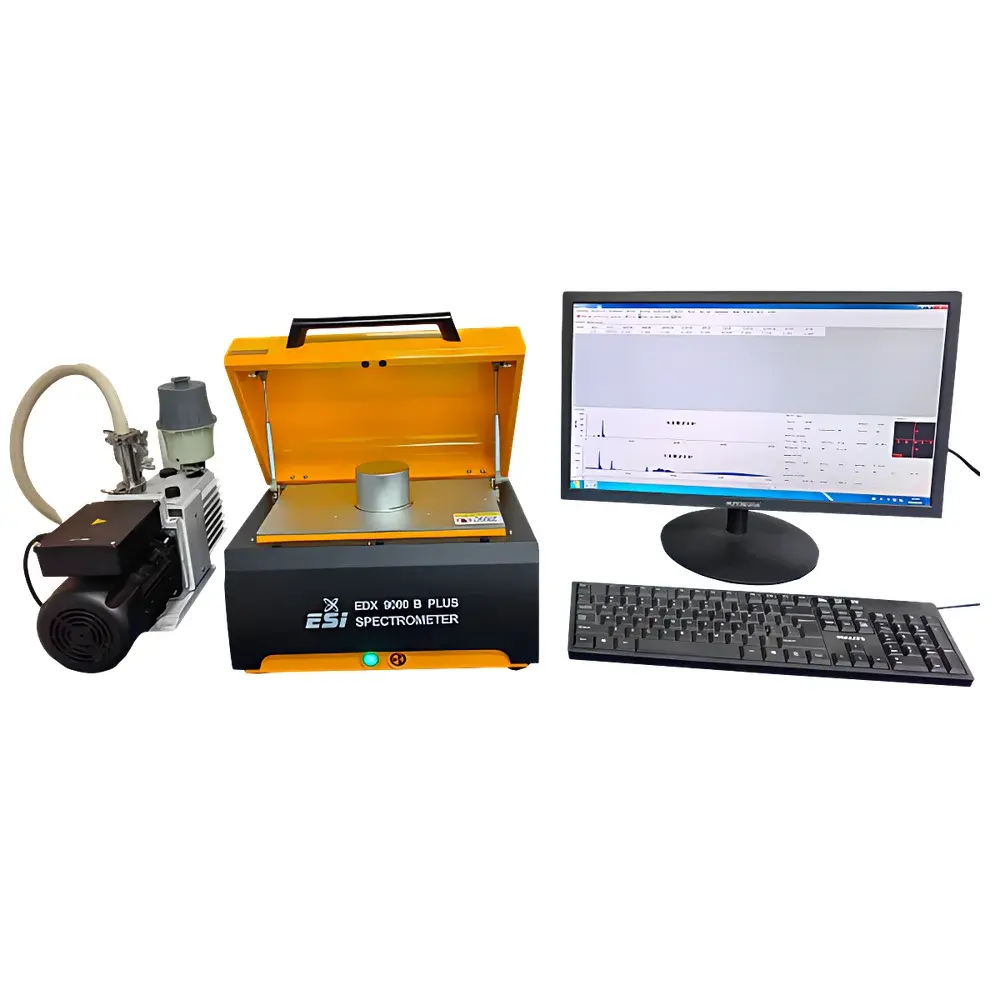
ESI EDX9000B PLUS Energy Dispersive X-Ray Fluorescence Spectrometer
| Brand | ESI |
|---|---|
| Origin | Jiangsu, China |
| Manufacturer Type | Direct Manufacturer |
| Regional Classification | Domestic (China) |
| Model | EDX9000B PLUS |
| Configuration | Benchtop/Floor-standing |
| Industry-Specific Application | Non-Ferrous Metals |
| Elemental Range | Na (Z=11) to U (Z=92) |
| Quantification Range | 1 ppm – 99.99% |
| Energy Resolution | <140 eV (Mn Kα) |
| Repeatability (RSD) | ≤0.05% |
| Detector | Peltier-Cooled Fast Silicon Drift Detector (FSDD) |
Overview
The ESI EDX9000B PLUS is a high-performance benchtop/floor-standing energy dispersive X-ray fluorescence (EDXRF) spectrometer engineered for quantitative and qualitative elemental analysis of copper-bearing ores and related geological, metallurgical, and industrial materials. Based on the fundamental principle of X-ray fluorescence—where primary X-rays excite atoms in a sample, inducing emission of characteristic secondary X-rays—the instrument delivers non-destructive, multi-element analysis with minimal sample preparation. Its optimized optical path includes a fully integrated vacuum system, enabling reliable detection and quantification of light elements (Na–F) alongside mid- and heavy-Z elements (e.g., Cu, Zn, Pb, Fe, As, Sb, Mo, U) across complex matrices typical of porphyry, sulfide, oxide, and carbonate-hosted copper deposits. Designed for routine operation in exploration labs, mine-site QC facilities, smelter feed control centers, and academic geochemistry departments, the EDX9000B PLUS meets the analytical rigor required for grade estimation, process optimization, and regulatory compliance.
Key Features
- Multi-element capability: Simultaneous quantification of up to 40 elements from sodium (Na, Z=11) to uranium (U, Z=92), including critical copper-associated elements (Cu, Fe, S, As, Mo, Pb, Zn, Ag) and major oxides (Na₂O, MgO, Al₂O₃, SiO₂, P₂O₅, SO₃, K₂O, CaO, TiO₂, Cr₂O₃, MnO, Fe₂O₃, ZnO, SrO).
- Advanced detector architecture: Peltier-cooled Fast Silicon Drift Detector (FSDD) with <140 eV energy resolution at Mn Kα, delivering superior peak separation, low background noise, and high count-rate linearity—even under extended acquisition protocols.
- Patented spectral enhancement: Multi-collimator/multi-filter configuration combined with background subtraction algorithms significantly improves signal-to-noise ratio and lowers detection limits for light elements.
- Stable vacuum environment: Dual-speed vacuum pumping system with auto-stabilized pressure control ensures consistent excitation conditions and eliminates atmospheric absorption effects on low-energy X-rays.
- Digital pulse processing: High-throughput digital multi-channel analyzer (MCA) with real-time dead-time correction and pile-up rejection supports robust data integrity across variable count rates.
- Ergonomic operational design: Intuitive touchscreen interface, modular sample chamber, and tool-free sample loading support rapid turnaround in high-volume testing environments.
Sample Compatibility & Compliance
The EDX9000B PLUS accommodates solid powders (pressed pellets or fused beads), bulk rock chips, drill core fragments, and polished sections—compatible with standard ASTM D5630 (plastic ash), ASTM C114 (cement analysis), ISO 21047 (ore assay), and GB/T 176–2017 (cement chemical analysis) sample preparation workflows. It supports GLP-compliant operation through audit-trail-enabled software logging, user access levels, electronic signatures, and full traceability of calibration history, measurement parameters, and raw spectrum archives. While not FDA 21 CFR Part 11–certified out-of-the-box, its data management framework is configurable to meet GMP-aligned documentation requirements for mineral processing QA/QC.
Software & Data Management
The system ships with ESI’s proprietary fundamental parameter (FP) quantification software, supporting matrix-matched and empirical calibrations, iterative inter-element correction (IEC), and oxide conversion routines. The software features multi-tasking capability with concurrent spectrum acquisition, real-time fitting, report generation, and database export (CSV, XML, PDF). All spectra are stored with metadata (operator ID, date/time stamp, tube voltage/current, filter/collimator selection, vacuum status), ensuring full reproducibility. Raw data files are compatible with third-party spectral evaluation tools (e.g., PyMca, AXIL) for advanced research applications.
Applications
- Copper ore grade control: Rapid determination of Cu, Fe, S, As, and gangue elements (Si, Al, Ca) in run-of-mine material, mill feed, and concentrate streams.
- Exploration geochemistry: Field-lab screening of soil, sediment, and rock samples for Cu anomaly mapping and vectoring toward mineralization.
- Smelting & refining: Monitoring impurity profiles (Pb, Bi, Sb, Te) in blister copper and anode slimes to optimize electrolytic refining efficiency.
- Environmental compliance: Quantification of regulated metals (As, Cd, Pb, Hg) in tailings, leachates, and reclaimed soils per EPA Method 6200.
- Academic & museum research: Non-invasive compositional profiling of archaeological copper artifacts, slag fragments, and historical pigments.
FAQ
Does the EDX9000B PLUS require liquid nitrogen cooling?
No—it uses a thermoelectrically cooled Fast SDD detector, eliminating cryogenic maintenance and enabling continuous 24/7 operation.
Can it analyze sulfur in chalcopyrite without vacuum?
Sulfur (S Kα, 2.308 keV) requires vacuum or helium purge; the integrated dual-speed vacuum system achieves optimal S sensitivity below 100 ppm.
Is FP calibration transferable between different copper ore types?
Yes—when supported by representative reference materials and validated with certified ore standards (e.g., CANMET, USGS, OREAS), FP models maintain accuracy across sulfide, oxide, and mixed mineralogies.
What sample preparation is recommended for highest precision?
For routine QC: 20–30 g of <75 µm powder pressed into 40 mm diameter pellets at ≥20 t pressure. For research-grade results: lithium borate fusion with internal standard addition.
How is long-term drift compensated?
Automatic recalibration via built-in reference sources and periodic verification using certified multi-element check standards (e.g., NIST SRM 278, 610) ensures <0.1% RSD over 6-month intervals.






