
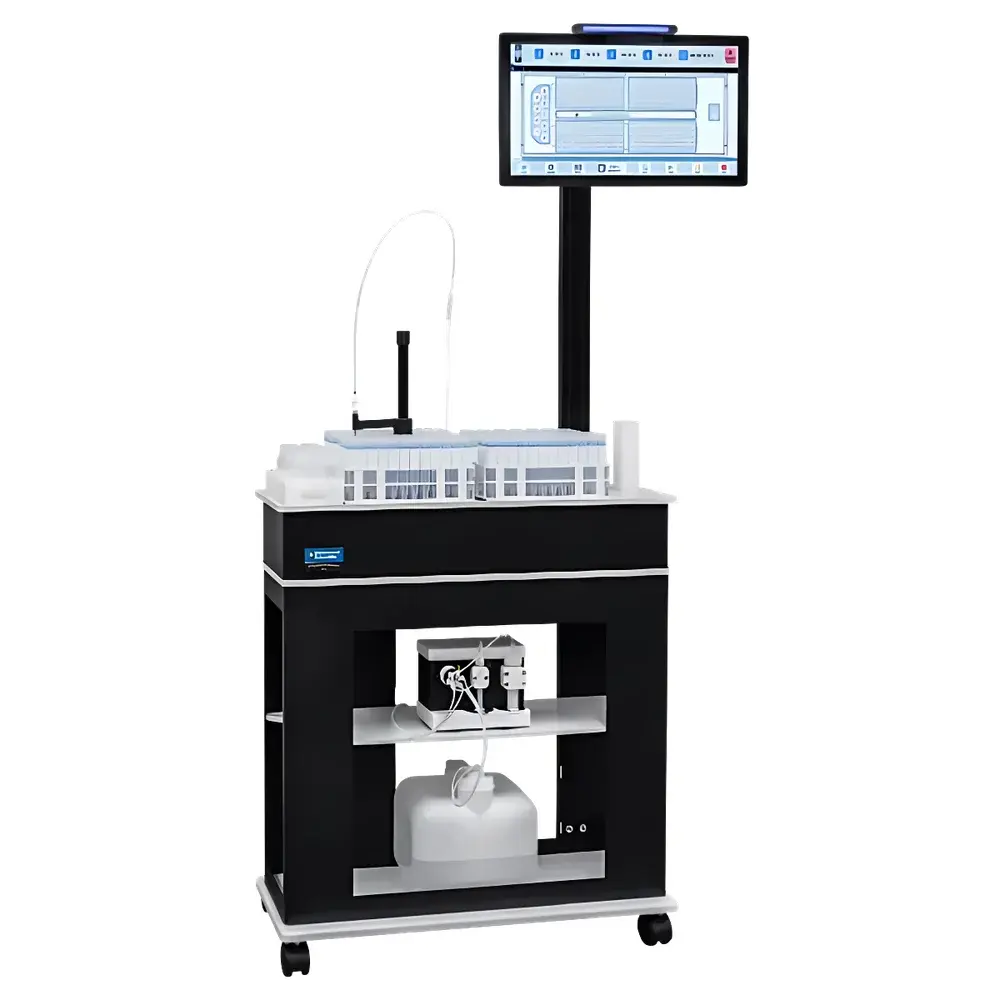
ESI LabStation Offline Liquid Sample Preparation Workstation
| Brand | ESI |
|---|---|
| Origin | Imported |
| Manufacturer Type | Authorized Distributor |
| Model | LabStation |
| Pricing | Upon Request |
Overview
The ESI LabStation Offline Liquid Sample Preparation Workstation is an integrated, benchtop automation platform engineered for reproducible, traceable, and operator-independent liquid handling in analytical laboratories. Designed specifically for offline (non-instrument-coupled) sample conditioning prior to analysis by ICP-OES, ICP-MS, AAS, or other elemental techniques, the LabStation implements precise fluidic control based on syringe-pump-driven dispensing, gravimetric verification (where applicable), and programmable multi-step protocols. Its architecture separates sample preparation from downstream instrumentation—eliminating instrument downtime, reducing cross-contamination risk, and enabling parallel processing of heterogeneous sample batches. The system operates independently of host analyzers, requiring no direct software or hardware integration, making it suitable for labs with mixed vendor instrument fleets or those undergoing phased automation upgrades.
Key Features
- Modular workstation design: Configurable as DilutionStation, FiltrationStation, ReagentStation, DispensingStation, or OilStation—each optimized for distinct sample matrices and protocol requirements.
- Integrated 10.1-inch industrial-grade touchscreen interface: Fully self-contained operation with no external PC, keyboard, or cable clutter; intuitive icon-based navigation and real-time status feedback via color-coded LED indicators.
- Chemically resistant enclosure: IP54-rated housing with removable, autoclavable components and splash-proof front panel—designed for routine use in regulated environments handling acids, organic solvents, and viscous oils.
- Method-driven workflow engine: Supports import of standardized method files (XML-based); enables version-controlled storage, audit-ready execution logs, and user-specific access levels.
- Traceable liquid handling: All dispense steps record timestamp, volume delivered, reagent lot ID (if scanned), and operator ID—aligned with GLP/GMP documentation requirements.
- Onboard cleaning cycle: Automated rinse-and-dry sequences for probes, tubing, and sample vessels using configurable solvent protocols—minimizing carryover between sample batches.
Sample Compatibility & Compliance
The LabStation accommodates a broad range of liquid matrices including aqueous environmental extracts, digested biological tissues, petroleum-based lubricants, semiconductor process chemicals, and clinical serum/plasma dilutions. Each module meets material compatibility standards for HNO₃ (up to 65%), HCl (up to 37%), HF (0.5–2%), and common organic solvents (e.g., methanol, isopropanol). System validation supports IQ/OQ documentation per ISO/IEC 17025 and ASTM D5685 (for oil dilution accuracy). Data integrity features—including electronic signatures, immutable audit trails, and 21 CFR Part 11–compliant user authentication—are available through optional software licensing.
Software & Data Management
The embedded LabStation OS provides local method storage (up to 500 protocols), real-time run monitoring, and export of CSV-formatted execution reports containing dispense volumes, error codes, and environmental sensor readings (temperature/humidity). Raw log files are time-stamped and digitally signed to ensure forensic traceability. Optional ESI Connect software enables centralized fleet management across multiple LabStations, remote method push, and integration with LIMS via RESTful API. All data exports comply with ISO 14155 Annex C and USP analytical instrument qualification guidelines.
Applications
- Environmental labs: Automated EPA Method 200.8/6020B sample dilution and internal standard addition for wastewater and soil leachate analysis.
- Petrochemical QA/QC: Rapid 20-second oil dilution per ASTM D7260 for wear metal analysis in turbine oils and hydraulic fluids.
- Clinical research: Reproducible serum dilution series for multi-element calibration curves under CLIA-certified workflows.
- Geochemistry: High-precision acidification and matrix-matching of rock digestates prior to ICP-MS analysis.
- Pharmaceutical excipient testing: Residue-on-evaporation sample prep with automated rinsing and drying cycles per USP .
FAQ
Is the LabStation compatible with third-party ICP-MS instruments?
Yes—it operates as a standalone offline platform; no vendor-specific drivers or OEM interfaces are required.
Can methods be validated per FDA 21 CFR Part 11?
With optional compliance software license, full electronic signature support, audit trail encryption, and role-based access control are enabled.
What maintenance is required for long-term reliability?
Quarterly calibration verification using NIST-traceable volumetric standards and annual preventive maintenance by ESI-certified field service engineers.
Does the system support barcode scanning for reagent tracking?
Yes—integrated 2D barcode reader supports GS1-compliant labels for reagents, standards, and sample tubes.
How is carryover minimized during high-sensitivity trace metal analysis?
Through programmable multi-solvent rinse sequences, positive-pressure air drying, and disposable probe tips (optional for FiltrationStation and DispensingStation modules).



