
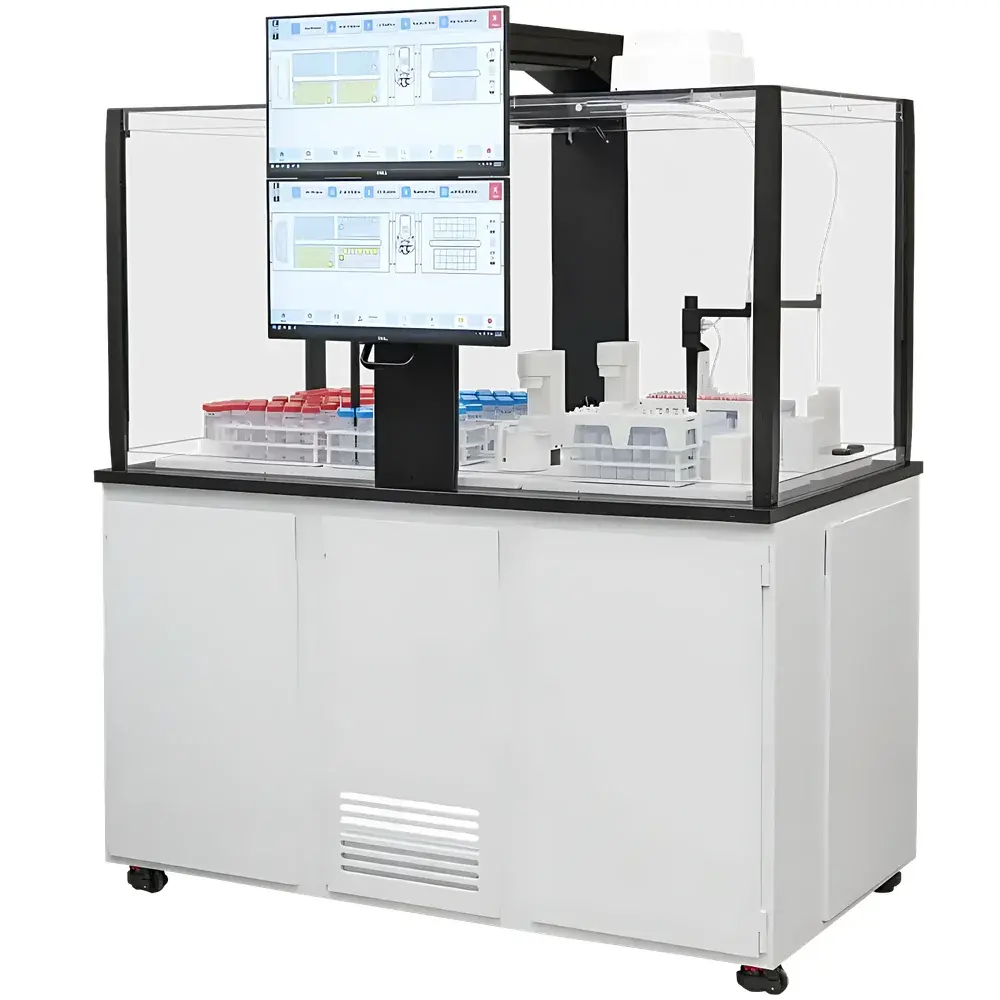
ESI TRAXStation Fully Automated Liquid Sample Preparation Workstation
| Brand | ESI |
|---|---|
| Origin | Imported |
| Manufacturer Type | Authorized Distributor |
| Model | TRAXStation |
| Pricing | Available Upon Request |
Overview
The ESI TRAXStation Fully Automated Liquid Sample Preparation Workstation is an integrated, walk-away solution engineered for high-integrity liquid sample handling in regulated and high-throughput analytical laboratories. Built upon ESI’s three-decade legacy in laboratory automation and trace elemental analysis, the TRAXStation implements a modular, closed-loop architecture grounded in precision fluidic control, robotic sample manipulation, and real-time digital traceability. It operates on a core principle of reproducible, contamination-minimized liquid handling—leveraging positive-displacement syringe pumps, ULPA-class (ISO Class 4) air filtration, and inert gas purging via mass flow controllers—to ensure sample integrity across dilution, filtration, internal standard addition, multi-element calibration, and storage workflows. Designed specifically for compatibility with ICP-OES, ICP-MS, and other elemental analyzers, the platform bridges the gap between manual sample prep and automated analytical data acquisition, supporting compliance-driven environments including environmental testing (EPA Method 200.2, 8.1), clinical trace metal analysis, and semiconductor-grade reagent qualification.
Key Features
- Compact footprint with integrated mobile cabinet—reduces lab space requirement by up to 4× versus conventional manual preparation setups
- Modular workflow configuration: supports interchangeable sample racks (e.g., 12 × 75 mm, 16 × 100 mm, 96-well formats) and customizable method templates for dilution, spiking, mixing, aliquoting, and cleaning cycles
- ULPA-filtered (ISO Class 4) anti-contamination enclosure with interlocked access doors and continuous laminar airflow—mitigates operator exposure and cross-sample carryover
- TRAXLink Sample Tracking System: rotary-lift mechanism enables automatic tube cap opening/closing, barcode scanning at every critical step (pre-/post-processing), and full audit trail generation per sample ID
- High-accuracy syringe pump system with external 3–50 mL glass or PTFE-coated syringes; capable of dispensing volumes down to 10 µL with ≤1.5% CV (coefficient of variation) under routine operation
- Dual articulating touchscreen interfaces—mounted on adjustable arms for ergonomic positioning and simultaneous local monitoring of two independent process zones
- Mass flow-controlled inert gas delivery (e.g., argon or nitrogen) for bubble-free acid addition and headspace purging—eliminates pressure-driven inconsistencies inherent in solenoid-valve-only systems
- Integrated needle-based reagent delivery using Luer-lock sampling probes with disposable inline filters; compatible with aggressive acids (e.g., HNO₃, HF blends) and organic modifiers
Sample Compatibility & Compliance
The TRAXStation accommodates aqueous matrices, digested environmental samples (soil, sludge, wastewater), biological fluids (serum, urine), food extracts, and high-purity industrial reagents. All wetted components—including tubing, syringes, and probe tips—are chemically resistant to nitric, hydrochloric, and hydrofluoric acids, as well as hydrogen peroxide and organic solvents. The system conforms to EPA Method 200.2 (determination of metals in water by ICP-MS) and EPA Method 8.1 (trace element analysis in drinking water), with built-in validation protocols for linearity, spike recovery, and carryover assessment. Data integrity complies with ALCOA+ principles; electronic records support 21 CFR Part 11-compliant user authentication, audit trails, and electronic signatures when deployed with validated LabSymphony software configurations.
Software & Data Management
Controlled exclusively via ESI’s LabSymphony software—a Windows-based, GxP-ready interface—the TRAXStation enables method creation, batch scheduling, real-time status visualization, and error logging. LabSymphony supports direct import of instrument method files from Thermo Fisher iCAP, Agilent 7900/8900, PerkinElmer NexION, and Bruker Aurora platforms. Raw metadata—including timestamps, syringe positions, dispense volumes, barcode reads, and environmental sensor logs (temperature, humidity, filter pressure)—is exportable in CSV, XML, or ASTM E1384-compliant formats. Seamless integration with Laboratory Information Management Systems (LIMS) is achieved through ODBC drivers and RESTful API endpoints, enabling bidirectional synchronization of sample IDs, test requests, and QC results without manual re-entry.
Applications
- Automated preparation of certified reference materials (CRMs) and matrix-matched calibration standards for ICP-MS quantification
- High-volume environmental monitoring programs requiring EPA-compliant digestion product dilution and internal standardization (e.g., As, Cd, Pb, U in drinking water)
- Trace metal analysis in clinical diagnostics—urinary iodine, serum zinc, and whole-blood lead quantitation with minimized analyst variability
- Quality control of high-purity chemicals used in semiconductor fabrication (e.g., HF, H₂O₂, NH₄OH) per SEMI C1–C36 specifications
- Preparatory workflows for battery electrolyte analysis (Li, Ni, Co, Mn) and nuclear fuel cycle material characterization (U/Pu isotopic ratio prep)
- Multi-analyte spiking for method validation studies, including recovery experiments and limit-of-detection assessments
FAQ
Does the TRAXStation support unattended overnight operation?
Yes—the system is rated for continuous 24-hour operation and can process and archive up to 1,500 samples per day with temperature-stabilized storage modules.
Can existing lab personnel operate the TRAXStation without specialized programming training?
LabSymphony employs a drag-and-drop method builder and preloaded SOP templates; basic operation requires less than 4 hours of hands-on training.
Is the TRAXStation compatible with non-ESI ICP-MS instruments?
Yes—standard ASCII-based method file import/export ensures interoperability with all major vendor platforms, including those from Shimadzu, Spectro, and SPECTRO ARCOS.
How is maintenance tracked and documented?
All service events, syringe replacements, filter changes, and calibration verifications are logged automatically and linked to instrument uptime metrics within LabSymphony’s maintenance dashboard.
What cybersecurity safeguards are implemented for network-connected deployments?
The workstation supports TLS 1.2+ encrypted communications, role-based access control (RBAC), and optional integration with enterprise Active Directory; no remote vendor access is enabled by default.
Related Products



