
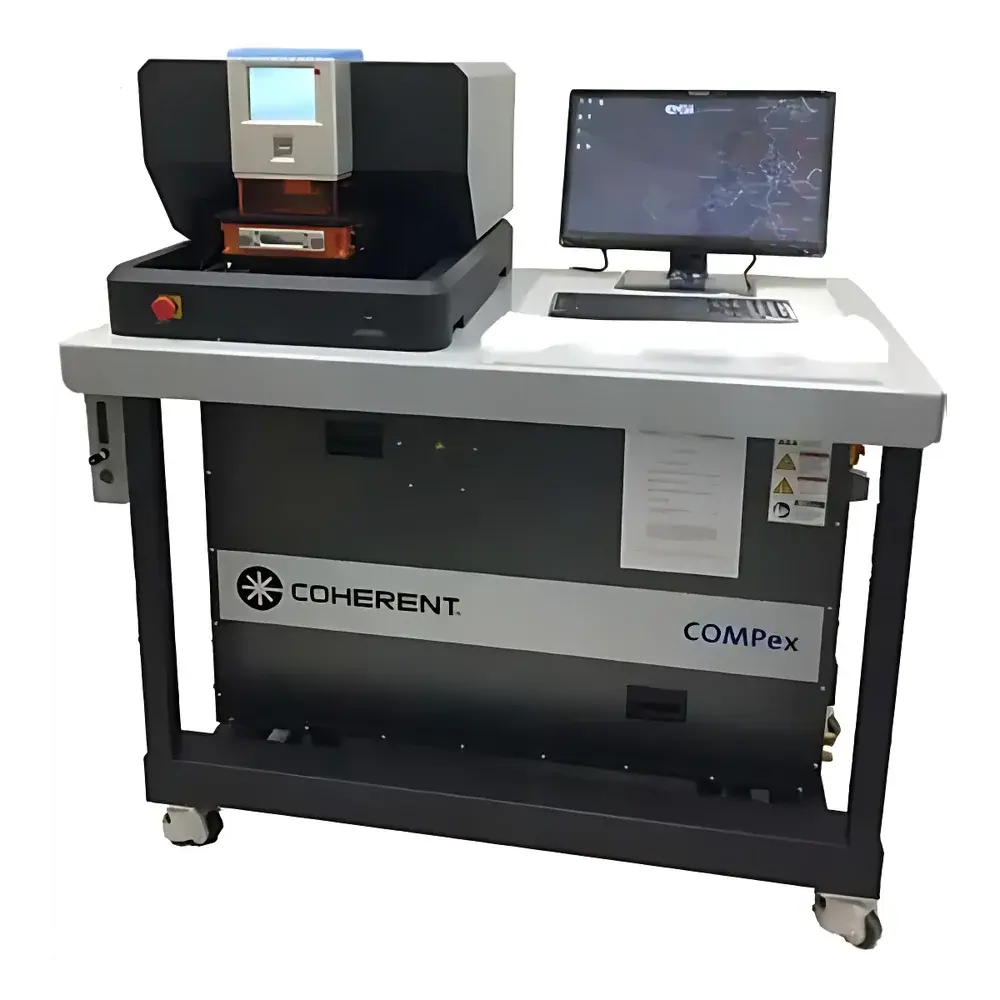
ESL ESL193HE High-Energy 193 nm Excimer Laser Ablation System
| Brand | ESI/ESL |
|---|---|
| Origin | France |
| Manufacturer | ESL (Elemental Scientific Lasers) |
| Type | Imported |
| Model | ESL193HE |
| Pricing | Upon Request |
Overview
The ESL ESL193HE is a high-energy, deep-ultraviolet (DUV) excimer laser ablation system engineered for precision solid-sample introduction into inductively coupled plasma mass spectrometry (ICP-MS) and optical emission spectrometry (ICP-OES). Operating at the 193 nm wavelength—generated by a Coherent COMPexPro® high-repetition-rate excimer laser—the system delivers short-pulse (<20 ns), high-photon-energy irradiation that enables efficient photochemical bond cleavage with minimal thermal perturbation. This physical ablation mechanism ensures stoichiometric sampling of heterogeneous solids—including silicates, metallic alloys, ceramics, and highly transparent dielectrics such as quartz and fluorite—without significant elemental fractionation or matrix-induced signal drift. Designed as a turnkey solution for quantitative microanalysis, the ESL193HE integrates beam delivery, sample chamber control, and real-time imaging into a single robust architecture optimized for reproducible, low-detection-limit analysis across geological, metallurgical, nuclear, and biomedical research domains.
Key Features
- Coherent COMPexPro® 193 nm excimer laser source delivering >50 J/cm² fluence at the sample surface, enabling ablation of refractory and optically transparent materials
- Continuously adjustable circular beam spot size (1–200 µm), with optional motorized rectangular beam shaping (e.g., 10 × 50 µm) for line-scan or large-area rastering
- Patented beam homogenization optics producing near-top-hat intensity profiles, resulting in uniform crater morphology, minimal rim formation, and exceptional depth-to-width consistency
- Dual-volume ablation cell with independent gas flow paths, compatible with dual concentric sample introduction modules for simultaneous multi-element or isotopic ratio monitoring
- Integrated 10-megapixel ultra-high-definition coaxial camera system with real-time focus feedback and calibrated micrometer-scale spatial referencing
- Modular beam transport path supporting both standard reflective optics and optional fiber-coupled delivery for flexible lab integration
- Secondary mass flow controller (MFC) for nitrogen addition—enabling ICP signal enhancement via plasma stabilization and improved ion transmission efficiency
Sample Compatibility & Compliance
The ESL193HE supports direct analysis of conductive and non-conductive solid matrices without conductive coating or pelletization. It is routinely deployed for certified reference material (CRM) validation, zircon U–Pb geochronology, trace-element mapping in semiconductor wafers, and inclusion analysis in synthetic diamonds. The system complies with ISO/IEC 17025 requirements for testing laboratories and supports GLP/GMP-aligned workflows through configurable audit trails, user-access controls, and electronic signature capability. When operated with ICP-MS platforms compliant with ASTM D5673, USP <232>/<233>, and EPA Method 6020B, the ESL193HE facilitates regulatory-grade trace metal quantification in environmental and clinical samples.
Software & Data Management
Control and acquisition are managed via ESL’s LA-Connect™ software suite—a Windows-based application built on .NET Framework with deterministic real-time loop timing. The interface provides synchronized laser firing, stage motion, gas flow modulation, and camera capture with sub-millisecond resolution. All parameters—including fluence, repetition rate, dwell time, scan velocity, and MFC setpoints—are logged with timestamped metadata in HDF5 format, ensuring full traceability per FDA 21 CFR Part 11 requirements. Export options include CSV, mzML, and vendor-neutral XML for seamless import into third-party data reduction packages (e.g., Iolite, Glitter, or PlasmaLab).
Applications
- High-spatial-resolution isotopic imaging of zircons, monazites, and apatites for geochronology and petrogenetic modeling
- Quantitative depth profiling of thin-film photovoltaic stacks (CIGS, perovskite) and barrier layer integrity assessment
- In situ analysis of bio-mineralized tissues (teeth, bone) for trace element biomarkers in nutritional and toxicological studies
- Multi-isotope ratio mapping (e.g., Pb, Sr, Nd, Hf) in meteoritic samples to constrain planetary differentiation processes
- Forensic glass and ceramic fragment sourcing via minor- and trace-element fingerprinting
FAQ
What is the typical ablation threshold for fused silica at 193 nm?
Fused silica exhibits a fluence threshold of ~2–3 J/cm² at 193 nm; the ESL193HE operates well above this range to ensure stable, repeatable craters with minimal subsurface cracking.
Can the system be integrated with time-of-flight ICP-MS instruments?
Yes—the ESL193HE’s low-jitter laser trigger output and programmable pulse delay synchronization are fully compatible with TOF-ICP-MS platforms requiring precise temporal alignment between ablation events and mass spectral acquisition windows.
Is remote diagnostics and firmware update support available?
ESL provides secure remote maintenance access via encrypted VNC tunneling, with over-the-air firmware updates validated against SHA-256 checksums and version-locked configuration backups.
Does the dual-volume cell require additional vacuum pumping infrastructure?
No—the ablation cell operates under standard He/Ar carrier gas flow (0.5–1.2 L/min); no external vacuum pump is needed, though optional differential pumping may be added for ultra-low background applications.
How is beam alignment verified and maintained during long-term operation?
The system includes an internal alignment verification protocol using a calibrated photodiode array and retroreflector target; automated alignment compensation is triggered after every 5000 pulses or upon temperature deviation >0.5°C.






