
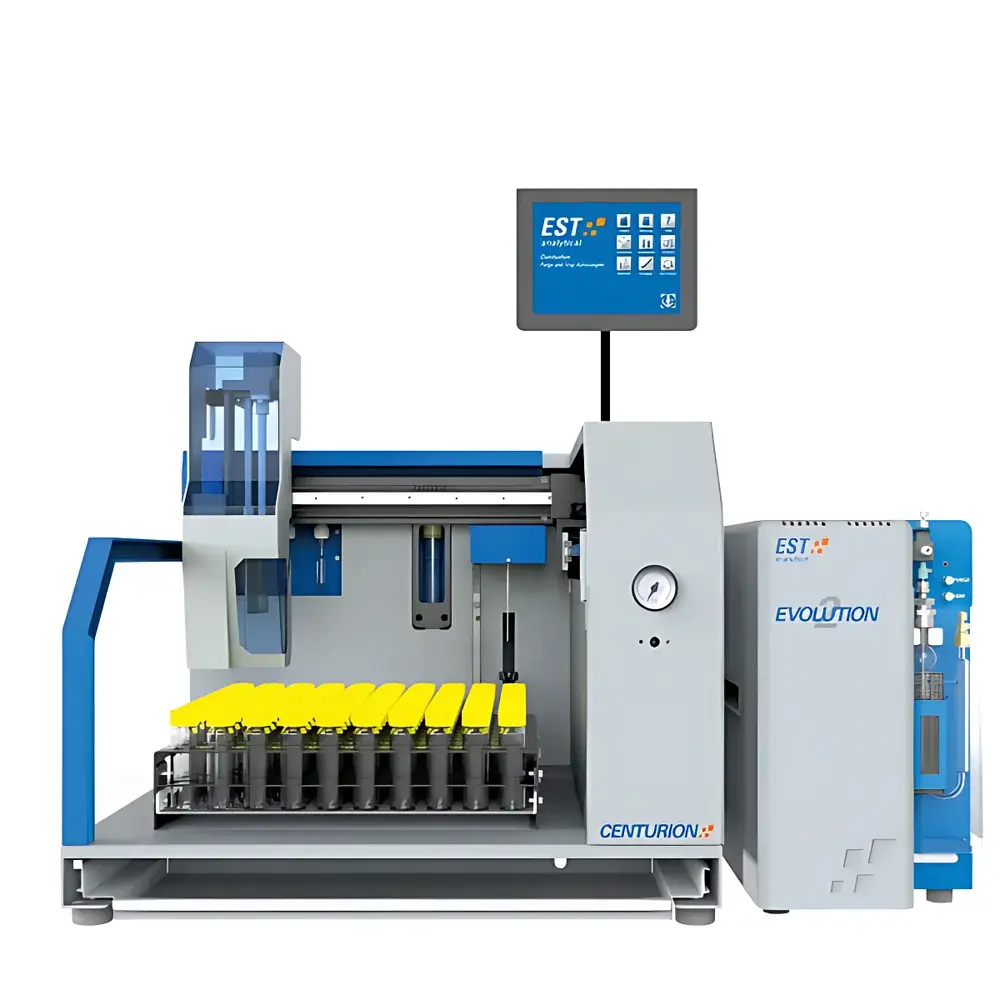
EST Centurion Purge and Trap Autosampler
| Brand | EST |
|---|---|
| Origin | USA |
| Model | Centurion |
| Sample Positions | 100 |
| Injection Precision | RSD < 3% |
| Trap Tube Temperature Range | Ambient to 280 °C |
| Purge Sample Heating Temperature | Ambient to 120 °C |
| Sample Vial Cooling Temperature | 4–10 °C |
Overview
The EST Centurion Purge and Trap Autosampler is a high-throughput, laboratory-grade automated sample introduction system engineered for the precise, reproducible, and unattended preparation of aqueous and solid environmental matrices prior to volatile organic compound (VOC) analysis by gas chromatography–mass spectrometry (GC–MS) or gas chromatography with flame ionization detection (GC–FID). It operates on the fundamental principle of purge-and-trap enrichment: inert carrier gas continuously sparges VOCs from a heated, agitated liquid or slurry sample into a sorbent-packed trap, where analytes are concentrated and subsequently thermally desorbed into the GC inlet. The Centurion functions exclusively as an intelligent front-end interface—designed for seamless integration with compatible purge-and-trap concentrators (e.g., Tekmar Atomx, Teledyne Tecton, or similar third-party systems)—and does not include an integrated concentrator module. Its architecture supports regulatory-compliant workflows for environmental monitoring laboratories performing routine analysis under U.S. EPA Methods 502.2, 524.2, 524.4, 624, 624.1, and corresponding Chinese HJ standards including HJ 605-2011, HJ 639-2012, HJ 686-2014, HJ 713-2014, HJ 735-2015, HJ 788-2016, HJ 806-2016, HJ 866-2017, and HJ 893-2017.
Key Features
- 100-position high-capacity carousel: Supports uninterrupted batch processing of up to 100 vials—among the highest capacity in its class—reducing manual intervention and increasing daily throughput for water, soil, sediment, and groundwater samples.
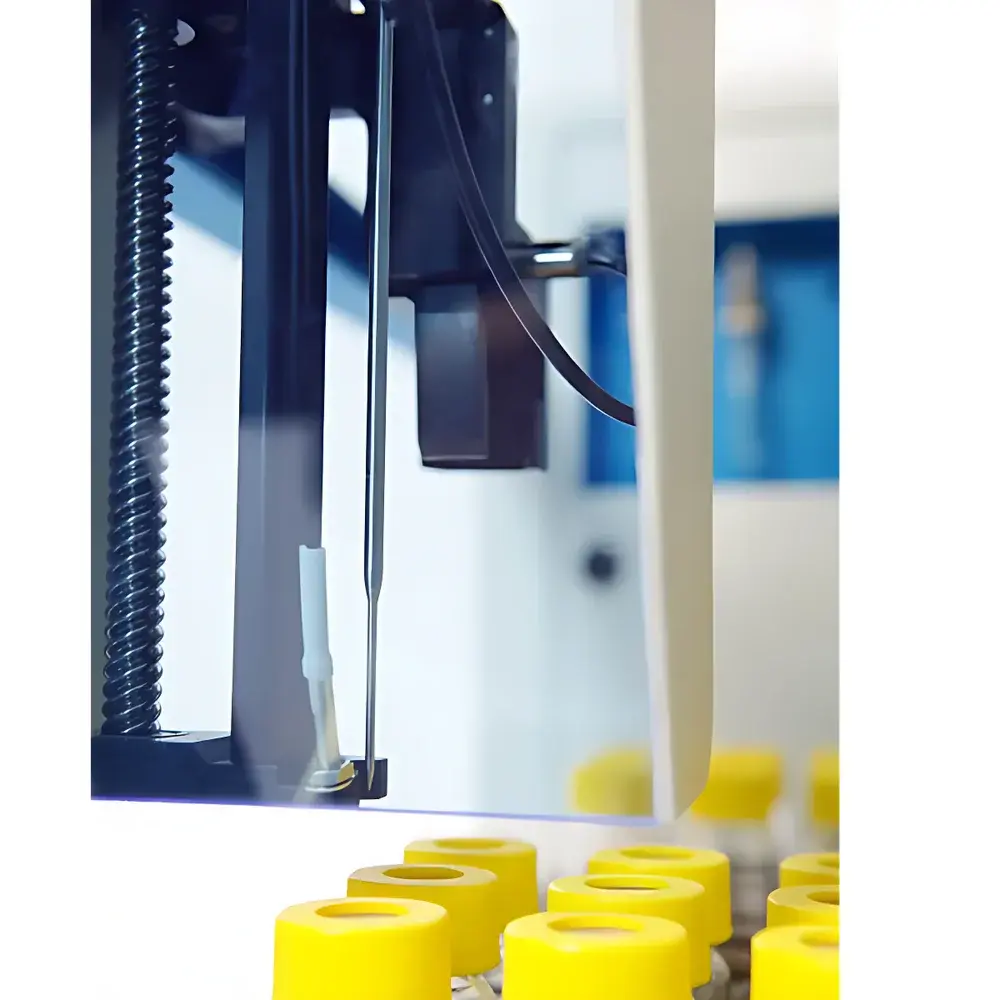
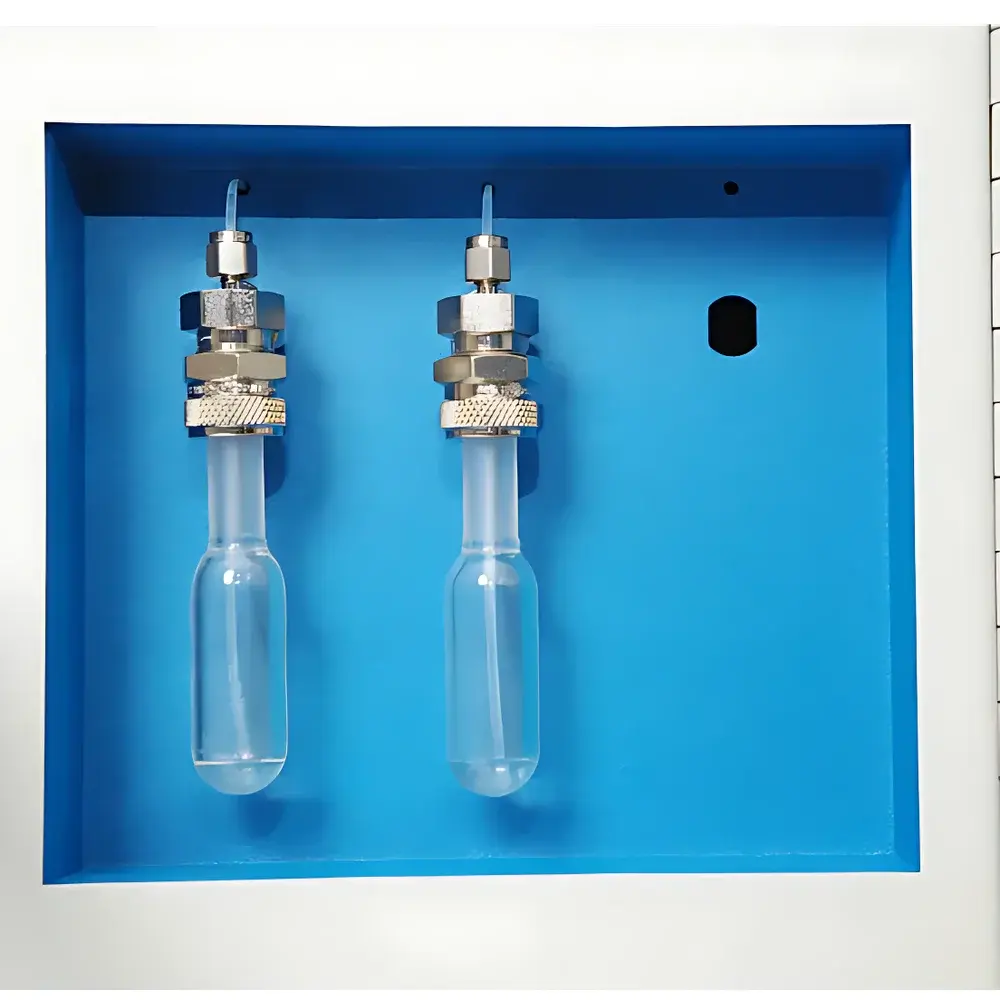
- Direct-water injection via pressure-driven transfer: A dedicated water probe moves precisely over each vial; carrier gas pressure displaces sample into either a 5 mL or 25 mL fixed-volume loop—or optionally, a 25 mL syringe—enabling programmable dilution and standard curve preparation without external pipetting.
- Optical vial detection system: Integrated photoelectric sensors confirm vial presence and position before needle insertion, preventing misalignment, needle breakage, and consumable waste caused by mechanical calibration drift.
- Hot-water needle wash (up to 90 °C): All rinse cycles utilize temperature-controlled deionized water, significantly minimizing carryover of semi-volatile and polar VOCs across injections—critical for low-level environmental quantitation.
- Programmable internal standard addition: A piezoelectric microdispensing valve—inspired by inkjet printhead technology—delivers internal standards (e.g., fluorobenzene, bromofluorobenzene) in discrete 1 µL increments from 1–100 µL per sample. UV-coated vials suppress photodegradation; pressurized delivery prevents volatilization loss.
- Standalone operation: Embedded Windows-based computing platform with touchscreen display, keyboard, and mouse eliminates dependency on host lab PCs and proprietary software installation—enhancing cybersecurity posture and simplifying instrument qualification (IQ/OQ).
Sample Compatibility & Compliance
The Centurion accommodates standard 40-mL EPA vials (with septa), 22-mL soil extraction vials (with stir bars), and 125-mL wide-mouth containers for heterogeneous solids. Solid-phase matrixes—including soils, sediments, and sludges—are processed using validated slurry protocols involving controlled agitation and temperature ramping during purge. All operational parameters—including purge time, temperature ramps, bake-out cycles, and trap desorption profiles—are fully configurable to meet method-specific requirements. The system supports audit-ready data integrity through timestamped event logs, user-access controls, and electronic signature capability aligned with FDA 21 CFR Part 11 principles. Routine use complies with ISO/IEC 17025:2017 quality management requirements for testing laboratories and supports GLP/GMP-aligned validation documentation packages.
Software & Data Management
The embedded control software provides intuitive graphical workflow configuration: users define sequence tables (sample ID, purge duration, trap temperature setpoints, internal standard volume, rinse steps), assign method templates, and schedule start times. All method files, sequence logs, and diagnostic reports are stored locally on the onboard SSD with optional network backup via Ethernet. Raw log data exports in CSV format for LIMS integration. No cloud connectivity or remote telemetry is enabled by default—ensuring full data sovereignty. Firmware updates are performed offline via USB drive, maintaining air-gapped security for regulated environments.
Applications
- Routine VOC analysis in drinking water, surface water, groundwater, and wastewater per U.S. EPA and China’s HJ methods
- Soil and sediment screening for BTEX, chlorinated solvents (e.g., PCE, TCE), vinyl chloride, and petroleum hydrocarbons (C6–C9)
- Compliance monitoring for landfill leachate, industrial effluent, and remediation site characterization
- Method development and validation studies requiring robust inter-day precision (RSD < 3% for both sample injection and internal standard addition)
- High-volume contract laboratories serving state environmental agencies and municipal utilities
FAQ
Does the Centurion include an integrated purge-and-trap concentrator?
No. The Centurion is a dedicated autosampler only. It must be connected to a separate purge-and-trap concentrator unit via standardized pneumatic and electrical interfaces.
Can it handle both liquid and solid samples without hardware modification?
Yes. The system automatically detects vial type and adjusts agitation speed, purge gas flow, and heating profile based on preconfigured method parameters for water, soil slurries, or sediment extracts.
Is the internal standard addition traceable and auditable?
Yes. Each internal standard delivery event is logged with volume, timestamp, operator ID, and method name. Audit trails cannot be edited or deleted without administrative privileges.
What maintenance intervals are recommended for optimal RSD performance?
Daily needle wash verification, weekly trap oven calibration check, and quarterly full-system performance verification using certified VOC standard mixtures are advised per EST Technical Bulletin TB-2023-04.
Does it support remote monitoring or troubleshooting?
Remote access is disabled by default. Onsite diagnostics are supported via HDMI video output and USB service port; remote assistance requires explicit, time-limited activation by authorized EST field engineers.





