
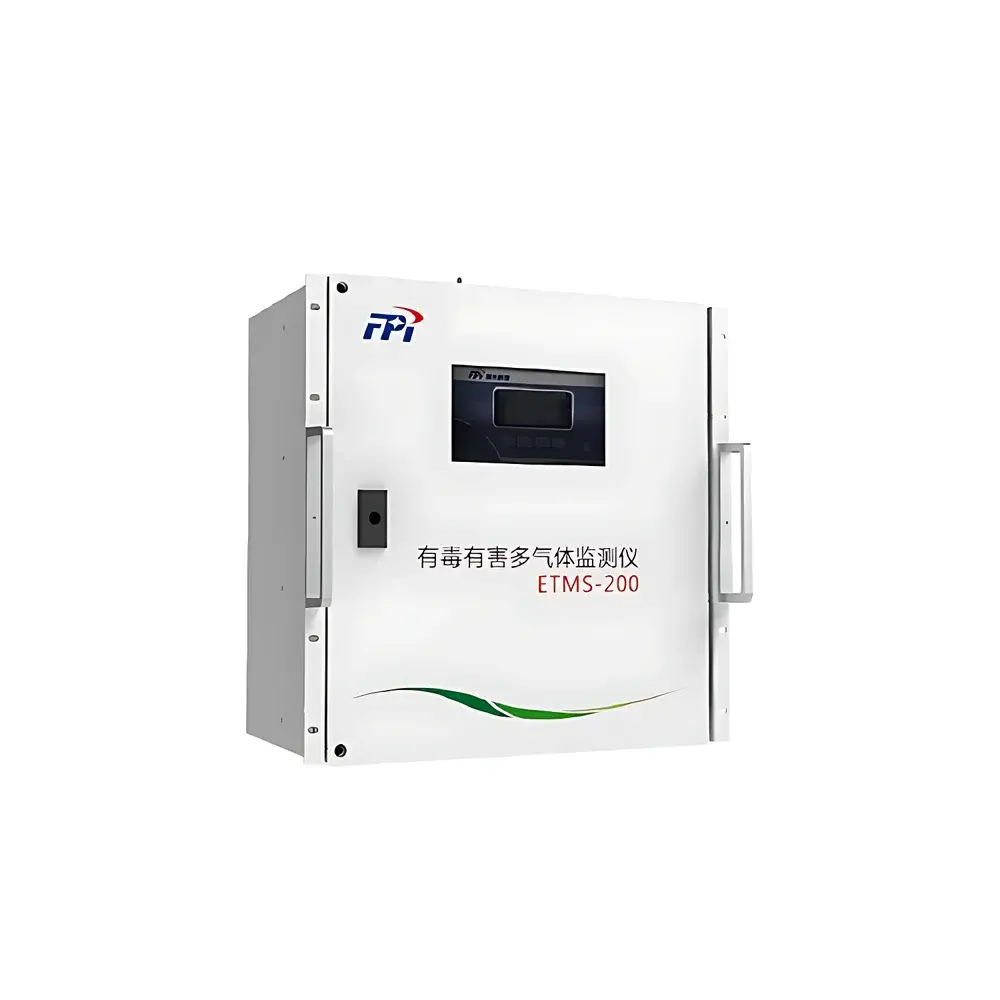
ETMS-200-ZG Multi-Gas Online Ambient Air Monitoring System by FPI (Hangzhou Focus Science & Technology Co., Ltd.)
| Brand | FPI (Focus Photonics Inc.) |
|---|---|
| Model | ETMS-200-ZG |
| Origin | Zhejiang, China |
| Manufacturer Type | OEM Manufacturer |
| Regional Classification | Domestic (China) |
| Pricing | Upon Request |
Overview
The ETMS-200-ZG is a fixed-site, real-time ambient air multi-gas monitoring system engineered for continuous, on-site detection of volatile organic compounds (VOCs), inorganic toxic gases (e.g., hydrogen sulfide, ammonia, chlorine, sulfur dioxide, nitrogen dioxide), and odor-active compounds in industrial atmospheric environments. It operates on electrochemical, metal oxide semiconductor (MOS), and photoionization detector (PID) sensor principles—each selected and calibrated per target analyte’s physicochemical behavior. Designed specifically for rapid-response environmental risk surveillance, the system delivers second-level sampling intervals and minute-level data resolution, enabling early warning of fugitive emissions, process leaks, or accidental releases in chemical industrial parks, refinery perimeters, wastewater treatment facilities, and landfill buffer zones. Its architecture integrates gas-phase pre-conditioning with thermal management and particulate mitigation to maintain sensor integrity under variable ambient humidity, temperature (−20 °C to +50 °C operational range), and dust loading—ensuring long-term stability without drift-induced recalibration.
Key Features
- Modular sensor array supporting simultaneous detection of up to 12 gas species—including VOCs (C2–C12 hydrocarbons, aromatics, ketones, aldehydes), H2S, NH3, Cl2, SO2, NO2, CO, O3, and HCN—with configurable sensor selection per site-specific risk assessment.
- Odor unit (OU) calculation engine compliant with EN 13725:2022 methodology, deriving dynamic odor concentration from weighted sensor response profiles across sulfur-, nitrogen-, and oxygen-containing malodorous compounds.
- Integrated sample conditioning: heated sampling line (60–80 °C), particulate filter (≤0.3 µm cut-off), mass-flow-controlled aspiration (±1% accuracy), and automated zero-air purging cycles to suppress cross-sensitivity and baseline drift.
- Embedded self-diagnostics: power-on system health check, sensor response validation, heater status monitoring, and fault-code logging aligned with IEC 61508 SIL 2 functional safety guidelines.
- GPRS/4G LTE cellular telemetry with TLS 1.2 encrypted payload transmission; supports MQTT and Modbus TCP protocols for integration into central SCADA or EMS platforms without dedicated fiber or Ethernet infrastructure.
- Hot-swappable sensor cartridges with RFID-tagged calibration history and lifetime tracking—enabling field replacement in <90 seconds without system shutdown or firmware reconfiguration.
- Explosion-proof enclosure rated Ex d IIB T4 Gb per GB 3836.1–2010 and ATEX Directive 2014/34/EU; IP65 ingress protection; compact footprint (600 × 450 × 300 mm) suitable for pole-, wall-, or rooftop-mounting.
Sample Compatibility & Compliance
The ETMS-200-ZG is validated for ambient air matrices containing total suspended particulates (TSP) ≤100 µg/m³, relative humidity 10–95% RH (non-condensing), and ambient pressure 86–106 kPa. It meets Chinese national standards HJ 654–2013 (ambient air quality monitoring—technical specifications for gaseous pollutant analyzers) and HJ 1019–2019 (environmental emergency monitoring technical guidelines). Sensor calibration traceability follows ISO/IEC 17025 requirements via accredited reference gas standards (NIST-traceable certified mixtures). Data acquisition complies with China’s “Technical Specification for Real-Time Emission Monitoring Systems” (HJ 75–2017) for audit-ready timestamped records, including sensor diagnostics, flow rate, temperature, and humidity metadata.
Software & Data Management
The embedded Linux-based firmware supports remote configuration via secure web interface (HTTPS) and SSH. Local data storage retains ≥30 days of 1-minute averaged records (gas concentrations, OU values, sensor voltages, diagnostic flags) on industrial-grade SD card. Cloud synchronization enables role-based access control (RBAC), customizable alert thresholds (SMS/email/push), and automated report generation (PDF/CSV) aligned with GLP documentation practices. Audit trails log all user actions, parameter changes, and calibration events with immutable timestamps—supporting regulatory readiness for MEE (Ministry of Ecology and Environment) inspections and third-party environmental audits.
Applications
- Fenceline monitoring at petrochemical complexes to verify compliance with GB 31571–2015 emission limits.
- Real-time odor impact assessment near composting facilities or anaerobic digesters.
- Mobile deployment on environmental emergency response vehicles for source identification during chemical spills.
- Long-term trend analysis of VOC speciation (e.g., benzene vs. toluene ratios) to distinguish industrial vs. biogenic contributions.
- Integration with meteorological stations (wind speed/direction, temperature, humidity, pressure, rainfall) for dispersion modeling input (e.g., CALPUFF, AERMOD).
FAQ
What calibration frequency is recommended for field operation?
Quarterly span calibration using certified standard gases is advised; zero checks should be performed daily via built-in zero-air generator.
Can the system operate unattended for extended periods?
Yes—designed for 5-year nominal service life with scheduled maintenance intervals every 6 months; onboard battery backup sustains 4 hours of operation during grid outage.
Is raw sensor output accessible for custom algorithm development?
Yes—Modbus TCP register map and ASCII serial protocol documentation are provided under NDA for OEM integration or research use.
Does the system support EPA Method TO-15 or EU EN 14662 compliance?
No—it is not a laboratory-grade speciated VOC analyzer; it serves as a screening and early-warning tool, not a regulatory reference method.
How is sensor cross-interference managed for complex gas mixtures?
Multi-sensor fusion algorithms apply empirically derived correction matrices based on co-location testing with FTIR and GC-MS reference systems.
Related Products







