
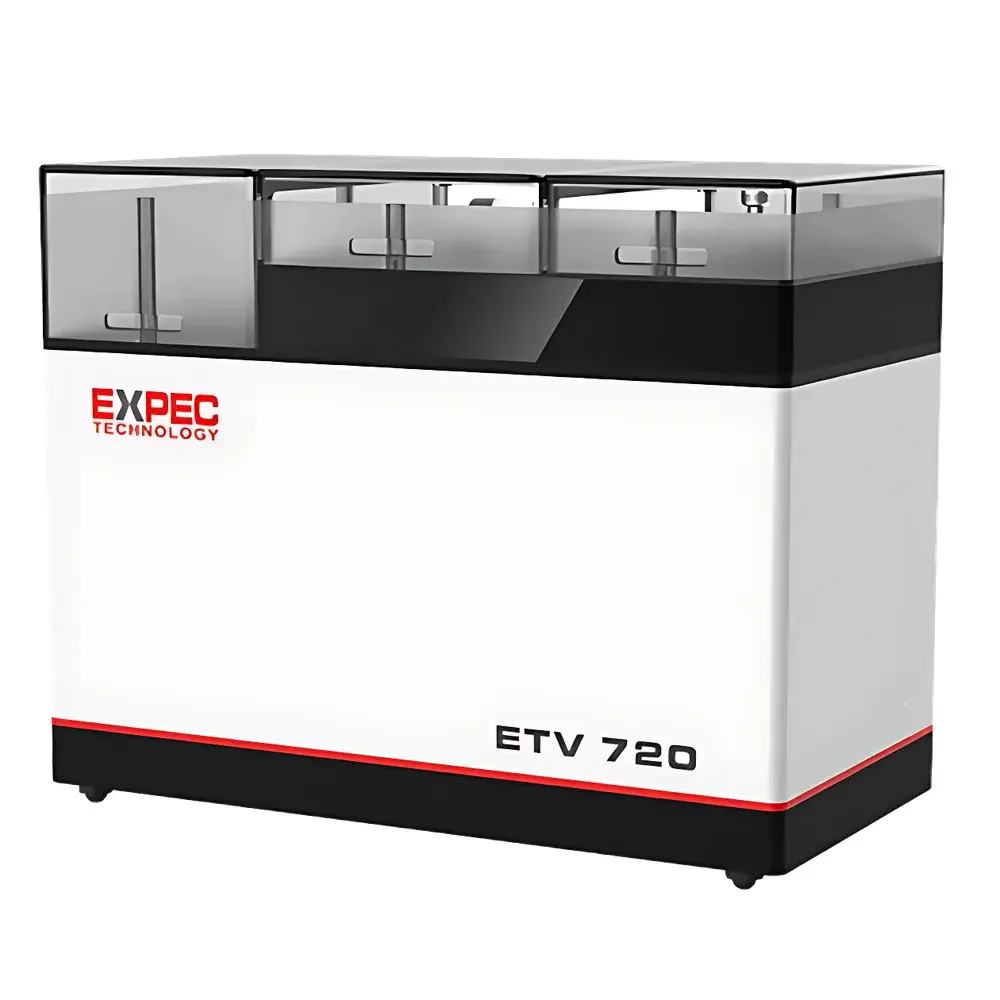
ETV 720 Solid Direct Sampling System by EXPEC
| Brand | EXPEC |
|---|---|
| Model | ETV 720 |
| Origin | Zhejiang, China |
| Type | Solid Direct Introduction Electrothermal Vaporization System |
| Max Temp | 3000 °C (infrared non-contact detection + PID control) |
| Sample Capacity | 40 boats |
| Motion Control | Micrometer-level precision positioning |
| Gas Flow Control | Milliliter-level accuracy |
| Automation | Fully automated sample loading, insertion, and thermal program execution |
| Compliance | Designed for ISO/IEC 17025-aligned workflows, compatible with GLP/GMP data integrity requirements |
Overview
The EXPEC ETV 720 Solid Direct Sampling System is an electrothermal vaporization (ETV) interface engineered for direct solid sample introduction into atomic absorption spectrometry (AAS), inductively coupled plasma optical emission spectrometry (ICP-OES), or inductively coupled plasma mass spectrometry (ICP-MS). Unlike conventional acid digestion-based workflows—which require multi-step wet chemistry including acid dissolution, reflux, evaporation, and volumetric dilution—the ETV 720 eliminates all liquid reagents and associated contamination risks. It enables quantitative elemental analysis of solid matrices via controlled thermal desolvation, pyrolysis, and volatilization directly from microgram-scale samples placed in graphite or ceramic sample boats. The system operates on the principle of resistive heating within a precisely regulated inert gas environment, where temperature gradients are applied to sequentially remove matrix interferences (e.g., moisture, organics) prior to analyte atomization. This approach preserves analyte integrity, minimizes memory effects, and delivers high reproducibility across heterogeneous solid samples.
Key Features
- Infrared non-contact temperature sensing combined with fast-response PID feedback control ensures stable, repeatable ramp-and-hold thermal profiles up to 3000 °C—critical for refractory element volatilization (e.g., As, Se, Cd, Pb, Cr).
- Micrometer-resolution motion control system positions sample boats with sub-10 µm repeatability, ensuring consistent geometric alignment relative to the vaporization zone and minimizing signal drift.
- Milliliter-accurate inert gas flow regulation (Ar or N₂) maintains laminar carrier conditions during vapor transport, reducing oxide formation and enhancing transport efficiency to the detector.
- 40-position automated carousel accommodates standardized sample boats; integrated robotic gripper performs synchronized loading, insertion, centering, and retrieval without manual intervention.
- Real-time instrument status monitoring includes thermocouple validation, gas pressure verification, positional encoder feedback, and power supply diagnostics—all logged with timestamps for auditability.
- Embedded safety architecture features hardware-enforced interlocks (e.g., door-open cutoff, overtemperature shutdown), automatic system reset after fault recovery, and intelligent heater aging assessment based on resistance drift trends.
Sample Compatibility & Compliance
The ETV 720 accepts powders, granules, filter papers, sediments, and thin-sectioned solids (≤5 mg mass per analysis) without size reduction or chemical pretreatment. It is validated for use with certified reference materials (CRMs) such as GBW07401 (soil), NIST SRM 1568b (rice flour), and BCR-681 (trace elements in sewage sludge). Instrument operation aligns with ISO 11885 (water—determination of selected elements by ICP-OES), ASTM D5683 (lead in soil by AAS), and USP / (elemental impurities in pharmaceuticals). Data acquisition supports 21 CFR Part 11-compliant electronic signatures when paired with EXPEC’s optional LIMS-integrated software suite, including full audit trail, user access controls, and immutable result archiving.
Software & Data Management
The EXPEC ETV Control Suite provides graphical method editor for multi-stage temperature programming (up to 8 segments), real-time thermal curve overlay, and auto-integration using adaptive peak detection algorithms that distinguish transient analyte signals from background drift. All raw signals, metadata (boat ID, operator, timestamp, ambient conditions), and processing parameters are stored in vendor-neutral SQLite databases. Export options include CSV, PDF analytical reports, and XML-formatted results compliant with ASTM E1915 and ISO/IEC 17025 clause 7.7. Remote diagnostics and firmware updates are supported via secure TLS-encrypted Ethernet connection.
Applications
- Rapid field-deployable screening of soil heavy metals (Pb, Cd, As, Hg, Cr) at regulatory thresholds (e.g., EPA Region 9, China GB 15618-2018).
- High-throughput quality control of food commodities—including cereals, spices, and infant formula—for EU Commission Regulation (EU) No 2023/915 compliance.
- Direct analysis of airborne particulate matter collected on quartz filters for source apportionment studies.
- Mineralogical fingerprinting of geological samples with minimal sample consumption (<1 mg), preserving rare specimens.
- Reference lab verification of digestion-free methodologies under ISO/IEC 17025 accreditation scope expansion.
FAQ
Does the ETV 720 require calibration with liquid standards?
Yes—quantitative analysis relies on external calibration using aqueous standard solutions; however, matrix-matched calibration or standard addition may be applied to correct for vaporization efficiency differences.
Can it be coupled to third-party ICP-MS instruments?
Yes—the system outputs a standardized 1/4″ Swagelok-compatible vapor transfer line and provides TTL/RS-232 trigger interfaces for synchronization with major OEM detectors (Agilent, Thermo Fisher, PerkinElmer).
What maintenance intervals are recommended for the graphite furnace and gas lines?
Graphite tube replacement is advised every 200–300 analyses depending on matrix aggressiveness; gas line filters should be inspected quarterly and replaced if particulate accumulation is observed.
Is method transfer possible between ETV 720 units in different laboratories?
Method portability is ensured through parameterized thermal programs, standardized boat geometry, and documented gas flow profiles—enabling cross-site reproducibility within ±5% RSD for CRM analysis.



