
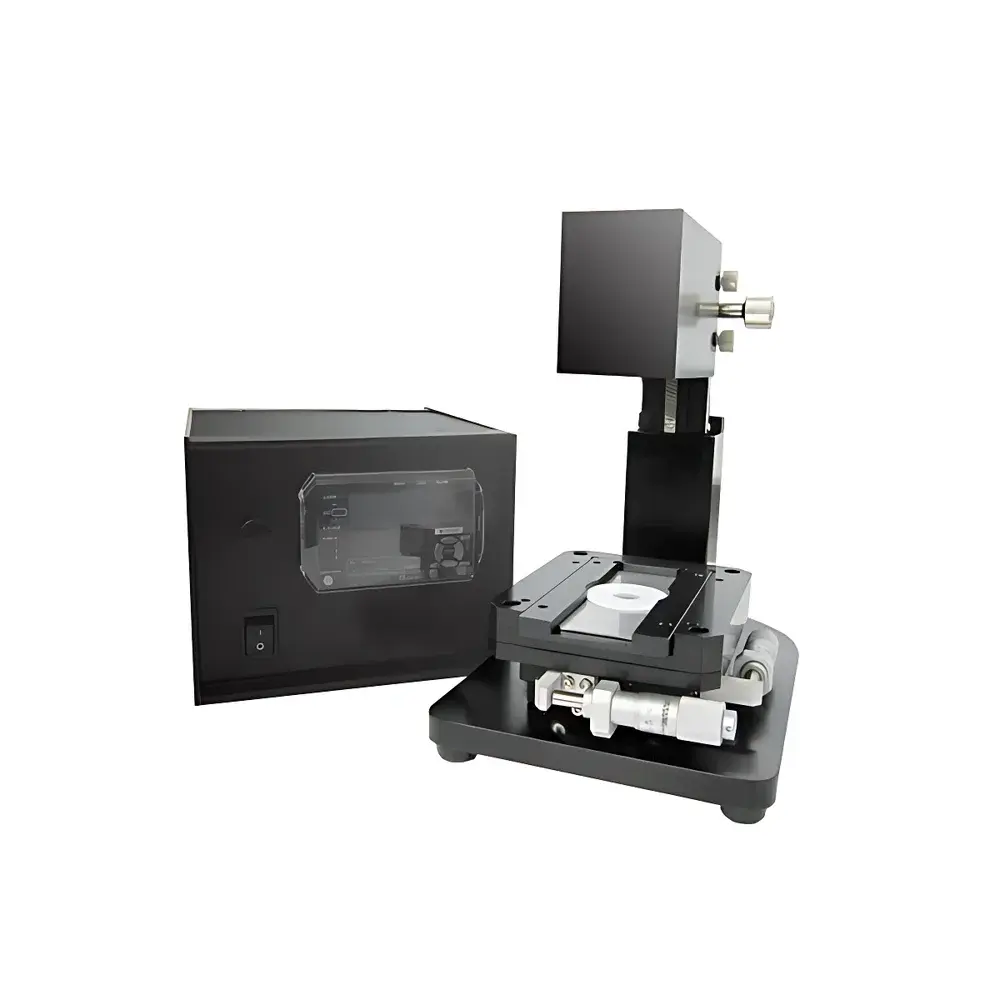
EU501 AcroEdge Photopolymer Cure Shrinkage Analyzer
| Brand | AcroEdge |
|---|---|
| Origin | Japan |
| Model | EU501 |
| Laser Wavelength | 655 nm (red semiconductor, visible) |
| Laser Class | FDA CDRH 21 CFR Part 1040.10 Class 2 |
| Output Power | 220 μW |
| Thickness Measurement Repeatability | ±2 μm |
| Sample Volume Requirement | < 5 mL |
| Host Dimensions (mm) | W130 × D150 × H105 |
| Detector Dimensions (mm) | W120 × D165 × H180 |
Overview
The EU501 AcroEdge Photopolymer Cure Shrinkage Analyzer is a precision metrology instrument engineered for quantitative, non-contact measurement of volumetric dimensional change during photopolymer and thermoset resin curing. It operates on the principle of high-resolution laser displacement sensing—specifically utilizing a collimated 655 nm red semiconductor laser (Class 2 per FDA CDRH 21 CFR Part 1040.10) to monitor real-time thickness reduction of a thin resin film under controlled UV or thermal exposure. Unlike traditional pycnometric methods (e.g., density bottle or Archimedean immersion), which infer shrinkage indirectly from density changes and are highly susceptible to entrapped air bubbles, micro-voids, or sample heterogeneity, the EU501 directly quantifies linear contraction normal to the substrate surface with sub-micron repeatability (±2 μm). This direct, geometric approach yields higher reproducibility and eliminates operator-dependent calibration drift associated with fluid displacement techniques. The system is optimized for low-volume testing (<5 mL per run), making it suitable for R&D labs working with expensive or synthetically limited photoresists, dental composites, 3D printing resins, and functional coatings where material conservation and rapid iteration are critical.
Key Features
- Non-contact, real-time thickness monitoring via high-stability 655 nm laser displacement sensor with ±2 μm repeatability
- Compact benchtop architecture: host unit (130 × 150 × 105 mm) and separate detector head (120 × 165 × 180 mm) enable flexible integration into gloveboxes, UV chambers, or temperature-controlled enclosures
- FDA-compliant Class 2 laser safety design—no interlocks or special shielding required for standard laboratory operation
- Minimal sample consumption: validated for films as thin as 50–500 μm; total resin volume requirement ≤ 4 mL per test
- Elimination of bubble-induced artifacts: avoids the systematic errors inherent in hydrostatic density-based shrinkage calculation
- Thermally stable mechanical platform with low-coefficient aluminum alloy housing to minimize thermal drift during extended cure cycles
Sample Compatibility & Compliance
The EU501 is validated for use with a broad spectrum of photoreactive and thermally activated polymer systems, including but not limited to: acrylate- and methacrylate-based 3D printing resins (SLA/DLP), epoxy-acrylate hybrids, cationic epoxies, dental restorative composites, UV-curable adhesives (e.g., structural bonding films), UV-offset inks, and thin-film optical coatings. Its measurement methodology aligns with ASTM D790 (flexural properties of cured polymers), ISO 3167 (multipurpose test specimens), and supports traceable compliance with ISO/IEC 17025 requirements for calibration uncertainty management. While the instrument itself does not perform full volumetric shrinkage modeling, its thickness-change data serves as a primary input for calculating linear shrinkage (εL) and—when combined with known lateral constraint conditions—enables estimation of biaxial or isotropic shrinkage per ISO 20432 (photopolymer characterization). Data acquisition logs meet GLP audit requirements for timestamped, operator-annotated test records.
Software & Data Management
The EU501 interfaces via USB 2.0 to dedicated Windows-based acquisition software (v3.2+), supporting synchronized logging of laser displacement, ambient temperature (via optional RTD probe), UV irradiance (with external radiometer input), and user-defined cure stage markers (e.g., “pre-cure baseline”, “mid-cure checkpoint”, “post-cure stabilization”). Raw displacement time-series data is exported in CSV and HDF5 formats for downstream analysis in MATLAB, Python (NumPy/Pandas), or statistical process control (SPC) platforms. Audit trails include digital signatures, session metadata (operator ID, instrument serial, firmware version), and automatic backup to network drives. Software complies with FDA 21 CFR Part 11 requirements for electronic records and signatures when configured with role-based access control and encrypted database storage.
Applications
- Photolithography R&D: Quantifying shrinkage in EUV and DUV photoresists to predict pattern fidelity loss and overlay error in advanced node semiconductor fabrication
- Additive manufacturing: Benchmarking shrinkage anisotropy across layer orientations in vat photopolymerization (VP) processes to inform compensation algorithms
- Dental materials development: Correlating monomer conversion kinetics (via FTIR) with measured linear shrinkage to optimize initiator systems and reduce interfacial stress at tooth-restoration margins
- Coatings formulation: Evaluating shrinkage-induced microcracking propensity in UV-cured anti-reflective or barrier films for OLED and flexible electronics
- Adhesive qualification: Assessing dimensional stability of UV-curable die-attach epoxies under thermal cycling, supporting JEDEC JESD22-A104 reliability protocols
FAQ
Does the EU501 measure volumetric shrinkage directly?
No—it measures uniaxial (thickness-direction) dimensional change with high precision. Volumetric shrinkage is inferred using assumptions about lateral constraint (e.g., rigid substrate adhesion) and Poisson’s ratio, or by combining with independent lateral expansion measurements.
Can the system accommodate elevated temperature curing beyond ambient?
Yes—the detector head and sample stage are compatible with externally mounted environmental chambers (−20 °C to 120 °C); thermal expansion of fixtures must be compensated in software via reference calibration runs.
Is the laser safe for prolonged operator exposure during routine use?
Yes—its 220 μW output at 655 nm meets FDA Class 2 limits (≤1 mW visible-light emission); no protective eyewear is mandated under normal operating conditions per ANSI Z136.1.
What is the minimum measurable film thickness?
The system reliably resolves thickness changes in films ≥50 μm thick; optimal signal-to-noise ratio is achieved between 100–300 μm for most transparent resins.
How is calibration traceability maintained?
Each unit ships with NIST-traceable step-height calibration standards (10 μm, 50 μm, 100 μm); annual verification against these artifacts ensures continued compliance with ISO/IEC 17025 clause 6.5.2.



