
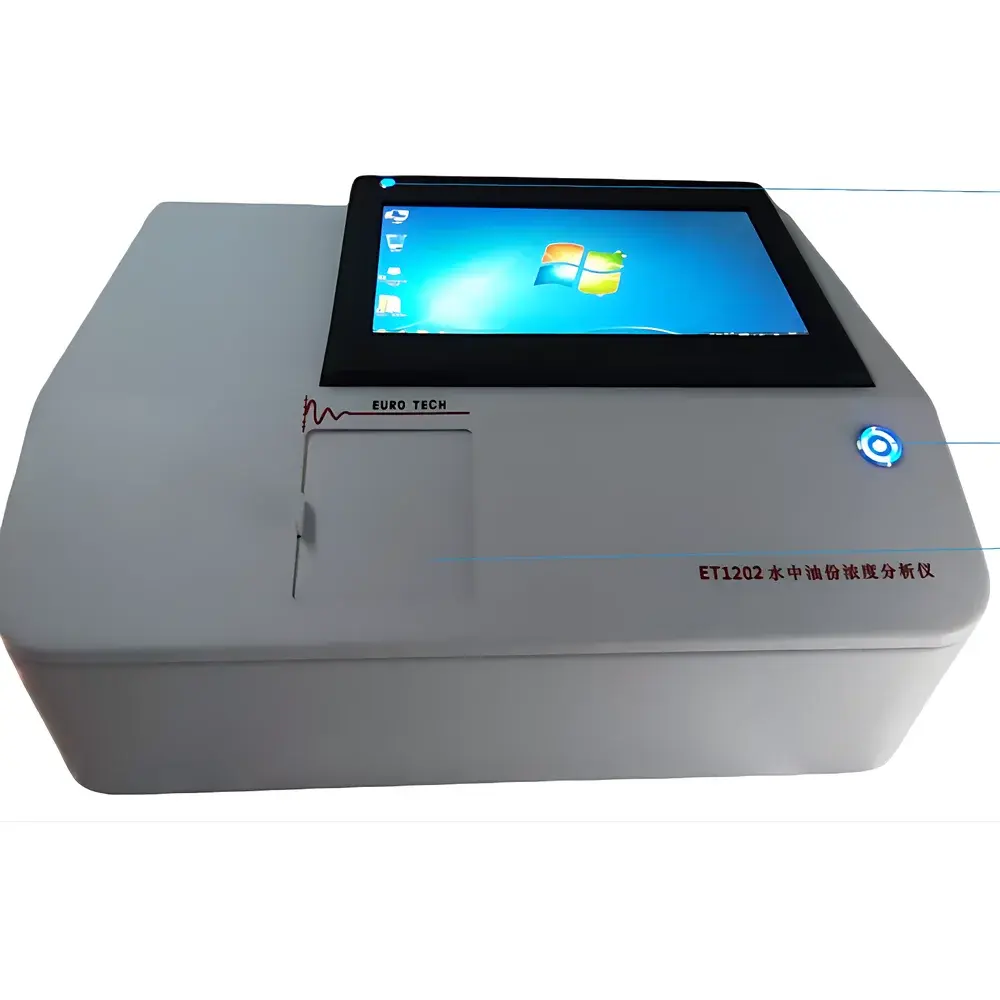
EURO TECH ET1202 Infrared Oil Content Analyzer
| Brand | EURO TECH |
|---|---|
| Origin | Shanghai, China |
| Model | ET1202 |
| Instrument Type | Laboratory Benchtop Analyzer |
| Measurement Principle | Infrared Spectrophotometry (Dual-Wavelength Absorption at 3030 cm⁻¹, 2960 cm⁻¹, and 2930 cm⁻¹) |
| Measurement Range | 0–1000 mg/L |
| Detection Limit | 0.2 mg/L (CCl₄ extract), 0.4 mg/L (C₂Cl₄ extract) |
| Wavenumber Accuracy | ±2 cm⁻¹ |
| Wavenumber Reproducibility | ±1 cm⁻¹ |
| Spectral Scan Range | 3400–2400 cm⁻¹ |
| Resolution | 0.1 ppm (as oil equivalent) |
| Measurement Frequency | 2 measurements/minute |
| Baseline Drift | <0.005 AU/30 min |
| Linearity Coefficient | ≥0.999 |
| Repeatability | RSD ≤1% (at 40 mg/L oil standard) |
| Sample Measurement Time | 35 seconds |
| Output Interface | USB 2.0 |
| Power Supply | 220 V ±10%, 50 Hz |
| Dimensions | 50 × 38 × 22 cm |
| Weight | 15 kg |
Overview
The EURO TECH ET1202 Infrared Oil Content Analyzer is a dedicated benchtop instrument engineered for quantitative determination of total petroleum hydrocarbons (TPH), animal-vegetable oils, and cooking fume oil in aqueous and gaseous matrices. It operates on the principle of infrared absorption spectrophotometry, adhering strictly to the Beer–Lambert law and calibrated against standardized reference spectra at three characteristic wavenumbers: 3030 cm⁻¹ (aromatic C–H stretch), 2960 cm⁻¹ (asymmetric CH₃ stretch), and 2930 cm⁻¹ (asymmetric CH₂ stretch). This triple-wavelength algorithm enables selective quantification of oil content while minimizing interferences from alcohols, ketones, and other organic solvents commonly present in environmental samples. Designed for compliance with HJ 637–2018 and HJ 637–2012 (China’s national standard for petroleum and animal-vegetable oil determination in water), the ET1202 supports both carbon tetrachloride (CCl₄) and perchloroethylene (C₂Cl₄) extraction protocols—ensuring method flexibility without hardware modification.
Key Features
- Dual-solvent compatibility: Pre-configured calibration modes for CCl₄ and C₂Cl₄ extractants, each with independent baseline correction and spectral compensation algorithms.
- Optical stability architecture: Mechanically aligned optical path with long-life infrared source and thermoelectrically stabilized detector; absorbance drift <0.005 AU over 30 minutes ensures measurement consistency across batch analysis.
- Zero-point memory function: Single zero calibration retained across multiple sample runs, eliminating repeated blank adjustments and reducing operator variability.
- Integrated spectral calibration: Built-in 10-point standard curve library compliant with HJ 637–2018 linearity requirements (R² ≥ 0.999); rapid single-point calibration option using one certified reference standard.
- High-resolution display & interface: 8-inch capacitive LCD touchscreen with intuitive menu navigation; real-time spectral preview, peak identification, and overlay comparison of sample vs. reference spectra.
- Robust data handling: Onboard storage for ≥1000 sample records including metadata (sample ID, operator, date/time, extraction solvent, calibration ID); export via USB 2.0 to CSV or proprietary .etd format compatible with LIMS integration.
Sample Compatibility & Compliance
The ET1202 accepts liquid-phase extracts prepared according to standard EPA Method 1664 (modified), ISO 9377-2:2000, and GB 18480–2001 (for cooking fume monitoring). It accommodates sample cells with 10-mm, 20-mm, or 40-mm pathlengths (optional accessories), supporting both direct transmission and reflectance configurations for emulsified or turbid samples. All measurement protocols are traceable to NIM (National Institute of Metrology, China) certified oil standards. The instrument meets GLP documentation requirements through audit-ready electronic logs—including calibration history, user login timestamps, and parameter change tracking—fully compliant with 21 CFR Part 11 when paired with validated software configuration.
Software & Data Management
Firmware v3.2 includes embedded analytical engine supporting concentration (mg/L), absorbance (AU), and transmittance (%T) readouts with automatic unit conversion. Spectral acquisition parameters (scan number, aperture, co-addition) are user-definable. Data export supports time-stamped reports with embedded chromatogram-style spectral plots, calibration curves, and statistical summaries (mean, SD, RSD). Optional PC software (ET-DataLink v2.1) enables remote control, multi-instrument fleet management, and automated report generation conforming to ISO/IEC 17025 clause 7.8 requirements for result reporting.
Applications
- Environmental laboratories: Quantitative analysis of petroleum hydrocarbons in surface water, groundwater, wastewater effluents, and sediment pore water per HJ 637–2018.
- Food service regulatory monitoring: Cooking oil fume concentration assessment in exhaust ducts and kitchen hoods per GB 18480–2001.
- Industrial compliance testing: Effluent monitoring for petrochemical, metalworking, and food processing facilities subject to discharge permits.
- Research applications: Kinetic studies of oil biodegradation, emulsion stability evaluation, and solvent recovery efficiency testing.
- Method validation support: Reference instrument for cross-laboratory intercomparison studies and QA/QC program implementation.
FAQ
Does the ET1202 comply with international standards beyond Chinese regulations?
Yes—it supports method adaptation to ISO 9377-2:2000 (petroleum hydrocarbons in water) and ASTM D7066-04 (infrared determination of oil and grease), with spectral resolution and wavenumber accuracy meeting minimum requirements for equivalence assessment.
Can the instrument be used with alternative extraction solvents such as hexane or cyclohexane?
No—only CCl₄ and C₂Cl₄ are supported due to their defined IR transparency windows and established extinction coefficients in the 2900–3000 cm⁻¹ region per HJ 637–2018. Use of non-certified solvents invalidates traceability and regulatory acceptance.
Is firmware upgrade capability available remotely?
Firmware updates require local USB-based installation using signed binary packages provided by EURO TECH Technical Support; no cloud or OTA functionality is implemented to maintain data integrity and regulatory compliance.
What maintenance intervals are recommended for optimal performance?
Optical alignment verification every 6 months; source lamp replacement every 24 months or after 5,000 hours of operation; annual full system performance verification using NIST-traceable oil standards is advised for GLP/GMP environments.
How is measurement uncertainty estimated for reported results?
Uncertainty budget incorporates contributions from detection limit (0.2 mg/L), repeatability (RSD ≤1%), wavenumber accuracy (±2 cm⁻¹), and calibration curve fit (R² ≥0.999); typical expanded uncertainty (k=2) is ±3.2% for concentrations >10 mg/L under routine laboratory conditions.
Related Products







