
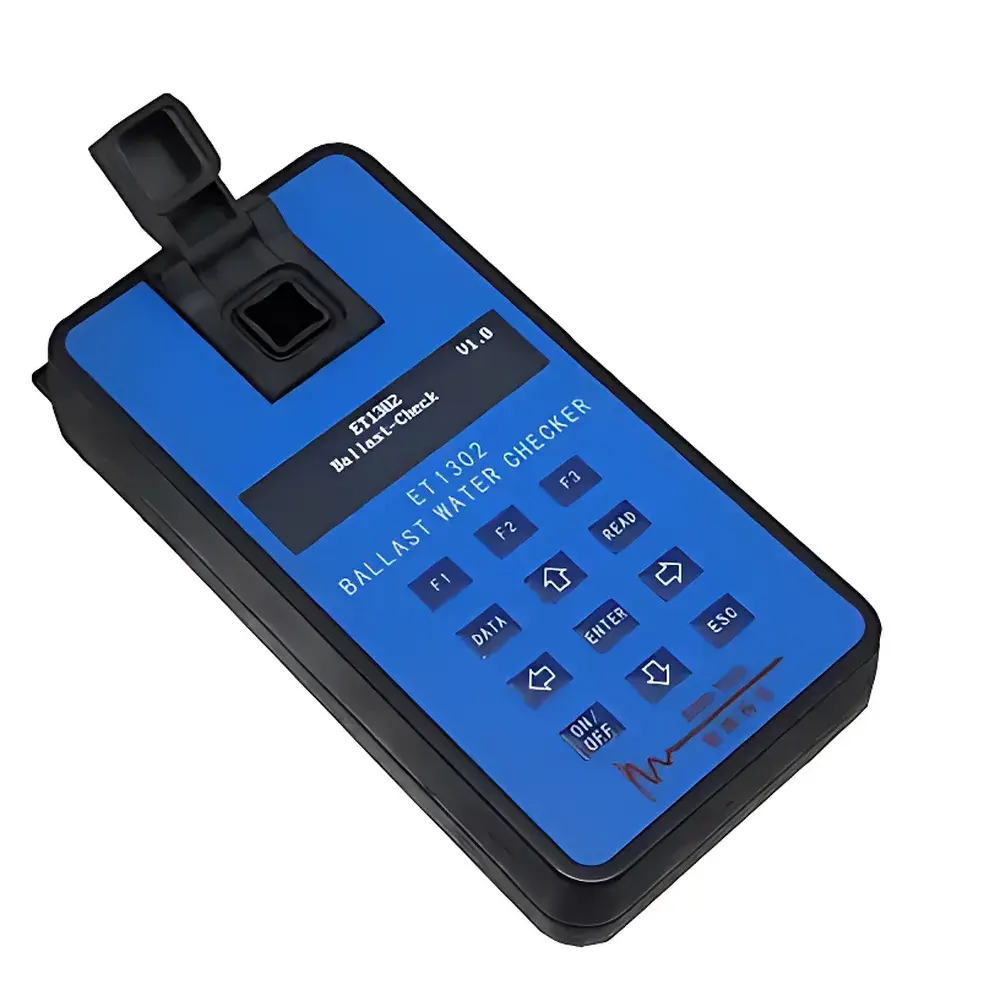
EURO TECH ET1302 Ballast Water Fluorometer
| Brand | EURO TECH |
|---|---|
| Origin | Shanghai, China |
| Model | ET1302 |
| Measurement Principle | Pulsed Amplitude Modulated (PAM) Chlorophyll-a Fluorescence |
| Detection Target | Phytoplankton in 10–50 µm and <10 µm size fractions |
| Sample Volume | 4 mL |
| Response Time | ≤60 s per measurement |
| Optical Path | 10 mm × 10 mm quad-cell cuvette |
| Instrument Weight | 0.68 kg |
| Dimensions | 200 mm × 105 mm × 35 mm |
| Enclosure Material | Polycarbonate (IPX4 splash-resistant) |
| Operating Temperature | 5–40 °C |
| Power Supply | 4 × AA alkaline batteries |
| Data Storage | 500 measurement records |
| Connectivity | Bluetooth 4.2 |
| Compliance Reference | IMO Ballast Water Management Convention (BWMC) Regulation D-2, MEPC.127(53), MEPC.252(67) |
Overview
The EURO TECH ET1302 Ballast Water Fluorometer is a field-deployable, regulatory-grade instrument engineered for rapid, indicator-based compliance assessment of ballast water discharge under the International Maritime Organization’s (IMO) Ballast Water Management Convention (BWMC), specifically Regulation D-2. It implements Pulsed Amplitude Modulated (PAM) chlorophyll-a fluorescence detection—a scientifically validated proxy method endorsed by IMO guidelines (MEPC.127(53) and MEPC.252(67)) for estimating viable phytoplankton abundance in the 10–50 µm size class. Unlike traditional microscopy or culture-based enumeration, the ET1302 delivers quantitative fluorescence signals correlated to photosynthetic activity, enabling real-time inference of algal viability without staining, culturing, or reagents. Its design aligns with the BWMC’s requirement for “indicative methods” that provide high reproducibility, low operator dependency, and traceable correlation to reference analytical techniques. The instrument is calibrated and verified against interlaboratory comparison data from CNAS-accredited national testing laboratories in China, ensuring metrological consistency with international validation protocols.
Key Features
- Regulatory alignment: Designed explicitly for D-2 compliance screening per IMO BWMC Annexes and associated G8/G9 guidance documents.
- Portability and field readiness: Compact footprint (200 × 105 × 35 mm), lightweight chassis (0.68 kg), and battery-powered operation support onboard vessel use, port state control (PSC) inspections, and land-based treatment system verification.
- PAM fluorescence technology: Employs modulated excitation and saturation pulse detection to minimize background interference and enhance signal specificity for functional chlorophyll-a in live phytoplankton cells.
- Minimal sample preparation: Requires only 4 mL of raw or filtered sample; no chemical reagents, fixatives, or incubation steps.
- Dual-stage risk assessment workflow: Supports sequential analysis of both 10–50 µm and <10 µm fractions—enabling stratified interpretation consistent with BWMC tiered verification logic.
- Robust human interface: Intuitive Chinese-language touchscreen display with guided operational prompts, automated pass/fail classification (RISK=LOW / RISK=HIGH), and on-device result logging.
- Traceable data handling: Stores 500 measurement records locally with timestamp, vessel ID, tank identifier, and filter status metadata; exportable via Bluetooth to secure audit logs.
Sample Compatibility & Compliance
The ET1302 accepts standard 10 mm pathlength square cuvettes compatible with ISO 7027-compliant optical geometry. It is validated for seawater, brackish, and freshwater matrices typical of ballast uptake environments. Sample introduction follows IMO-recommended pre-filtration protocols: initial analysis of the 10–50 µm fraction (retained on 50 µm mesh, then further filtered through 10 µm polycarbonate membranes). The instrument’s detection limit and dynamic range (0–0.6 BWAI units) are benchmarked against reference microscopy counts per ISO 11711 and US EPA Method 1623.2-derived phytoplankton viability criteria. While not a definitive enumeration tool, its outputs satisfy IMO’s indicative method performance criteria for precision (RSD <15% across replicate measurements) and correlation (r² ≥0.88 vs. reference microscopy across 12 species groups including diatoms, dinoflagellates, and cryptophytes).
Software & Data Management
Data acquisition and reporting are managed through an embedded firmware platform compliant with GLP principles. Each measurement record includes immutable metadata: date/time stamp, user ID (optional), vessel name, ballast tank number, filtration step indicator (50 µm pre-filter / 10 µm secondary filter), and calculated BWAI value. Bluetooth 4.2 enables encrypted wireless transfer to certified laboratory information management systems (LIMS) or regulatory reporting portals. Exported CSV files include ISO 8601 timestamps and adhere to IMO’s data integrity requirements for audit trail retention. Firmware supports over-the-air updates and includes built-in self-diagnostics (lamp intensity monitoring, cuvette alignment check, battery voltage logging) to ensure measurement continuity during extended deployments.
Applications
- Onboard verification of ballast water treatment system (BWTS) performance prior to discharge.
- Port State Control (PSC) inspections under IMO Resolution A.1155(32) and regional enforcement frameworks (e.g., USCG Type Approval follow-up, EU BWMS Directive 2017/1987).
- Commissioning and routine maintenance testing of UV, electrochlorination, and filtration-based BWTS installations.
- Research and development of novel ballast water management technologies requiring rapid viability feedback.
- Training and competency assessment for shipboard officers and marine environmental auditors.
FAQ
Does the ET1302 meet IMO D-2 regulatory requirements for official compliance testing?
The ET1302 is an indicative method instrument aligned with IMO MEPC.252(67) and intended for preliminary screening and operational monitoring—not standalone certification. It must be used within a quality-assured framework alongside confirmatory reference methods where required.
Can it differentiate between live and dead algae?
Yes—PAM fluorescence selectively detects photochemical quenching capacity, which correlates strongly with photosystem II functionality and thus physiological viability, unlike passive fluorophores or absorbance-based assays.
Is calibration traceable to international standards?
Calibration is performed using NIST-traceable chlorophyll-a reference standards and verified through interlaboratory comparison programs coordinated by China’s National Institute of Metrology (NIM) and accredited third-party labs.
What maintenance is required for long-term field use?
Routine cleaning of the optical window and cuvette holder with lint-free wipes and deionized water; annual verification of LED output stability and detector linearity via factory service protocol.
Does it support multi-language firmware beyond Chinese?
Firmware version 2.3+ includes optional English UI localization, configurable via Bluetooth-linked configuration utility; other languages available upon request for fleet-wide deployments.
Related Products







