
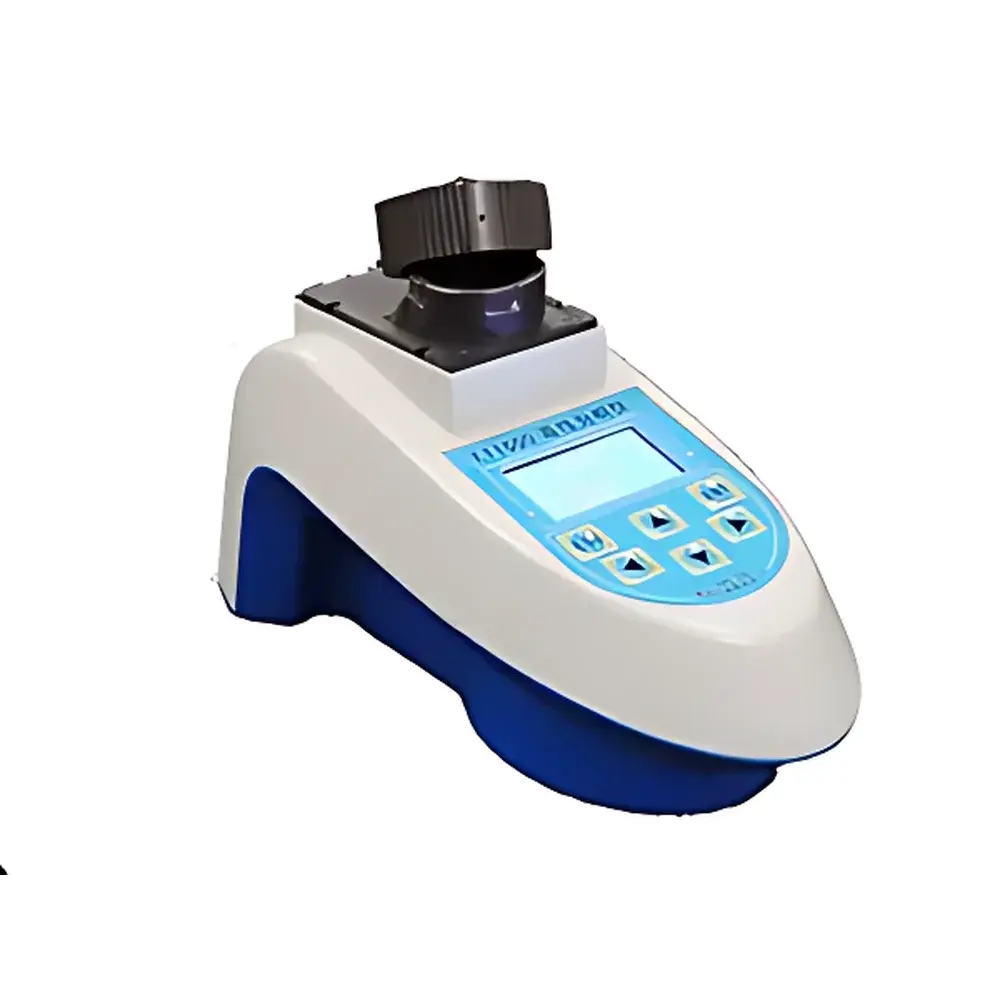
Euro Tech ET1500 Water Toxicity Analyzer
| Brand | Euro Tech |
|---|---|
| Origin | Shanghai, China |
| Manufacturer Type | Authorized Distributor |
| Region of Origin | Domestic (China) |
| Model | ET1500 |
| Instrument Type | Laboratory Benchtop Analyzer |
| Biological Indicator | *Aliivibrio fischeri* (lyophilized bioluminescent bacteria) |
| Operating Temperature Range | 15–40 °C |
| Reagent Storage Temperature | 2–8 °C (reconstituted), –20 °C (lyophilized long-term) |
| Coefficient of Variation (CV) | ≤1% (intra-assay, n=10 at IC₅₀ concentration) |
| Batch Capacity | 4 assay groups × 17 samples per group |
| Exposure Time | 0–99 s (programmable in 1-s increments) |
| Detection System | Photomultiplier Tube (PMT) |
| Spectral Response | 300–650 nm (peak sensitivity at 400 nm) |
| Light Measurement Range | 0–1,000,000 RLU (Relative Light Units) |
| Sample Vessel | 12 mm diameter × 55 mm height glass or polystyrene test tube |
| Data Storage | 1900 measurement records with timestamp, sample ID, and exposure time |
| Interface | RS-232C serial port for PC connectivity and data export |
| Display | Backlit LCD (128 × 64 pixels) |
| Power Supply | 4 × AA alkaline or Ni-MH rechargeable batteries (≥2600 mAh capacity) or external AC adapter (220 V ±10%, 50 Hz) |
| Dimensions (L×W×H) | 320 × 170 × 180 mm |
| Weight | 2.0 kg |
| Environmental Operating Conditions | 10–90% RH (non-condensing) |
Overview
The Euro Tech ET1500 Water Toxicity Analyzer is a laboratory-grade bioluminescence-based toxicity detection system engineered for rapid, quantitative assessment of acute toxicity in aqueous environmental samples. It operates on the well-established principle of metabolic inhibition in the marine bioluminescent bacterium *Aliivibrio fischeri*. Under normal physiological conditions, this strain emits visible light via the enzymatic oxidation of reduced flavin mononucleotide (FMNH₂) and a long-chain aldehyde, catalyzed by bacterial luciferase. When exposed to toxicants—including heavy metals (e.g., Cu²⁺, Cd²⁺, Hg²⁺), organic pollutants (e.g., phenols, pesticides, PAHs), and disinfection by-products—the electron transport chain is disrupted, reducing ATP synthesis and consequently suppressing light emission. The degree of luminescence inhibition correlates directly with toxicant concentration, enabling quantification of sample toxicity as percentage inhibition (%I) or effective concentration (EC₅₀/IC₅₀) values. Designed for compliance with ISO 11348-3 (Water quality — Determination of the inhibitory effect of water samples on the light emission of *Vibrio fischeri*), the ET1500 delivers reproducible, trace-level sensitivity—detecting sub-mg/L toxicity thresholds when used with validated buffer systems.
Key Features
- High-sensitivity photomultiplier tube (PMT) detector with optimized quantum efficiency at 400 nm, ensuring reliable low-light signal capture across the 300–650 nm bioluminescence spectrum
- Programmable exposure time (0–99 s in 1-second increments), supporting kinetic and endpoint assay protocols per ISO 11348-3 Annex A
- Built-in batch processing mode: up to four independent assay groups (17 samples each), facilitating parallel testing of control, reference, and field samples
- On-device calculation of inhibition rates and IC values (e.g., IC₁₀, IC₂₀, IC₅₀) with user-definable thresholds and automatic pass/fail flagging
- Integrated data logging with timestamp, sample ID, exposure duration, raw RLU, and calculated % inhibition—1900 records retained with non-volatile memory
- Dual power operation: battery-powered portability (4 × AA, ≥2600 mAh) or continuous AC operation (220 V ±10%, 50 Hz)
- Backlit monochrome LCD interface with intuitive menu navigation in English; supports direct RLU readout and real-time inhibition visualization
Sample Compatibility & Compliance
The ET1500 is validated for use with a broad range of aqueous matrices, including drinking water, surface water, wastewater influent/effluent, leachates, and industrial process streams. Sample pretreatment (e.g., pH adjustment to 6.5–7.5, filtration through 0.45 µm membrane) is performed prior to analysis per ISO 11348-3 requirements. The system accommodates lyophilized *A. fischeri* reagents from multiple certified suppliers, including those formulated with heavy metal–specific or organic compound–specific buffering agents to enhance selectivity and lower detection limits. All assay protocols align with internationally recognized frameworks: ISO 11348 series (acute toxicity), ASTM D5660 (standard guide for microbial toxicity testing), and EU Water Framework Directive (WFD) monitoring guidelines. Device firmware supports audit-trail–capable operation under GLP-compliant workflows when paired with validated PC software.
Software & Data Management
Data acquisition and reporting are enabled via RS-232C serial interface to Windows-based desktop applications (provided separately). Exported datasets include full metadata: operator ID, assay date/time, sample identifiers, raw RLU, normalized inhibition, IC calculations, and instrument status logs. Files are saved in CSV and PDF formats compatible with LIMS integration and regulatory submission (e.g., EPA, EEA). Optional software modules support statistical analysis (ANOVA, regression modeling), calibration curve generation, and automated report generation compliant with ISO/IEC 17025 documentation standards. No cloud dependency or proprietary runtime environments are required—data remains under full user control at all times.
Applications
- Rapid screening of drinking water distribution networks for accidental or intentional contamination events
- Monitoring toxicity trends at municipal wastewater treatment plant inlets and outlets to assess treatment efficacy and identify shock loads
- Environmental impact assessment of industrial effluents prior to discharge permitting (e.g., textile, electroplating, pharmaceutical facilities)
- Validation of advanced oxidation processes (AOPs) and activated carbon adsorption performance through toxicity removal profiling
- Research applications in ecotoxicology, including mixture toxicity evaluation and bioavailability studies using standardized bacterial endpoints
- Complementary use alongside chemical-specific methods (e.g., ICP-MS, GC-MS) to detect unknown or synergistic toxicants not covered by targeted analysis
FAQ
What biological indicator does the ET1500 use?
It employs freeze-dried *Aliivibrio fischeri*, a Gram-negative marine bacterium standardized in ISO 11348-3 for acute toxicity testing.
Can the ET1500 quantify specific contaminants like lead or atrazine?
No—it measures total acute toxicity (nonspecific response); identification and quantification of individual compounds require complementary analytical instrumentation.
Is the instrument suitable for field deployment?
Yes—its lightweight design (2.0 kg), battery operation, and rugged enclosure support mobile lab and emergency response use, though reagent refrigeration must be managed externally.
How is data integrity ensured during regulatory audits?
All measurements include immutable timestamps and operator tags; optional PC software enables 21 CFR Part 11–compliant electronic signatures and audit trails when configured per site-specific validation protocols.
What is the shelf life of the lyophilized bacterial reagent?
Unopened vials retain viability for ≥18 months at –20 °C; reconstituted suspensions remain stable for up to 7 days when stored at 2–8 °C in the dark.
Related Products







