
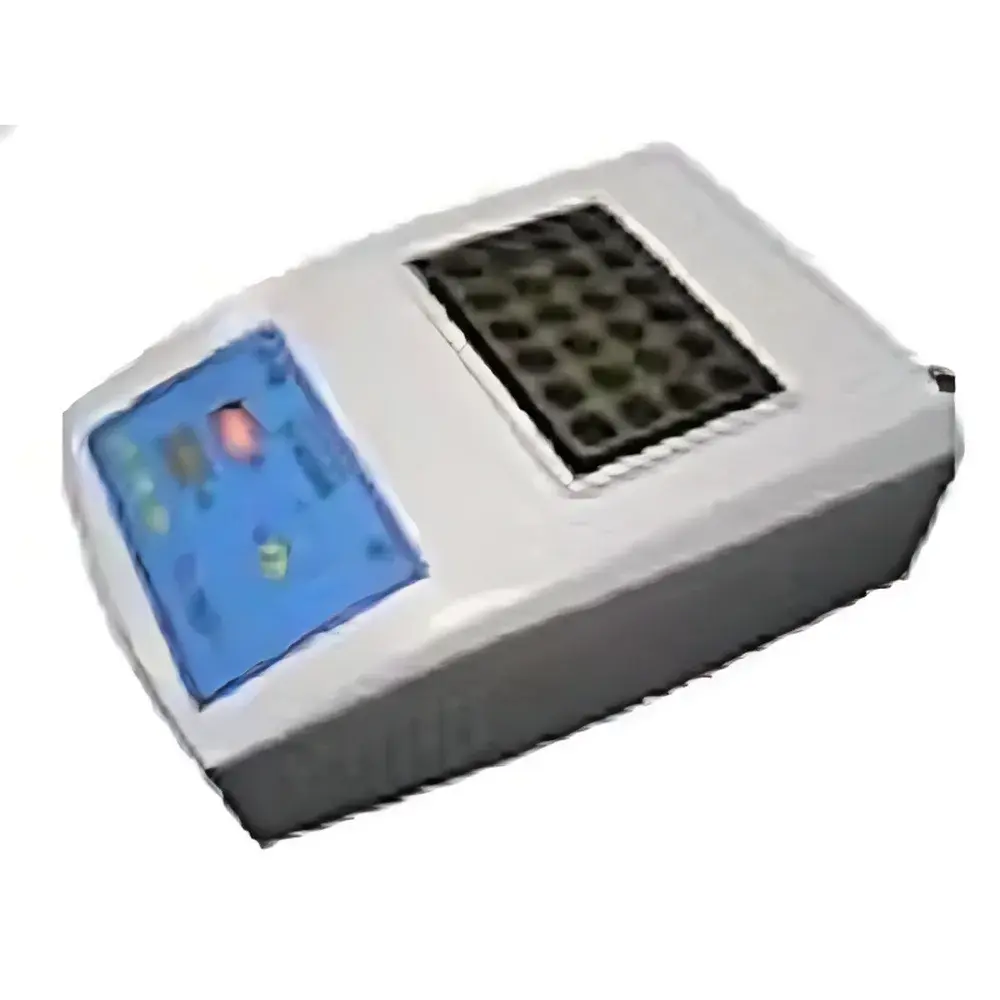
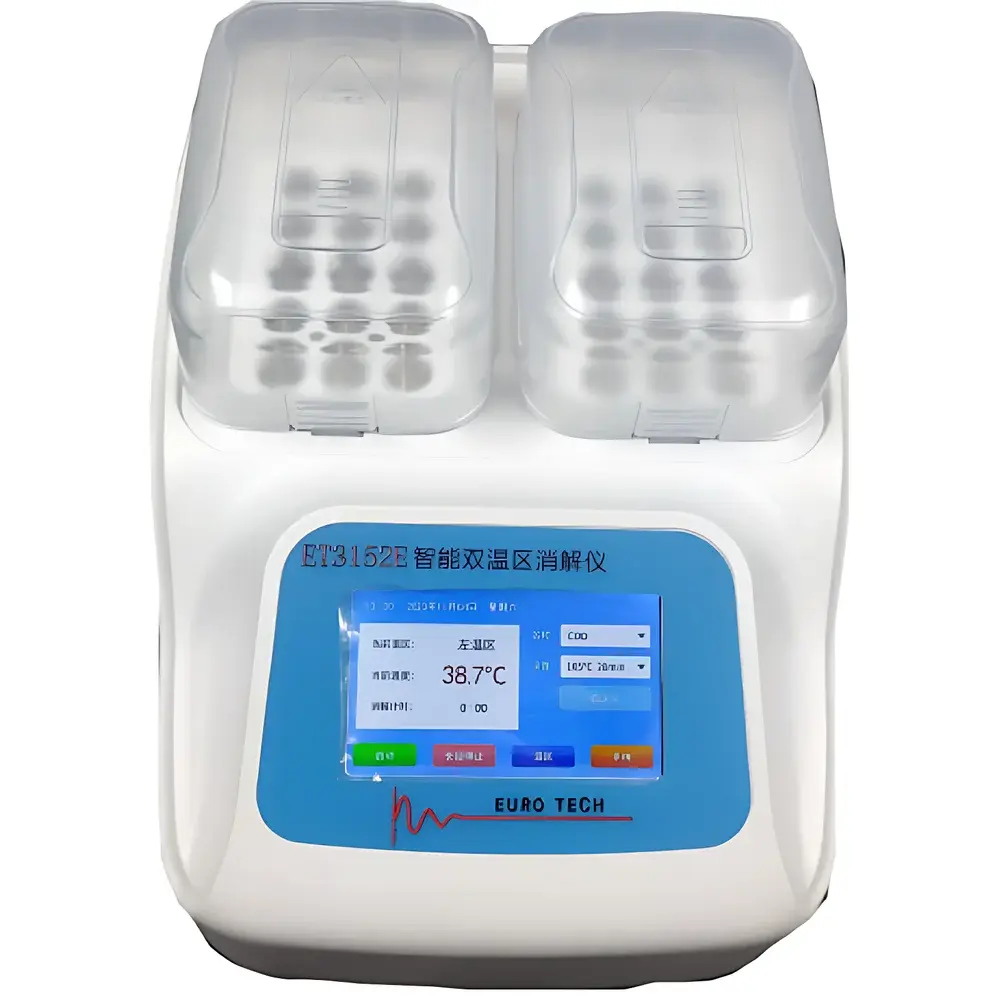
EuroTech ET3150B and ET3152E Multi-Function Digestion Systems
| Brand | EuroTech |
|---|---|
| Origin | Shanghai, China |
| Manufacturer Type | Authorized Distributor |
| Country of Origin | China |
| Model | ET3150B, ET3152E |
| Price Range | USD 1,400–2,800 |
| Digestion Method | Rapid Digestion |
| Heating Module | Precision Aluminum Block with Embedded PID-Controlled Heaters |
| Batch Capacity | 24 samples |
| Temperature Range | 105–165 °C (±1 °C) |
| Temperature Accuracy | ±1 °C |
| Sample Vessel Compatibility | 24 × Φ16 mm × 100 mm glass tubes |
| Timer Accuracy | ±1 min |
| Power Supply | 220 V ±10%, 50 Hz, 300 W |
| Operating Ambient | 5–50 °C |
| Dimensions (W×D×H) | 340 × 245 × 115 mm |
| Net Weight | 3.5 kg |
| Ramp Time to 150 °C | ≤20 min |
| Timer Range | 1–1860 min |
| Safety Features | Auto-shutdown, Overtemperature Alarm, Audible & Visual End-of-Digestion Alert |
Overview
The EuroTech ET3150B and ET3152E Multi-Function Digestion Systems are benchtop thermal reactors engineered for standardized wet-chemical digestion in environmental water quality laboratories. Designed to comply with core regulatory digestion protocols—including ISO 6060 (COD), ISO 11908 (total phosphorus), and ISO 11909 (total nitrogen)—these instruments deliver precise, reproducible heating profiles across two independent temperature zones (ET3152E) or a single uniform zone (ET3150B). Each unit employs a solid aluminum heating block with embedded high-stability resistive elements and closed-loop PID temperature control, ensuring minimal thermal gradient (<±0.8 °C across all 24 positions) and long-term drift stability (<±0.3 °C over 8 h at 150 °C). The systems operate on the principle of controlled conductive heating, eliminating convective air currents that compromise inter-sample consistency—critical for method validation under ISO/IEC 17025 and EPA-compliant QA/QC workflows.
Key Features
- Dual independent temperature zones (ET3152E only): Enables simultaneous digestion of COD (150 °C) and total phosphorus (105 °C) batches without cross-contamination or sequential delays
- High-precision digital PID controller: Maintains setpoint accuracy within ±1 °C across full operating range (105–165 °C), verified per ASTM E220 calibration traceability requirements
- Programmable timer with 1-minute resolution: Supports digestion durations from 1 to 1860 minutes (31 hours), with automatic power cutoff and audible/visual end-cycle notification
- Optimized 24-position aluminum block: Accepts standard Φ16 mm × 100 mm borosilicate glass digestion tubes; block geometry ensures uniform heat transfer and minimizes edge-effect deviation
- Low thermal inertia design: Achieves 150 °C in ≤20 minutes from ambient, reducing daily throughput latency in high-volume municipal or industrial wastewater labs
- Integrated safety architecture: Includes overtemperature lockout, open-circuit heater detection, and non-volatile memory retention of last-used parameters after power interruption
Sample Compatibility & Compliance
The ET3150B/ET3152E supports standard digestion vials used in APHA 5220D (COD), ISO 6878 (total phosphorus), and EN 15971 (total nitrogen) methods. Tube dimensions (Φ16 × 100 mm) align with EPA-approved digestion kits (e.g., Hach LCK series, Merck Spectroquant®). All thermal performance specifications meet the repeatability and accuracy criteria defined in ISO/IEC 17025:2017 Clause 6.4.3 for equipment used in accredited testing. Units are CE-marked and compliant with IEC 61010-1:2010 for laboratory electrical safety. No modifications or third-party accessories are required to satisfy GLP documentation requirements for digestion step traceability.
Software & Data Management
While the ET3150B/ET3152E operate via front-panel keypad interface (no PC dependency), their parameter logs—including set temperature, actual block temperature (recorded every 30 s), timer start/end timestamps, and alarm events—are retained in non-volatile memory for ≥100 cycles. When paired with the EuroTech ET1151M COD Photometer (sold separately), the combined workflow supports semi-automated data linkage: digestion completion triggers a status flag visible on the photometer’s display, enabling chronological batch tracking. Audit trails generated meet FDA 21 CFR Part 11 “electronic record” definitions when exported manually via USB or documented in lab notebooks per GMP Annex 11 principles.
Applications
- Routine COD determination in municipal wastewater influent/effluent per ISO 6060 and EPA 410.4
- Simultaneous total phosphorus (TP) and total nitrogen (TN) digestion in surface water monitoring programs aligned with EU Water Framework Directive reporting
- Method development and validation studies requiring tight thermal control (e.g., optimizing persulfate oxidation efficiency for low-concentration TN)
- Educational laboratory instruction in environmental chemistry, where robustness, safety, and intuitive operation support student-led digestion protocols
- Third-party environmental testing labs maintaining ISO/IEC 17025 accreditation for inorganic nutrient and organic load parameters
FAQ
What standards does the ET3152E support for COD digestion?
It meets ISO 6060:1989 and APHA Standard Method 5220D for closed-reflux colorimetric COD analysis, with thermal profile validation performed using NIST-traceable RTDs.
Can the ET3150B digest samples at different temperatures simultaneously?
No—only the ET3152E features dual independent zones. The ET3150B maintains one uniform temperature across all 24 positions.
Is calibration certificate included with shipment?
A factory calibration report (including as-found/as-left data at 105 °C and 150 °C) is supplied. UKAS-accredited calibration is available as an optional service.
What maintenance is required beyond routine cleaning?
None. The solid-state heating block and sealed electronics require no periodic recalibration or consumable replacement under normal operation.
Are replacement digestion blocks available?
Yes—EuroTech offers OEM-matched aluminum blocks (P/N ET-BLK-24-AL) with pre-drilled Φ16 mm holes and integrated thermistor wells, ensuring continued thermal fidelity across instrument lifetime.
Related Products







